
What is a Private Limited Company?
A Private Limited Company is a business entity registered under the Companies Act, 2013 with the Ministry of Corporate Affairs (MCA). It has a legal identity separate from its owners, the liability of shareholders is limited to the capital they invest, and its shares cannot be offered to the general public.
It is the most popular structure among Indian startups and growing businesses because investors, banks, large customers and government tenders all treat it as the most credible form of business. If you plan to raise funding, issue ESOPs, or build a business you may one day sell, a Private Limited Company is almost always the right choice.
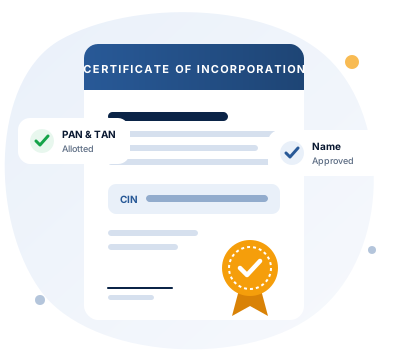
Good to know: incorporation anywhere in India is now processed online by the MCA's Central Registration Centre through the SPICe+ (INC-32) form. A single application gives you the Certificate of Incorporation, PAN, TAN, EPFO and ESIC registrations together.
Why founders choose a Private Limited Company
Limited liability
Your personal assets stay protected. Shareholders are liable only up to their unpaid share capital.
Easy fundraising
Issue equity to angel investors and VCs, and grant ESOPs to your team.
Separate legal entity
The company can own property, sign contracts, sue and be sued in its own name.
Perpetual succession
The company continues to exist even when directors or shareholders change.
Higher credibility
Company details are publicly verifiable on the MCA portal, building trust with clients and lenders.
Easy ownership transfer
Ownership changes hands simply by transferring shares — the business keeps running.
Requirements to register a Pvt Ltd company
- Minimum 2 directors — both must be individuals aged 18 or above. At least one director must be resident in India (stayed in India for 182 days or more in the financial year).
- Minimum 2 shareholders — the same two people can be both directors and shareholders. Shareholders may be individuals or companies.
- A unique company name — not identical or too similar to an existing company, LLP or registered trademark, and ending with "Private Limited".
- A registered office address in India — commercial or residential, owned or rented. A home address in Noida, Ghaziabad or Delhi is perfectly acceptable.
- No minimum paid-up capital — you can start with any amount. Most founders begin with ₹1 lakh authorised capital.
- Digital Signature Certificate (DSC) for every director and subscriber, since all MCA forms are signed digitally.
Foreign nationals and NRIs can be directors and shareholders. Their documents need to be notarised and apostilled in their country of residence — we guide you through it.
Documents required for Pvt Ltd registration
Clear scanned copies or phone photos are enough. Share them on WhatsApp or email — no physical submission needed.
For each director & shareholder
- PAN card (mandatory for Indian nationals)
- Aadhaar card
- Identity proof — Passport, Voter ID or Driving Licence
- Address proof — latest bank statement, electricity, telephone or mobile bill (not older than 2 months)
- Passport-size photograph
- Email ID and mobile number
For the registered office
- Latest utility bill — electricity, gas, telephone or mobile (not older than 2 months)
- No Objection Certificate (NOC) from the property owner
- Rent or lease agreement, if the premises are rented
- Sale deed or property tax receipt, if self-owned
Private Limited Company registration process
Here is exactly what happens after you engage us. You only need to share documents and approve drafts — we do the rest.
Digital Signature Certificates (DSC) Day 1–2
We obtain Class-3 DSCs for all proposed directors and subscribers through a quick Aadhaar-based eKYC and video verification.
Name reservation — SPICe+ Part A Day 2–4
We run a name and trademark availability check, then apply with up to two name choices in order of preference, along with your business objects.
Drafting MoA, AoA & declarations Day 3–5
Our CS drafts the e-MoA (INC-33) and e-AoA (INC-34) tailored to your business, plus director consent (DIR-2) and declarations (INC-9).
Filing SPICe+ Part B with linked forms Day 5–7
We file the incorporation application with DIN allotment for up to three directors, and AGILE-PRO-S (INC-35) for EPFO, ESIC, Professional Tax and bank account. Government fees and stamp duty are paid at this stage.
Certificate of Incorporation Day 7–10
On approval, the MCA issues the Certificate of Incorporation with your Corporate Identification Number (CIN), along with the company's PAN and TAN.
Bank account & commencement After COI
We help you open the current account, deposit the subscription money, and file INC-20A so your company can legally commence business.
Choose the plan that fits your stage
Basic
Only the incorporation, done properly.
+ govt. fees, DSC & stamp duty
Choose Basic- Name reservation
- DIN for 2 directors
- MoA & AoA drafting
- SPICe+ filing
- COI, PAN & TAN
Standard
Incorporate and start operating.
+ govt. fees & stamp duty
Choose Standard- Everything in Basic, plus:
- 2 Class-3 DSCs included
- Bank account assistance
- INC-20A filing
- Share certificates & registers
Premium
Incorporation + first-year setup.
+ govt. fees & stamp duty
Choose Premium- Everything in Standard, plus:
- GST registration
- MSME (Udyam) registration
- Auditor appointment (ADT-1)
- 1-year CS support
Prices are professional fees, exclusive of GST. Additional directors or shareholders beyond two are charged at actual DSC/DIN cost.
What you pay to the government — Delhi vs Uttar Pradesh
Government charges are separate from our professional fee and are paid directly on the MCA portal at the time of filing. They depend on two things: the state of your registered office and your authorised share capital.
| Component | Delhi | Noida / Ghaziabad (UP) |
|---|---|---|
| MCA registration fee | Nil for authorised capital up to ₹15 lakh; slab-based above that | |
| Name reservation fee | ₹1,000 (included within SPICe+ where Part A & B are filed together) | |
| Stamp duty on MoA, AoA & SPICe+ | As per Delhi stamp rates — AoA duty is linked to authorised capital | As per Uttar Pradesh stamp rates — generally a fixed, lower amount for small capital |
| PAN & TAN application | Nominal fee, collected with SPICe+ | |
| Jurisdictional ROC | ROC Delhi | ROC Kanpur |
Because stamp duty rates are revised by state governments from time to time, we calculate the exact amount for your city and capital and put it in writing before you pay. What we quote is what you pay.
Compliances every new Pvt Ltd company must complete
Getting the certificate is only the beginning. Missing these early steps is the most common reason new companies end up paying penalties.
- Open a current bank account and deposit the subscription money committed by shareholders in the MoA.
- File INC-20A (declaration for commencement of business) within 180 days of incorporation.
- Appoint the first statutory auditor within 30 days of incorporation through a board resolution.
- Hold the first board meeting within 30 days of incorporation, and at least four board meetings every year.
- Issue share certificates to subscribers within 60 days of incorporation and pay stamp duty on them.
- Maintain statutory registers and display the company name, CIN and registered office address on letterheads and at the office.
- File annual returns every year — AOC-4 and MGT-7/7A with the ROC, plus the income tax return.
Private Limited Company registration — common questions
How much does it cost to register a Private Limited Company in Delhi NCR?
Our professional fee starts at ₹999. On top of that you pay for Digital Signatures, MCA government fees and state stamp duty, which vary between Delhi and Uttar Pradesh and with your authorised capital. We share an itemised written quote before you make any payment.
How many days does Pvt Ltd company registration take?
Typically 7–10 working days from the date we receive complete documents. Name approval and final approval depend on processing time at the MCA's Central Registration Centre.
Is there any minimum capital requirement?
No. The Companies (Amendment) Act, 2015 removed the minimum paid-up capital requirement. You can incorporate with any amount of capital. Many founders choose ₹1 lakh authorised capital to keep government fees low.
Can a husband and wife, or two family members, register a Private Limited Company?
Yes. Any two individuals can be the directors and shareholders, including spouses or family members, as long as at least one director is resident in India.
Can a salaried person become a director?
Legally, yes — the Companies Act does not prohibit it. However, you should check your employment agreement, since many employers restrict employees from holding directorships or running another business.
Do I need a commercial office to register the company?
No. A residential address can serve as the registered office. You need a recent utility bill and a No Objection Certificate from the owner of the property.
What happens if my proposed company name is rejected?
The MCA allows one resubmission with new names under the same application. We run a thorough name and trademark check beforehand to minimise the chance of rejection, and we handle the resubmission at no extra professional fee.
Is GST registration mandatory after incorporation?
Not automatically. GST registration is required once your turnover crosses the prescribed threshold, or from day one if you make inter-state supplies of goods, sell through e-commerce platforms, or fall under other mandatory categories. It is included in our Premium plan.