
What is a Limited Liability Partnership?
A Limited Liability Partnership (LLP) is a body corporate registered under the Limited Liability Partnership Act, 2008. It combines the operational flexibility of a traditional partnership with the key advantage of a company — the partners' personal assets are protected from the debts of the business.
An LLP is a separate legal entity, can own property and enter into contracts in its own name, and continues to exist even when partners change. The rights and duties of partners are governed by a written LLP Agreement, which makes it a favourite among professionals, consultants, agencies and family-run service businesses.
Good to know: unlike a company, one partner of an LLP is not liable for the misconduct or negligence of another partner. Each partner is responsible only for their own acts.
Why choose an LLP?
Limited liability
Partners' liability is limited to their agreed contribution. Personal assets stay protected.
Lower compliance cost
No mandatory audit until turnover exceeds ₹40 lakh or contribution exceeds ₹25 lakh.
Flexible management
Profit sharing, roles and decision-making are set freely in the LLP Agreement.
Separate legal entity
The LLP owns assets, signs contracts and sues or is sued in its own name.
Perpetual succession
Admission, retirement or death of a partner does not dissolve the LLP.
No limit on partners
Start with two partners and add as many as the business needs.
Requirements to register an LLP
- Minimum 2 partners — individuals or bodies corporate. There is no upper limit on the number of partners.
- Minimum 2 designated partners — both must be individuals, and at least one must be resident in India (stayed in India for 120 days or more in the financial year).
- A unique name ending with "LLP" or "Limited Liability Partnership", not identical or too similar to an existing company, LLP or trademark.
- A registered office in India — commercial or residential, owned or rented.
- No minimum contribution — partners can contribute any amount, in cash or in kind. Stamp duty on the LLP Agreement is linked to the contribution.
- Digital Signature Certificate (DSC) for the designated partners, since all LLP forms are signed digitally.
An LLP cannot raise equity funding the way a company can — it has partners, not shareholders. If you plan to bring in angel or VC investors, consider a Private Limited Company instead.
Documents required for LLP registration
Clear scanned copies or phone photos are enough. Share them on WhatsApp or email — no physical submission needed.
For each partner / director
- PAN card (mandatory for Indian nationals)
- Aadhaar card
- Identity proof — Passport, Voter ID or Driving Licence
- Address proof — latest bank statement or utility bill (not older than 2 months)
- Passport-size photograph
- Email ID and mobile number
For the registered office
- Latest utility bill — electricity, gas, telephone or mobile (not older than 2 months)
- No Objection Certificate (NOC) from the property owner
- Rent or lease agreement, if the premises are rented
- Sale deed or property tax receipt, if self-owned
LLP registration process
You share the documents and approve drafts. We take care of everything on the MCA portal.
Digital Signature Certificates Day 1–2
We obtain Class-3 DSCs for the designated partners through Aadhaar-based eKYC and video verification.
Name reservation — RUN-LLP Day 2–5
After a name and trademark check, we apply to reserve your LLP name with up to two choices in order of preference.
Incorporation filing — FiLLiP Day 5–9
We file Form FiLLiP with partner details, registered office proof and consent of partners. DPIN is allotted to designated partners who do not already have a DIN.
Certificate of Incorporation Day 9–12
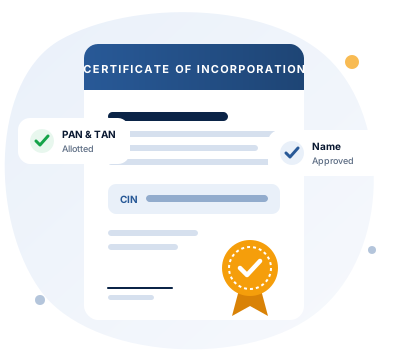
The Registrar issues the Certificate of Incorporation with your LLP Identification Number (LLPIN), along with the LLP's PAN and TAN.
LLP Agreement & Form 3 Within 30 days
We draft the LLP Agreement, get it executed on stamp paper of the applicable state value, and file it in Form 3 within 30 days of incorporation to avoid additional fees.
Bank account & registrations After COI
We help you open the current account and obtain GST or MSME registration if your business needs them.
LLP registration plans
Basic
Only the incorporation, done properly.
+ govt. fees, DSC & stamp duty
Choose Basic- Name reservation (RUN-LLP)
- DPIN for 2 designated partners
- FiLLiP filing
- Certificate of Incorporation
- LLP PAN & TAN
Standard
Incorporate with a proper LLP Agreement.
+ govt. fees & stamp duty
Choose Standard- Everything in Basic, plus:
- 2 Class-3 DSCs included
- Customised LLP Agreement drafting
- Form 3 filing
- Bank account assistance
Premium
Incorporation + first-year compliance.
+ govt. fees & stamp duty
Choose Premium- Everything in Standard, plus:
- GST registration
- MSME (Udyam) registration
- First-year Form 11 & Form 8 filing
- 1-year expert support
Prices are professional fees, exclusive of GST. Stamp duty on the LLP Agreement depends on the state (Delhi or Uttar Pradesh) and the total contribution — we confirm the exact amount in your written quote.
LLP vs Private Limited Company
| Feature | LLP | Private Limited Company |
|---|---|---|
| Governing law | LLP Act, 2008 | Companies Act, 2013 |
| Owners | Partners (min. 2, no maximum) | Shareholders (min. 2, max. 200) |
| Statutory audit | Only above ₹40 lakh turnover or ₹25 lakh contribution | Mandatory for every company |
| Annual ROC forms | Form 11 and Form 8 | AOC-4 and MGT-7 / MGT-7A |
| Board meetings & AGM | Not required by law | Mandatory |
| Equity funding & ESOPs | Not possible | Easy — preferred by investors |
| Best suited for | Professionals, agencies, service firms | Startups and growth businesses |
Compliances every LLP must complete
- File the LLP Agreement in Form 3 within 30 days of incorporation.
- Form 11 (Annual Return) — due by 30 May every year, even if the LLP had no business.
- Form 8 (Statement of Account & Solvency) — due by 30 October every year.
- Income tax return (ITR-5) every year, and a tax audit where applicable.
- Report changes — any change in partners (Form 4) or in the LLP Agreement (Form 3) must be filed within 30 days.
LLP registration — common questions
How much does LLP registration cost in Delhi NCR?
Our professional fee starts at ₹1,499. In addition you pay for Digital Signatures, MCA government fees (based on contribution) and state stamp duty on the LLP Agreement. We share an itemised written quote before you pay.
How long does it take to register an LLP?
Typically 10–15 working days from the date we receive complete documents, subject to name approval and processing time at the MCA.
Is there a minimum capital requirement for an LLP?
No. There is no minimum contribution. Partners may contribute any amount, and the contribution can be in cash, property or other assets as recorded in the LLP Agreement.
Does an LLP need to get its accounts audited?
Only if its annual turnover exceeds ₹40 lakh or its total contribution exceeds ₹25 lakh. Below these limits a statutory audit under the LLP Act is not mandatory.
What happens if the LLP Agreement is not filed within 30 days?
Form 3 can still be filed later, but the MCA charges additional fees that keep increasing with the period of delay. We track this deadline for every LLP we incorporate.
Can an existing partnership firm be converted into an LLP?
Yes. A registered or unregistered partnership firm can be converted into an LLP under the LLP Act, provided all partners of the firm become partners of the LLP. We handle conversions as well.
Can an NRI or foreign national be a partner in an LLP?
Yes, subject to FEMA rules and the sector in which the LLP operates. At least one designated partner must be resident in India.