
What is a Public Limited Company?
A Public Limited Company is a company registered under the Companies Act, 2013 that is not a private company. It has no restriction on the transfer of its shares, no upper limit on the number of shareholders, and may invite the public to subscribe to its shares or debentures.
A public company does not have to be listed. Many businesses incorporate as unlisted public companies to build a wide shareholder base, prepare for an SME or main-board IPO, or meet the requirements of lenders and regulators in sectors such as finance and infrastructure.
Demat from day one: under Rule 9A, every unlisted public company must issue its securities only in dematerialised form. That means obtaining an ISIN soon after incorporation — we plan for this upfront.
Advantages of a Public Limited Company
Access to public capital
Raise funds from the public through an IPO and list on the NSE or BSE, including their SME platforms.
Unlimited shareholders
No ceiling of 200 members — bring in as many investors as you need.
Freely transferable shares
Shareholders can enter and exit without restrictions in the Articles.
Limited liability
Shareholders are liable only up to the unpaid amount on their shares.
Highest credibility
Greater disclosure builds trust with banks, institutions and large customers.
Perpetual existence
A separate legal entity that continues regardless of changes in ownership or management.
Requirements to register a Public Limited Company
- Minimum 3 directors — all individuals, at least one resident in India. Maximum 15, extendable by special resolution.
- Minimum 7 shareholders — individuals or bodies corporate. There is no maximum.
- No minimum paid-up capital — the earlier ₹5 lakh requirement was removed in 2015.
- Name ending with "Limited" — unique and not conflicting with an existing company, LLP or trademark.
- A registered office in India with valid address proof and owner's NOC.
- DSC for all directors and subscribers, and DIN for every director.
Higher governance obligations apply as you grow — such as independent directors, an audit committee, secretarial audit and a whole-time Company Secretary once paid-up capital or turnover crosses the prescribed thresholds. We map out what applies to you before you incorporate.
Documents required
KYC is needed for all three directors and all seven subscribers. A person can be both.
For each director & subscriber
- PAN card (mandatory for Indian nationals)
- Aadhaar card
- Identity proof — Passport, Voter ID or Driving Licence
- Address proof — latest bank statement or utility bill (not older than 2 months)
- Passport-size photograph
- Email ID and mobile number
For the registered office
- Latest utility bill — electricity, gas, telephone or mobile (not older than 2 months)
- No Objection Certificate (NOC) from the property owner
- Rent or lease agreement, if the premises are rented
- Sale deed or property tax receipt, if self-owned
Public Limited Company registration process
Digital Signature Certificates Day 1–3
Class-3 DSCs for all directors and subscribers.
Name reservation — SPICe+ Part A Day 3–5
Name and trademark check, followed by reservation with up to two name choices.
Drafting MoA & AoA Day 4–8
Our Company Secretary drafts the Memorandum and Articles suited to a public company, with clauses that support future fundraising.
Filing SPICe+ Part B Day 8–11
Incorporation application with DIN allotment, AGILE-PRO-S, director consents and declarations, and payment of government fees and stamp duty.
Certificate of Incorporation Day 11–15
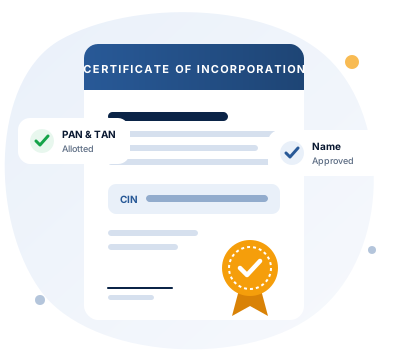
The MCA issues the Certificate of Incorporation with CIN, PAN and TAN.
Post-incorporation set-up After COI
Bank account, INC-20A, auditor appointment and — as required by Rule 9A — ISIN and demat of the subscribers' shares.
Public Limited Company registration plans
Basic
Incorporation with 3 directors and 7 subscribers.
+ govt. fees, DSC & stamp duty
Choose Basic- Name reservation
- DIN for 3 directors
- MoA & AoA drafting
- SPICe+ filing
- COI, PAN & TAN
Standard
Incorporate and start operating.
+ govt. fees & stamp duty
Choose Standard- Everything in Basic, plus:
- DSCs for 3 directors included
- Bank account assistance
- INC-20A filing
- Auditor appointment (ADT-1)
- Statutory registers
Premium
Incorporation + Rule 9A demat readiness.
+ govt., depository & RTA fees
Choose Premium- Everything in Standard, plus:
- ISIN application with NSDL or CDSL
- RTA appointment support
- GST registration
- 1-year CS support
Prices are professional fees, exclusive of GST. Government fees and stamp duty depend on the state of registration and authorised capital. Depository and RTA charges are payable at actuals.
Public Limited vs Private Limited Company
| Feature | Public Limited | Private Limited |
|---|---|---|
| Minimum directors | 3 | 2 |
| Minimum shareholders | 7 | 2 |
| Maximum shareholders | No limit | 200 |
| Transfer of shares | Freely transferable | Restricted by the Articles |
| Invitation to public | Allowed | Prohibited |
| Demat of securities | Mandatory for all (Rule 9A) | Mandatory except small companies (Rule 9B) |
| Compliance level | Highest | High |
Key compliances for a public company
- INC-20A within 180 days, and appointment of the first auditor within 30 days of incorporation.
- ISIN and dematerialisation of all securities, and half-yearly reconciliation of share capital in Form PAS-6.
- At least four board meetings every year and an Annual General Meeting within six months of the financial year end.
- AOC-4 and MGT-7 with the ROC every year, along with the income tax return.
- MGT-14 for the wider range of board and special resolutions that public companies must file.
Public Limited Company — common questions
Does a Public Limited Company have to be listed on a stock exchange?
No. A public company can remain unlisted indefinitely. Listing is a separate process regulated by SEBI and the stock exchanges, which you can take up when the business is ready.
What is the minimum capital required?
There is no minimum paid-up capital requirement under the Companies Act. You choose the authorised capital based on your funding plans; government fees and stamp duty increase with it.
Can the 7 shareholders include the 3 directors?
Yes. Directors can also be shareholders. You need seven distinct subscribers in total, of whom three or more can be the directors.
Can a Private Limited Company be converted into a Public Limited Company?
Yes. It involves increasing the number of directors and members to the required minimum, altering the MoA and AoA by special resolution, and filing the prescribed forms with the ROC. We handle such conversions.
Is an ISIN mandatory for an unlisted public company?
Yes. Rule 9A requires every unlisted public company to issue securities only in demat form and to facilitate dematerialisation of existing securities, which requires an ISIN from NSDL or CDSL.