
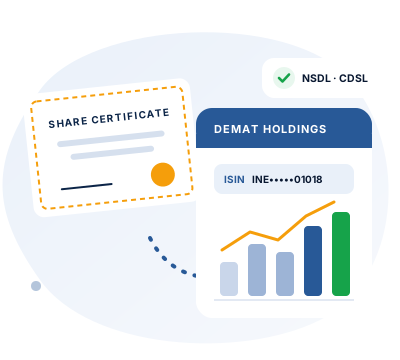
What Rule 9B requires
Rule 9B was inserted into the Companies (Prospectus and Allotment of Securities) Rules, 2014 by an MCA notification dated 27 October 2023. It extends to private companies the dematerialisation regime that Rule 9A had already applied to unlisted public companies since 2018.
A covered private company must (a) issue securities only in dematerialised form, and (b) facilitate dematerialisation of all its existing securities. Before any fresh issue, buy-back, bonus or rights offer, the entire holding of its promoters, directors and key managerial personnel must already be in demat. And any security holder who wants to transfer securities or subscribe to new ones must first dematerialise their existing holding.
Which private companies must comply
- Every private company that is not a small company. A small company is one with paid-up capital not exceeding ₹4 crore and turnover not exceeding ₹40 crore.
- Every holding company and every subsidiary company, because the Act says a holding or subsidiary can never be a small company — regardless of its own capital and turnover. A ₹1 lakh subsidiary of another company is covered.
- Companies that cross the small-company limits later must comply within 18 months from the close of the financial year in which they ceased to be small.
- Exempt: small companies and government companies. (Section 8 companies were initially the subject of debate; obtain advice on your specific position.)
The deadline and where things stand
Companies that were not small companies as at 31 March 2023 were given 18 months — until 30 September 2024 — to comply. The MCA subsequently extended this to 30 June 2025 for private companies (other than producer companies). That date has passed. A covered company that still holds shares in physical form is now in default and, more practically, cannot allot shares to an investor or register a transfer until it fixes the position.
Enforcement is through the general penalty provisions of the Companies Act, but the real cost shows up in transactions: funding rounds, share transfers among founders, ESOP allotments and even a routine transfer on a shareholder's death all stall until the ISIN is in place and the relevant holdings are in demat.
How to comply with Rule 9B
Confirm applicability Week 1
Check paid-up capital, turnover and whether the company is a holding or subsidiary. Pass a board resolution approving dematerialisation.
Appoint a Registrar & Transfer Agent Week 1
A SEBI-registered RTA handles the interface with the depositories and processes demat requests.
Sign the tripartite agreement Week 1–2
Between the company, the RTA and NSDL and/or CDSL.
Obtain the ISIN Week 2–4
The depository allots an ISIN for each class of security (equity shares; separately for preference shares or debentures) after verifying the company's documents.
Shareholders open demat accounts In parallel
Promoters, directors and KMP first; others as needed. Any Depository Participant will do.
Dematerialise existing shares Week 4–6
Each holder submits a Dematerialisation Request Form with the physical certificates to their DP. The RTA verifies against the register of members and the shares are credited electronically.
File PAS-6 every half-year Ongoing
Reconciliation of share capital audit report within 60 days of 30 September and 31 March, certified by a practising CS or CA.
What Rule 9B compliance costs
There are three sets of charges: the depository's one-time joining fee and annual custody fee (based on the number of ISINs and shareholders), the RTA's set-up and annual fees, and professional fees for the resolutions, agreements, ISIN application and PAS-6 filings. For a typical private company with a handful of shareholders, the all-in first-year cost is usually in the range of ₹40,000–70,000, with a lower recurring amount thereafter. Our ISIN and demat service starts at ₹14,999 in professional fees, with depository and RTA charges at actuals.
Frequently asked questions
My private company has ₹1 lakh capital and ₹20 lakh turnover. Does Rule 9B apply?
Not unless it is a holding or subsidiary company. On those numbers it is a small company and is exempt — until it crosses ₹4 crore paid-up capital or ₹40 crore turnover, or acquires or becomes a subsidiary.
We are a subsidiary of a foreign company. Are we covered?
Yes. A subsidiary cannot be a small company, so Rule 9B applies regardless of your capital and turnover.
We missed the 30 June 2025 deadline. What now?
Comply as soon as possible. Obtain the ISIN, dematerialise the promoters' and directors' holdings, and start filing PAS-6. The company is exposed to penalties for the period of default, but the practical consequence — inability to allot or transfer — is removed once you comply.
Do all shareholders have to dematerialise immediately?
Promoters, directors and KMP must before any fresh issue or buy-back. Other holders must before they transfer or subscribe. In practice most companies get everyone into demat in one exercise.
Is one depository enough?
Yes. Admitting the security with both NSDL and CDSL is optional and is useful when shareholders' demat accounts are spread across DPs of both depositories.