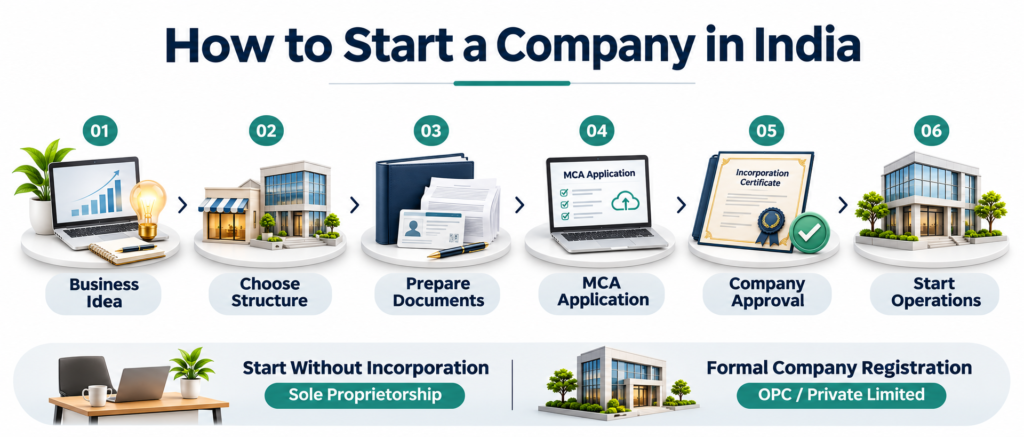
Starting a company in India can feel confusing when you have a business idea but know very little about company registration, legal documents, or government rules. You may be ready to sell products, offer services, or build a startup, but questions about MCA, ROC, GST, directors, and annual filings can make the process seem much harder than it actually is.
Do you need to register a company before earning your first rupee? Can you start a business from home? What if you choose the wrong business structure or submit incorrect documents? And how much paperwork will you have to manage after registration?
The good news is that learning how to start a company in India does not mean you have to become an expert in company law. You need to understand your business requirements, choose a suitable structure, prepare the necessary documents, and complete the registrations that apply to your business.
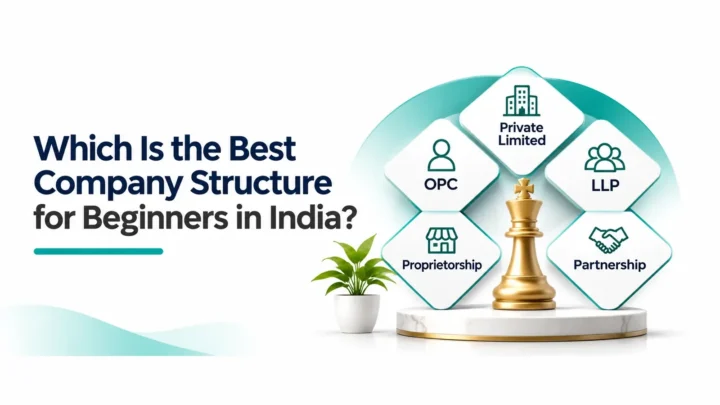
Not every entrepreneur needs a Private Limited Company immediately. Some people can begin as Sole Proprietors, while others may benefit from registering a Limited Liability Partnership (LLP), One Person Company (OPC), or Private Limited Company.
You also do not have to handle every registration form yourself. Probay’s team of Chartered Accountants (CAs) and Company Secretaries (CSs) helps entrepreneurs understand business registration, prepare incorporation documents, manage applicable MCA filings, and plan for ongoing compliance.
Whether you are starting with personal savings, working on a side business, launching a startup with friends, or leaving your job to become self-employed, understanding the process before registration can help you avoid unnecessary expenses and paperwork.
What Should I Do to Start a Business Without Any Legal or Regulatory Complications?
Before thinking about company registration, start with one simple question: What exactly will my business do?
A person selling handmade products from home has different requirements from someone opening a restaurant or starting a software company with three partners.
Your business activity, number of owners, location, expected turnover, and future plans all influence which registrations and approvals you may need.
1. Understand Your Business Activity
Write down your business idea in simple words.
For example:
- I want to sell clothes online.
- I want to provide digital marketing services.
- I want to start a software company with my friend.
- I want to open a small manufacturing business.
- I want to provide consulting services to Indian companies.
- I want to sell handmade products through social media.
Once you understand your activity, it becomes easier to identify the applicable registrations.
A food business may require FSSAI registration or a licence. Certain financial services require regulatory approvals. A manufacturing unit may need local and environmental permissions depending on its operations.
Company registration alone does not automatically authorise every business activity.
2. Decide Whether You Need a Separate Legal Entity
A separate legal entity is a business that the law recognises as different from its owners.
A Private Limited Company, OPC, and LLP have separate legal identities. A Sole Proprietorship does not.
For example, when you operate as a Sole Proprietor, you are generally personally responsible for business debts.
A Private Limited Company has its own legal identity, and shareholders generally enjoy limited liability. However, personal guarantees, fraud, wrongful conduct, and certain legal obligations can still create personal responsibility.
Understanding this difference is important before choosing a structure.
3. Check Which Registrations Apply to Your Business
Not every business needs the same registrations.
| Registration | What it does | Is it required for every business? |
|---|---|---|
| Company incorporation | Establishes a company as a legal entity | No |
| LLP registration | Establishes a Limited Liability Partnership | Only when choosing an LLP |
| GST registration | Registers a business under GST law | Depends on applicable rules |
| Udyam registration | Recognises eligible MSMEs | Generally voluntary |
| Shops and Establishments registration | Covers applicable commercial establishments | Depends on state law |
| FSSAI registration or licence | Regulates eligible food businesses | Required where applicable |
| Trade licence | Permits certain local business activities | Depends on local rules |
| Professional tax registration | Covers applicable professional tax obligations | Depends on the state |
Registering for every available scheme is not necessarily helpful. Some registrations create additional filing or recordkeeping responsibilities.
A CA can help you understand tax-related registrations, while a CS can explain corporate registration and statutory filing requirements.
4. Understand the Cost of Running a Registered Company
Many first-time founders focus only on incorporation expenses.
However, a registered company may also need accounting, statutory audit, annual ROC filings, income-tax returns, and other compliance services.
Even if your company earns no money during its first year, certain statutory responsibilities may continue.
Before incorporating, estimate both your setup expenses and the cost of maintaining the company for at least one year.
Probay’s CA and CS team can help founders understand these responsibilities before choosing a business structure.

How to Start a Business in India Without Registering a Company
You do not always need a Certificate of Incorporation to begin earning money.
Many freelancers, consultants, independent professionals, and small traders operate as Sole Proprietors without incorporating a company under the Companies Act, 2013.
However, operating without company incorporation does not mean you can ignore tax laws, licences, or other business regulations.
What Is a Sole Proprietorship?
A Sole Proprietorship is a business owned and controlled by one individual.
The owner receives the profits, manages operations, and is personally responsible for the business’s liabilities.
For example, imagine you are a graphic designer who wants to start providing logo design services from home.
You may be able to begin offering services as a Sole Proprietor without registering a Private Limited Company.
However, you must still meet applicable income-tax, GST, and other legal requirements.
Benefits of Starting as a Sole Proprietor
A Sole Proprietorship may be suitable when you are starting alone, have limited capital, and want to test whether customers are interested in your services.
It generally involves less incorporation-related paperwork and fewer corporate compliance requirements than a registered company.
You do not need shareholders, directors, or MCA incorporation documents.
However, the main disadvantage is unlimited personal liability. Business debts and legal claims may expose your personal assets.
When Is a Sole Proprietorship Not Suitable?
A Sole Proprietorship may not be the best option if you plan to bring in co-owners, raise equity investment, issue shares, or enter contracts involving significant financial risks.
For example, two founders building a software platform and planning to raise investment may find a Private Limited Company more suitable.
Can You Register a Company Later?
Yes. You can begin as a Sole Proprietor and later transfer or reorganise the business into a company structure.
However, this is not simply a change of name.
Assets, contracts, licences, tax registrations, and other business interests may need to be transferred or updated. Tax implications must also be considered.
A CA can help assess the financial and tax consequences, while a CS can assist with company incorporation and relevant corporate documentation.
Want to start earning legally without heavy company registration? Speak with the Probay team to understand whether a Sole Proprietorship is suitable for your business.
I Know Nothing About Business Terms: How Can I Register a Business Without Heavy Compliance?
If you have never registered a company before, words such as MCA, ROC, DIN, DSC, MOA, and AOA may sound confusing.
You do not need to memorise every legal term. You only need to understand what these terms mean and why they matter.
Common Company Registration Terms Explained
| Term | Full form | Simple explanation |
|---|---|---|
| MCA | Ministry of Corporate Affairs | Government ministry responsible for administering company and LLP laws |
| ROC | Registrar of Companies | Authority responsible for maintaining company records and administering statutory filings |
| DSC | Digital Signature Certificate | Used to sign electronic documents |
| DIN | Director Identification Number | Unique identification number allotted to a director |
| MOA | Memorandum of Association | Contains the company’s main objects and other fundamental details |
| AOA | Articles of Association | Contains rules for managing the company |
| CIN | Corporate Identification Number | Unique identification number allotted to an incorporated company |
| PAN | Permanent Account Number | Used for income-tax identification |
| TAN | Tax Deduction and Collection Account Number | Used for applicable TDS and TCS obligations |
| GSTIN | Goods and Services Tax Identification Number | Identifies a GST-registered taxpayer |
| SPICe+ | Simplified Proforma for Incorporating Company Electronically Plus | Integrated online company incorporation application |
| COI | Certificate of Incorporation | Official evidence that a company has been incorporated |
What Is MCA in Company Registration?
The Ministry of Corporate Affairs administers major company and LLP laws in India.
When you incorporate a Private Limited Company or OPC, the application is submitted through the MCA system.
The process includes details about the proposed company name, directors, shareholders, registered office, and incorporation documents.
What Is ROC and Why Does It Matter?
The Registrar of Companies maintains statutory company records and administers various corporate filing requirements.
For example, companies must submit prescribed annual financial and corporate information.
These responsibilities continue after incorporation.
Do You Have to Complete Every Form Yourself?
No. Founders can engage qualified professionals to assist with the registration process.
A Company Secretary can assist with company law requirements, incorporation documentation, statutory records, and applicable ROC filings.
A Chartered Accountant can assist with accounting, taxation, financial reporting, and incorporation-related work within the applicable professional scope.
Probay’s CA and CS team helps entrepreneurs understand these requirements and complete relevant registration and compliance procedures.
Which Company Structure Is Easiest to Manage If You Have Zero Business Knowledge?
There is no single structure that is best for every entrepreneur.
Someone starting a small business with ₹50,000 may have different requirements from two founders investing ₹10 lakh in a technology startup.
The right structure depends on ownership, financial risk, compliance responsibilities, and future plans.

Comparison of Business Structures in India
| Factor | Sole Proprietorship | Partnership Firm | LLP | OPC | Private Limited Company |
|---|---|---|---|---|---|
| Minimum owners | 1 | 2 | 2 partners | 1 member | 2 shareholders |
| Separate legal identity | No | No | Yes | Yes | Yes |
| Limited liability | No | Generally no | Generally yes | Generally yes | Generally yes |
| MCA incorporation | No | No | Yes | Yes | Yes |
| Annual MCA filings | No | No | Yes | Yes | Yes |
| Statutory audit | Depends on applicable tax rules | Depends on applicable tax rules | Threshold-based | Generally required | Generally required |
| Outside equity investment | Not through company shares | Not through company shares | Not through company shares | Limited suitability | Generally suitable |
| Compliance complexity | Low | Low to moderate | Moderate | Moderate to high | Higher |
| Commonly suitable for | Small solo businesses | Traditional partner-run businesses | Professional and service firms | Individual founders | Startups and growing businesses |
Limited liability is subject to exceptions, including certain personal guarantees and wrongful conduct.
Sole Proprietorship: For Someone Starting Small
A Sole Proprietorship may be suitable for freelancers, small retailers, independent consultants, and people testing a business idea.
It is relatively simple to manage because one individual owns and controls the business.
However, the owner is personally responsible for business liabilities.
Partnership Firm: For Two or More People Working Together
A Partnership Firm allows two or more people to operate a business and share profits.
A written partnership deed should explain capital contributions, profit-sharing arrangements, responsibilities, decision-making powers, and exit conditions.
Without clear terms, disagreements can become difficult to resolve.
Traditional partners generally have unlimited liability for partnership obligations.
LLP: For Partners Who Want Limited Liability
A Limited Liability Partnership has a separate legal identity and generally provides limited liability to its partners.
It can be suitable for consulting businesses, agencies, professional service firms, and other partner-managed ventures.
An LLP requires at least two designated partners, including at least one who meets the applicable residency requirement.
It also has annual MCA filing obligations.
Probay provides LLP Registration Services for entrepreneurs who need assistance with incorporation and documentation.
One Person Company: For a Solo Founder Who Wants a Company
An OPC allows an eligible individual to establish a company with a separate legal identity.
It can be useful when you want to operate alone but prefer a corporate structure.
An OPC requires a nominee and has accounting, audit, and statutory filing responsibilities.
You can explore One Person Company Registration to understand the requirements.
Private Limited Company: For Entrepreneurs Planning to Grow
A Private Limited Company is commonly chosen by founders who want to establish a scalable business, bring in co-founders, issue shares, or raise equity investment.
It generally requires at least two directors and two shareholders. The same individuals may serve in both roles, subject to applicable requirements.
A Private Limited Company has a separate legal identity and generally provides limited liability to shareholders.
However, it also requires more formal accounting, statutory audit, annual ROC filings, and corporate records.
Probay’s Private Limited Company Registration Services can help founders understand and complete the applicable incorporation process.
How Can Probay’s CA and CS Team Help You Choose?
Choosing the cheapest structure is not always the best decision.
A CA can help assess taxation, accounting expenses, and financial reporting requirements.
A CS can explain company law responsibilities, ownership arrangements, and statutory compliance obligations.
Together, these perspectives help founders compare the practical cost of starting and maintaining different business structures.
Step-Zero Checklist for Beginners: Even If You Don’t Know What ROC, MCA, or DIN Means
Before paying registration fees, complete this basic checklist.
Business Planning Checklist
- I know what product or service my business will offer.
- I know whether I will start alone or with partners.
- I have identified who will invest money in the business.
- I have estimated my initial business expenses.
- I have calculated how much money I need for the first six months.
- I understand the basic differences between Sole Proprietorship, LLP, OPC, and Private Limited Company.
- I have shortlisted two or three business names.
- I have identified a possible registered-office address.
- I have checked whether my business needs GST registration.
- I have considered whether special licences or permissions apply.
- I understand that company registration may create annual compliance responsibilities.
- I have considered professional assistance for incorporation.
You can copy this checklist into your notes or a document and mark each item as you complete it.
If you cannot answer every question, that simply means those decisions should be clarified before registration.
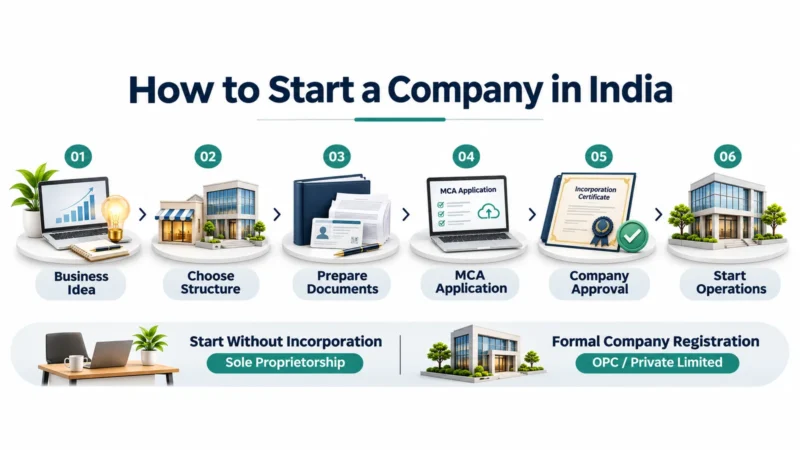
How to Start a Company in India Online: Step-by-Step Registration Process
Company incorporation in India is largely an online process.
For a typical Private Limited Company, the process includes selecting a name, preparing documents, obtaining digital signatures, submitting incorporation forms, and completing post-incorporation requirements.
Step 1: Choose the Business Structure
Decide whether a Private Limited Company, OPC, LLP, or another structure suits your plans.
Your choice affects the number of owners, management requirements, statutory filings, and ongoing expenses.
For example, two friends starting an IT consulting business may compare an LLP with a Private Limited Company.
A CA and CS can help them understand the financial and corporate compliance implications.
Step 2: Select a Company Name
Choose a name that reflects your business and is distinguishable from existing companies and relevant trademarks.
Before submitting the application, check whether the proposed name conflicts with an existing company or trademark.
A name may face objections if it is too similar to an existing name, misleading, or contains restricted words without approval.
Company name approval does not automatically provide trademark protection.
Step 3: Obtain Digital Signature Certificates
A DSC allows authorised individuals to sign electronic documents securely.
Proposed directors and subscribers who must digitally sign incorporation documents need valid digital signatures.
These certificates are issued by licensed certifying authorities after the required verification.
Step 4: Prepare Director and Shareholder Information
The application requires details of the proposed directors and shareholders.
These may include names, identity information, residential addresses, contact details, occupations, and share subscriptions.
Eligible proposed directors who do not already have a DIN may obtain one through the incorporation process.
Step 5: Prepare the MOA and AOA
The Memorandum of Association describes the company’s main objects and other fundamental details.
The Articles of Association contain rules governing the company’s internal management.
For example, if two founders are starting a software company, they should understand how ownership and management arrangements will work.
A separate shareholders’ agreement may also be useful for recording important arrangements between founders.
A Company Secretary can assist with the relevant corporate documentation.
Step 6: Submit the SPICe+ Incorporation Application
SPICe+ is the integrated online incorporation application provided through the MCA system.
It includes two main parts:
- Part A covers company name reservation.
- Part B covers incorporation details and linked registration services.
Depending on the application, linked forms include e-MOA, e-AOA, INC-9, and AGILE-PRO-S.
The integrated process also supports DIN allotment, PAN, TAN, and certain other registrations or applications.
Step 7: Complete Applicable Professional Certification
Company incorporation forms contain declarations and professional certification requirements.
A practising CA, CS, or CMA, as authorised for the relevant filing, may be involved in certification.
The professional reviews the relevant information and documentation before certifying the application.
Founders remain responsible for providing truthful and accurate information.
Step 8: Pay Government Charges
The total registration cost may include applicable government filing fees, stamp duty, digital signatures, and professional charges.
The amount depends on the company type, authorised capital, registered-office state, and other circumstances.
Always request an itemised quotation before making payment.
Step 9: Receive the Certificate of Incorporation
Once the application is approved, the company receives its Certificate of Incorporation and Corporate Identification Number.
PAN and TAN are generally allotted through the integrated incorporation process.
At this stage, the company legally exists as a separate entity.
Step 10: Complete Post-Incorporation Requirements
Depending on the company, the next steps may include opening or activating its bank account, receiving share subscription money, appointing the first auditor, issuing share certificates, maintaining statutory registers, and filing the declaration of commencement of business.
Applicable companies with share capital generally need to file Form INC-20A within 180 days of incorporation before commencing business or exercising borrowing powers.
A CA and CS team can help identify these requirements and establish a compliance plan.
Company Registration Checklist
- Business structure selected.
- Proposed company name checked.
- Directors and shareholders identified.
- Digital Signature Certificates arranged.
- Director and shareholder documents verified.
- Registered-office documents prepared.
- MOA and AOA prepared.
- SPICe+ and applicable linked forms completed.
- Professional certification completed where required.
- Government charges paid.
- Certificate of Incorporation received.
- PAN and TAN details verified.
- Post-incorporation compliance requirements identified.
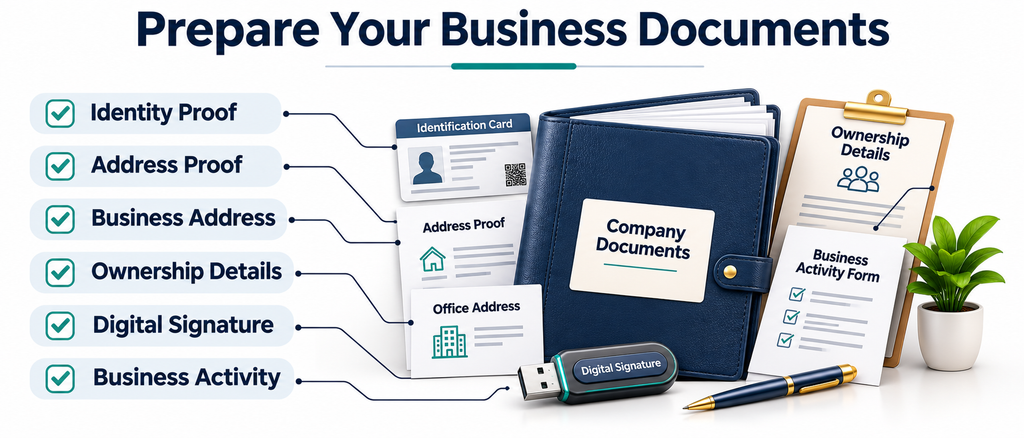
What Documents Are Required to Start a Company in India?
Incorrect or incomplete documents can delay company incorporation.
Before starting the application, prepare the necessary identity, address, ownership, and registered-office documents.
Documents Required From Directors and Shareholders
| Document | Purpose | What to check |
|---|---|---|
| PAN card | Identity and tax identification | Name and details are correct |
| Aadhaar or other accepted identity proof | Identity verification | Information matches the application |
| Recent bank statement or utility bill | Residential address proof | Meets applicable recency requirements |
| Photograph | Identification | Image is clear |
| Email address | Official communication | Email is active |
| Mobile number | Verification | Number is accessible |
| DSC | Electronic signing | Certificate is valid |
Foreign nationals, non-resident applicants, and corporate shareholders may need additional documents and authentication.
Documents Required for the Registered Office
The registered office is the company’s official address for statutory communications.
Depending on the circumstances, the documents may include:
- Recent electricity, water, or other accepted utility bill.
- Ownership or occupancy proof.
- Rent or lease agreement, where applicable.
- No Objection Certificate from the property owner, where required.
- Other prescribed address documents.
Can You Use Your Home Address for Company Registration?
Yes. A residential address can often be used as a company’s registered office when the necessary documentation and permissions are available.
For example, if you live with your parents, the property owner may provide the required permission.
However, using a home address for registration does not automatically permit every commercial activity at that property.
Local restrictions and licensing requirements may still apply.
Document Preparation Checklist
- All names match the identity documents.
- Residential address proofs are recent and acceptable.
- Registered-office address is written consistently.
- Property owner permission is available where required.
- Document scans are clear and readable.
- Director and shareholder information is complete.
- Shareholding details are agreed upon.
- Business activity is correctly described.
- Digital signatures are valid.
- Required declarations are accurate.
Probay’s CA and CS team can help identify the documents relevant to your proposed company and review filing-related requirements.
How Much Does It Cost to Start a Company in India?
The cost of starting a company includes more than government registration fees.
You may also need digital signatures, professional assistance, stamp duty, accounting services, and annual compliance support.
Company Registration Cost Breakdown
| Expense | What it covers | When it is paid |
|---|---|---|
| DSC charges | Digital signing certificates | Initially and on renewal |
| MCA filing charges | Applicable government filing fees | During incorporation |
| Stamp duty | Duty on incorporation documents | During incorporation |
| Professional fees | Document preparation and filing assistance | As agreed |
| Registered-office expenses | Office documentation or facilities | Depends on arrangement |
| Accounting expenses | Maintaining financial records | Recurring |
| Statutory audit | Audit where legally required | Generally annually |
| ROC filing expenses | Annual and event-based company filings | Recurring or event-based |
| Tax compliance expenses | Applicable tax returns and related services | Recurring |
Is There a Minimum Capital Requirement?
An ordinary Private Limited Company generally does not have a prescribed minimum paid-up capital requirement under the Companies Act, 2013.
However, you still need enough money to operate the business.
Certain regulated activities may have separate capital requirements.
What Is Authorised Capital and Paid-Up Capital?
Authorised capital is the maximum share capital a company is permitted to issue under its current constitutional documents.
Paid-up capital represents the amount paid by shareholders against shares issued to them.
For example, a company may have authorised share capital of ₹1 lakh but initially issue shares worth ₹10,000.
The remaining authorised capital does not automatically need to be deposited into the company’s bank account.
Should You Choose the Cheapest Registration Package?
Not without checking what is included.
One package may cover basic incorporation, while another may include digital signatures, additional documentation, or post-incorporation assistance.
Before paying, ask for a written breakdown of government charges, professional fees, applicable GST on services, exclusions, and recurring costs.
A CA can help estimate financial and tax-related expenses, while a CS can explain the relevant corporate compliance requirements.
Can I Run a Side-Hustle Informally First, and When Must I Register a Legal Entity?
You can often start freelancing, selling products through social media, or developing software without incorporating a company. However, you must comply with applicable tax, licensing and business regulations.
Can You Start a Business While Working a Full-Time Job?
Yes, provided your employment agreement allows it. Check for restrictions on outside business activities, competing services and conflicts of interest before starting.
When Should You Consider Incorporation?
There is no fixed income threshold at which a Sole Proprietorship must become a Private Limited Company. However, incorporation may be beneficial when you want to:
- Bring in co-founders or issue equity shares.
- Raise funds from investors.
- Establish a separate legal identity.
- Enter significant commercial contracts.
- Create a formal ownership structure.
A freelancer earning ₹40,000 per month may continue as a Sole Proprietor, while two founders seeking investment may need a Private Limited Company before earning any revenue. The decision depends on business requirements, not income alone.
What Happens If You Register a Company but Never Start Trading?
Even without revenue, an incorporated company may need to maintain accounting records, complete audits and submit annual filings. If you no longer need the company, you may consider a company strike-off, subject to eligibility and outstanding legal obligations.
What Are the Most Common Legal and Compliance Mistakes New Founders Make?
Avoiding these common mistakes from the beginning can help founders prevent unnecessary expenses, legal complications and compliance issues.
1. Choosing the Wrong Business Structure
Do not choose a business structure based on its popularity. Consider your ownership requirements, investment plans, liability protection and ongoing compliance obligations.
2. Ignoring Annual Compliance Costs
Company registration is only the beginning. A Private Limited Company generally requires statutory audits, financial statements, ROC filings and income-tax compliance. Budget for these recurring expenses.
3. Not Agreeing on Ownership Before Registration
Co-founders should agree on capital contributions, ownership percentages, profit distribution, voting rights, management responsibilities and exit arrangements before incorporation.
4. Providing Incorrect Business Activity Details
Your incorporation documents should accurately reflect your proposed business activities. Incorrect company objects can cause registration difficulties or complications during future business expansion.
5. Ignoring GST and Tax Responsibilities
Not every business requires immediate GST registration. Our Chartered Accountants can help determine applicable tax obligations, registration requirements and financial record-keeping responsibilities.
6. Mixing Personal and Company Money
A company is a separate legal entity. Keep personal and business finances separate, with proper records of capital contributions, expenses, reimbursements and payments.
7. Forgetting ROC Deadlines
Missing statutory deadlines can result in additional fees and penalties. Our Company Secretaries can help maintain a compliance calendar, identify applicable forms and complete necessary filings.
8. Not Maintaining Proper Records
Preserve incorporation documents, statutory registers, financial records, resolutions and important correspondence. Organised documentation simplifies audits, annual filings and future ownership changes.

What Happens After Company Registration?
Receiving the Certificate of Incorporation is an important milestone, but it is not the end of the process.
Your company now has statutory responsibilities that must be managed.
Important Post-Incorporation Requirements
| Requirement | General timing | Why it matters |
|---|---|---|
| First board meeting | Generally within 30 days, subject to exemptions | Records initial company decisions |
| First auditor appointment | Generally within 30 days for applicable companies | Establishes statutory audit arrangements |
| Company bank account | As required for operations and applicable filings | Keeps company finances separate |
| Share subscription money | According to applicable requirements | Records shareholder contributions |
| INC-20A | Generally within 180 days for applicable companies | Declaration of commencement of business |
| Share certificates | Within prescribed statutory periods | Records share ownership |
| Statutory registers | As required under company law | Maintains official company records |
| Financial statements | Every financial year | Records financial position and performance |
| Annual ROC filings | Every financial year | Meets statutory reporting requirements |
| Income-tax return | According to applicable tax rules | Reports company income and other required information |
The exact deadlines and exemptions depend on the company and applicable law.
What Is Company Annual Filing?
Company annual filing involves submitting financial statements through Form AOC-4 and annual returns through Form MGT-7 or MGT-7A, as applicable, to the Registrar of Companies (ROC).
These filings are separate from income-tax returns and may be mandatory even if your company earns no revenue. Probay’s Company Annual Filing Services can help you manage these compliance requirements.
How Can a CA and CS Team Help After Incorporation?
Our Chartered Accountants assist with accounting, financial statements, tax compliance and statutory audits, subject to applicable requirements.
Our Company Secretaries assist with statutory registers, corporate records, board and shareholder meetings, annual returns and event-based ROC filings.
Together, our CA and CS team helps you manage compliance responsibilities and statutory deadlines.
Post-Incorporation Checklist
- Store the Certificate of Incorporation and verify PAN and TAN details.
- Open a company bank account and receive share subscription money.
- Appoint the first auditor and conduct the first board meeting, as applicable.
- Issue share certificates and prepare statutory registers.
- File INC-20A, where applicable.
- Establish accounting records and check GST requirements.
- Prepare an annual ROC filing and income-tax compliance calendar.
- Store all important company documents securely.
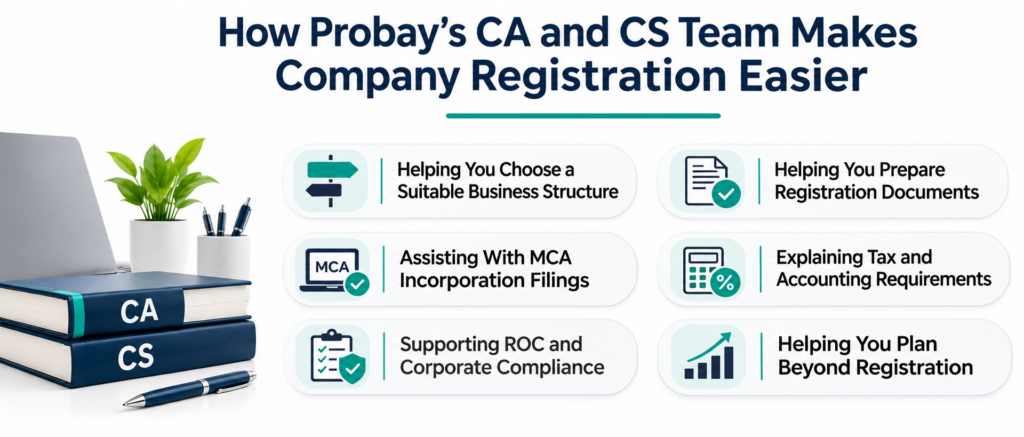
How Probay’s CA and CS Team Makes Company Registration Easier
Starting a company involves understanding legal documents, registration forms, tax requirements and ongoing compliance. As a founder, you should be able to focus on developing your business rather than learning complicated legal procedures.
Probay’s team of Chartered Accountants and Company Secretaries helps simplify company registration and ongoing compliance, supporting your business from incorporation to future growth.
1. Helping You Choose a Suitable Business Structure
Our CA and CS team helps you compare Sole Proprietorship, Partnership Firm, LLP and Private Limited Company based on ownership, investment plans, taxation, compliance costs and future growth. This helps you choose a structure that suits your actual business requirements.
2. Helping You Prepare Registration Documents
Our professionals assist with checking director and shareholder details, registered-office documents and incorporation paperwork. Proper documentation helps reduce errors, unnecessary corrections and registration delays.
3. Assisting With MCA Incorporation Filings
Our CA and CS team assists with SPICe+, applicable linked forms and professional certification where required. We help you understand each stage of incorporation while ensuring the necessary information is prepared accurately. Government approval remains subject to applicable requirements and processing.
4. Explaining Tax and Accounting Requirements
Our Chartered Accountants help you understand bookkeeping, tax registrations, financial statements, income-tax compliance and statutory audit requirements. This makes managing business finances easier, especially for first-time entrepreneurs.
5. Supporting ROC and Corporate Compliance
Our Company Secretaries assist with statutory records, resolutions, annual filings and applicable ROC forms. They also support corporate changes such as director appointments, registered-office changes and share issuance.
6. Helping You Plan Beyond Registration
As your business grows, bringing in investors, expanding operations or changing ownership may involve additional legal, financial and tax requirements. Our combined CA and CS expertise helps you understand and manage these responsibilities at different stages of business growth.
How Probay’s CA and CS Team Can Support Different Stages
| Business stage | CA-related assistance | CS-related assistance |
|---|---|---|
| Before registration | Tax and financial considerations | Entity structure and corporate requirements |
| Document preparation | Financial and tax-related information | Incorporation documents and statutory details |
| Incorporation | Applicable professional certification and tax-related matters | Company law documentation and applicable filing certification |
| After incorporation | Accounting, tax, audit and financial reporting | Statutory registers, resolutions and ROC compliance |
| Annual compliance | Financial statements, audit and tax returns | Annual returns and corporate filings |
| Business changes | Financial and tax implications | Corporate approvals and event-based filings |
The exact services depend on the engagement, professional authorisations, and requirements of the business.
For founders, the benefit of working with a coordinated team is being able to discuss both financial and corporate compliance questions without trying to understand every technical requirement alone.
Company Registration in Delhi, Noida and Ghaziabad
Although company incorporation is governed mainly by central law, your registered-office location determines applicable ROC jurisdiction, stamp duty and certain state-specific requirements.
Company Registration in Delhi
Whether you are starting a technology, consulting, retail or trading business, choosing the right structure and preparing accurate registration documents is essential. Local licences may also apply depending on your business activity.
Our Company Registration in Delhi services help entrepreneurs manage these requirements with professional CA and CS support.
Company Registration in Noida
Noida is a major hub for IT companies, startups, consulting businesses and manufacturing units. Companies registered here fall under the applicable Uttar Pradesh jurisdiction and may require additional local or industry-specific approvals.
Our Company Registration in Noida services help simplify documentation and incorporation requirements.
Company Registration in Ghaziabad
Whether you are starting a trading company, manufacturing unit, service business or online venture, your business structure should match your ownership, financial risk and growth plans.
Our Company Registration in Ghaziabad services help founders choose a suitable structure and complete incorporation formalities.
Can Your Registered Office and Business Location Be Different?
Yes. A company can maintain its registered office in one location and operate elsewhere, subject to applicable laws. The registered office must remain accessible for official communications, while additional business locations may require separate tax, labour, municipal or licensing compliance.
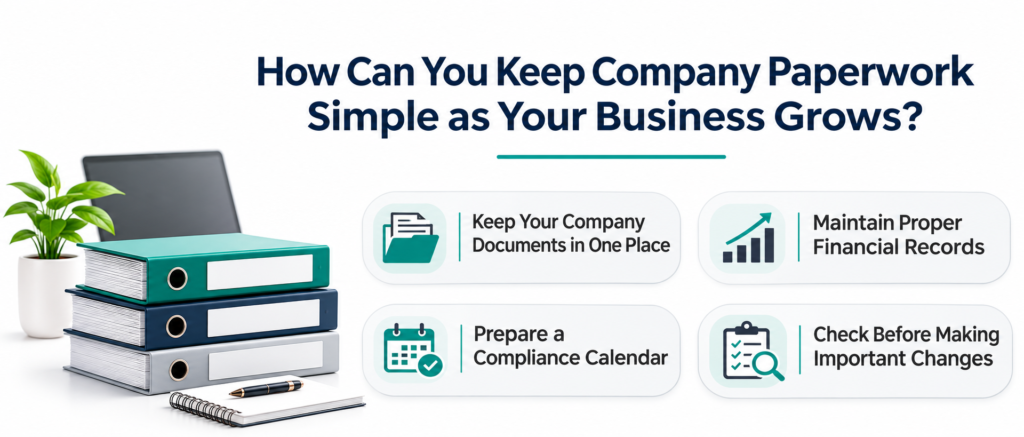
How Can You Keep Company Paperwork Simple as Your Business Grows?
You do not need a large administrative team to manage company paperwork. A simple system can help you organise documents, maintain financial records and meet compliance deadlines.
Keep Your Company Documents in One Place
Store your Certificate of Incorporation, MOA, AOA, PAN, TAN, applicable GST documents, shareholder records, statutory registers and government correspondence in a secure digital folder. Maintain backups and restrict access to sensitive information.
Maintain Proper Financial Records
Record business income, expenses, invoices, payments and shareholder contributions. Keep personal and company finances separate. Accurate records simplify tax returns, audits, financial reporting and business decisions.
Prepare a Compliance Calendar
Maintain a calendar covering applicable ROC filings, tax returns, GST returns, audits and event-based filings. Probay’s CA and CS team can help identify your compliance obligations and manage statutory deadlines.
Check Before Making Important Changes
Appointing directors, changing the registered office, issuing shares, modifying company objects or changing the capital structure may require statutory filings. Consult our CA and CS team beforehand to avoid documentation errors and missed compliance requirements.
Ongoing Company Compliance Checklist
- Business income and expenses are recorded.
- Invoices and payment records are organised.
- Company and personal finances are kept separate.
- Important contracts and documents are stored securely.
- GST returns are filed where applicable.
- TDS obligations are reviewed where applicable.
- Board and shareholder meeting requirements are monitored.
- Statutory registers are updated when required.
- Annual financial statements are prepared.
- Statutory audit is completed where applicable.
- ROC annual filings are completed.
- Income-tax returns are filed.
- Changes in directors, ownership or registered office are reviewed for filing requirements.
- Upcoming compliance deadlines are checked regularly.
Frequently Asked Questions About Starting a Company in India
1. How can I start a company in India without knowing anything about legal paperwork?
Choose a suitable business structure based on your ownership and business goals. Probay’s CA and CS team can help you prepare documents, complete registration filings and understand your legal responsibilities.
2. Can I start a business in India without registering a company?
Yes. You can operate as a Sole Proprietorship without MCA incorporation. However, applicable tax registrations, business licences and other approvals may still be required.
3. Which company structure is best for a beginner?
A Sole Proprietorship suits many small individual businesses, an LLP suits partners seeking limited liability, and an OPC suits eligible single founders. A Private Limited Company may be suitable for businesses planning to raise equity investment.
4. Is a CA or CS compulsory for company registration?
Applicable incorporation forms require certification by an authorised practising professional, such as a CA, CS or CMA. Founders can prepare information independently but must fulfil applicable certification requirements.
5. How can Probay’s CA and CS team help me register a company?
Our CA and CS team assists with business structure selection, documentation, incorporation filings, taxation, accounting and post-registration compliance requirements.
6. How much money do I need to start a Private Limited Company?
There is generally no minimum paid-up capital requirement. However, you should budget for government charges, stamp duty, professional fees, business operations and ongoing compliance.
7. Can I register a company online from home?
Yes. Company registration is generally completed online through the MCA portal using the required documents and digital signatures, subject to applicable verification requirements.
8. Can I use my residential address for company registration?
Yes, provided you have the required documents and permissions. Local restrictions on conducting business activities from residential properties must also be considered.
9. Is GST registration mandatory immediately after company incorporation?
No. GST registration depends on turnover, business activity, location and applicable GST provisions. Our Chartered Accountants can help determine whether registration is necessary.
10. How long does company registration take in India?
Company registration may take approximately 7–10 working days after documents are ready. Actual timelines depend on name approval, document accuracy, government processing and any required corrections.
11. Can I register a company with only one director?
Yes. An eligible individual can register an OPC with one director, one member and a nominee. An ordinary Private Limited Company requires at least two directors and two shareholders.
12. Do I need to file annual returns if my company has no income?
Yes. Even companies without revenue generally have annual ROC filing and other statutory obligations, depending on their structure and circumstances.
13. What happens if I miss an ROC filing deadline?
Late filings may attract additional fees, penalties and legal consequences. Certain annual ROC forms attract additional filing fees of ₹100 per day.
14. Can a CA help with company registration and taxation?
Yes. A Chartered Accountant can assist with incorporation, accounting, GST, tax planning, financial reporting and professional certification where authorised.
15. What does a Company Secretary do during company registration?
A Company Secretary assists with incorporation documents, company law requirements, statutory records, ROC filings and professional certification where authorised.
16. Can I change my business structure later?
Yes. However, restructuring may involve transferring assets, contracts and business interests. Consult a CA and CS to understand the applicable legal and tax implications.
17. Can I start a company while working in a private job?
Yes, subject to your employment agreement. Check for restrictions on outside business activities, competing services and conflicts of interest.
18. What is the difference between company registration and company annual filing?
Company registration establishes a legal entity, while annual filing involves submitting prescribed financial and corporate information to the ROC. Registration is generally a one-time process, whereas annual compliance is recurring.
19. Can Probay help after my company has been registered?
Yes. Depending on your service requirements, our CA and CS team assists with accounting, taxation, annual filings, corporate records and ongoing statutory compliance.
20. What is the best way to avoid legal paperwork mistakes when starting a company?
Choose the right business structure, prepare accurate documents, understand applicable registrations and maintain a compliance calendar. Professional CA and CS support can help reduce preventable legal and filing mistakes.
Ready to Start Your Company Without the Paperwork Headache?
Turn your business idea into a legally registered company with Probay’s expert CA and CS team. From choosing the right business structure to managing registration and ongoing compliance, we simplify the process so you can focus on growing your business.
Get Professional Company Registration Assistance From Probay