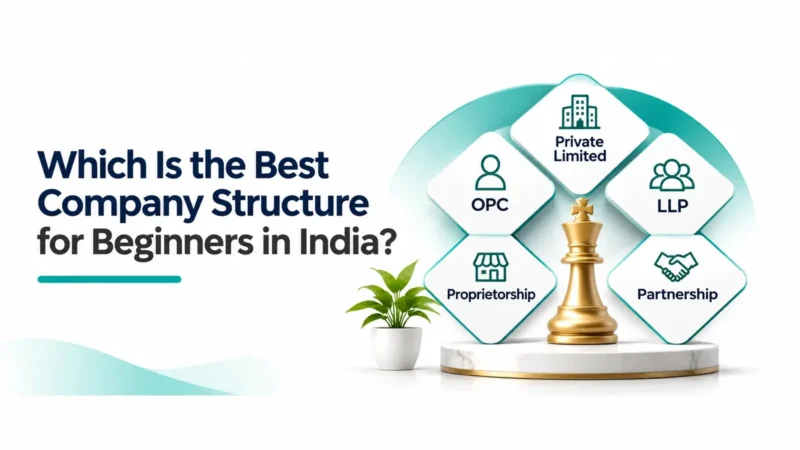
Choosing the Best Company Structure for Beginners in India depends on your budget, ownership preferences, business risks and future growth plans.
Should you start a Sole Proprietorship, Partnership Firm, LLP, One Person Company (OPC), or Private Limited Company? Each structure has different registration costs, legal responsibilities, tax implications and ownership benefits.
Choosing the wrong structure can lead to unnecessary expenses, compliance complications and personal financial risks.
At Probay, our team of Chartered Accountants (CAs) and Company Secretaries (CSs) helps first-time entrepreneurs compare business structures, understand legal requirements and choose the right option based on their business goals and financial capacity.
What Is a Business Structure, and Why Does It Matter for Beginners?
A business structure is the legal form under which you operate your business. It determines ownership, financial liability, taxation, registration and compliance responsibilities.
Beginners in India commonly consider five business structures:
- Sole Proprietorship
- Partnership Firm
- Limited Liability Partnership (LLP)
- One Person Company (OPC)
- Private Limited Company
Not all business structures are legally recognised as companies. Sole Proprietorships and traditional Partnership Firms differ from incorporated companies and LLPs.
Choosing the right structure helps you manage costs, reduce financial risks and support future business growth.
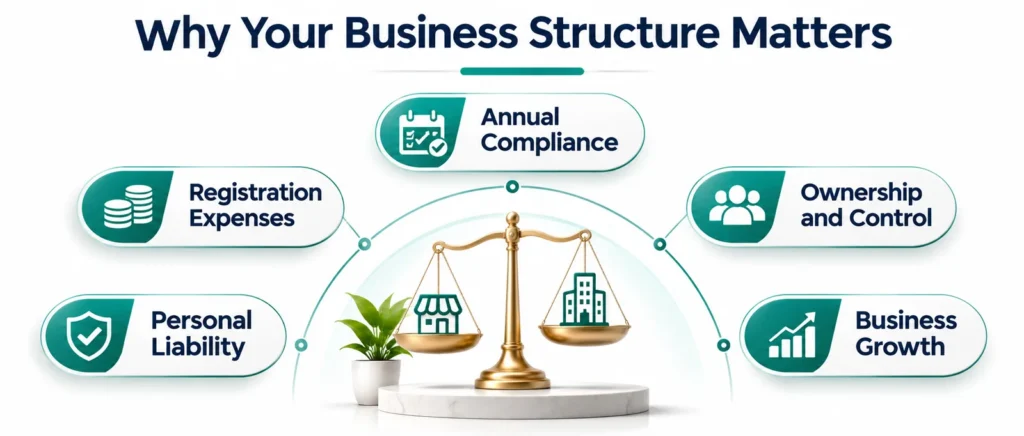
Why Your Business Structure Matters
Personal Liability
A Sole Proprietorship generally has unlimited personal liability, while LLPs and companies offer limited liability, subject to exceptions such as fraud and personal guarantees.
Registration Expenses
Registration costs vary depending on the business structure, documentation, government fees, digital signatures and professional assistance required.
Annual Compliance
LLPs and companies require statutory filings even with minimal business activity. Sole Proprietorships generally have fewer compliance requirements, although tax and other legal obligations still apply.
Ownership and Control
Some structures allow single ownership, while others require multiple owners. Your choice determines how ownership, control and decision-making are managed.
Business Growth
Your business structure affects your ability to attract investors, issue shares and expand operations.
The right structure should balance affordability, legal protection, compliance responsibilities and future growth opportunities.
Best Low-Budget Business Structure in India for Beginners With Zero Experience
If you are starting a business with limited savings, avoid spending most of your capital on registration. Keep sufficient funds for equipment, inventory, marketing, software, rent and daily business expenses.
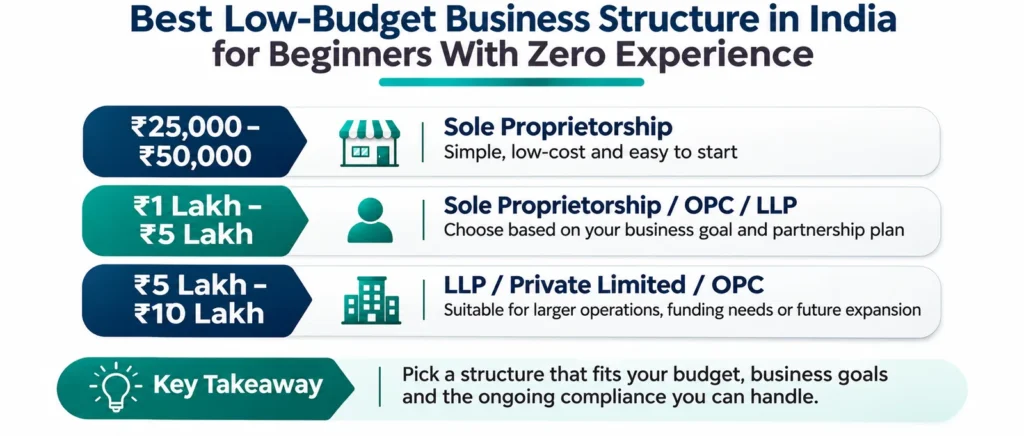
Starting a Business With ₹25,000 to ₹50,000
A Sole Proprietorship may be the simplest and most affordable option for beginners starting a small, low-risk business independently.
Suitable business ideas include:
- Freelance graphic design and content writing
- Home-based tutoring
- Tailoring services
- Digital marketing services
- Small online reselling
- Independent consulting
A Sole Proprietorship does not require incorporation under the Companies Act. However, GST registration, Shops and Establishments registration, FSSAI registration or other licences may apply depending on your business activities, turnover and location.
Starting a Business With ₹1 Lakh to ₹5 Lakh
With this budget, you can consider the following business structures:
- Sole Proprietorship: Suitable for testing business ideas with lower operating and compliance costs.
- One Person Company (OPC): Suitable for eligible solo founders seeking a separate legal identity and limited liability.
- LLP: Suitable for two or more founders seeking operational flexibility and limited liability.
Consider both initial registration expenses and ongoing compliance costs before making a decision.
Starting a Business With ₹5 Lakh to ₹10 Lakh
With a larger investment, you may need a structure that supports employees, supplier contracts, financial protection and business expansion.
- LLP: Suitable for founders who want operational flexibility without issuing shares.
- Private Limited Company: Suitable for businesses planning to attract investors, raise equity funding and expand.
- OPC: Suitable for eligible single founders seeking complete ownership and limited liability.
A higher investment does not automatically require company incorporation. Choose a structure based on your business risks, operational needs and growth plans rather than your budget alone.
Budget-Based Business Structure Comparison
| Starting budget | Structure worth considering | Main advantage | Important consideration |
|---|---|---|---|
| ₹25,000–₹50,000 | Sole Proprietorship | Simple for one owner | Unlimited personal liability |
| ₹50,000–₹1 lakh | Sole Proprietorship or OPC | Choice between simplicity and corporate separation | OPC requires company compliance |
| ₹1 lakh–₹5 lakh | Sole Proprietorship, OPC, or LLP | Flexibility based on ownership | LLP requires at least two partners |
| ₹5 lakh–₹10 lakh | LLP, OPC, or Private Limited | Suitable for more formal operations | Higher recurring compliance costs |
| Above ₹10 lakh | LLP or Private Limited, depending on plans | Supports structured operations and growth | Budget alone should not decide the structure |
These are illustrative planning ranges, not legal capital thresholds. Most of these structures do not have a general statutory minimum paid-up capital requirement.
How Probay’s CA and CS Team Helps You Avoid Unnecessary Registration Expenses
Registering a Private Limited Company is not always the best option for beginners. Probay’s CA and CS team helps you choose a business structure based on your budget, operational needs and growth plans.
Our Chartered Accountants help estimate registration expenses, tax obligations, accounting costs and annual compliance expenses, while our Company Secretaries explain incorporation, ownership and statutory filing requirements.
This professional assistance helps you avoid unnecessary registration expenses, reduce compliance burdens and preserve working capital for business growth.
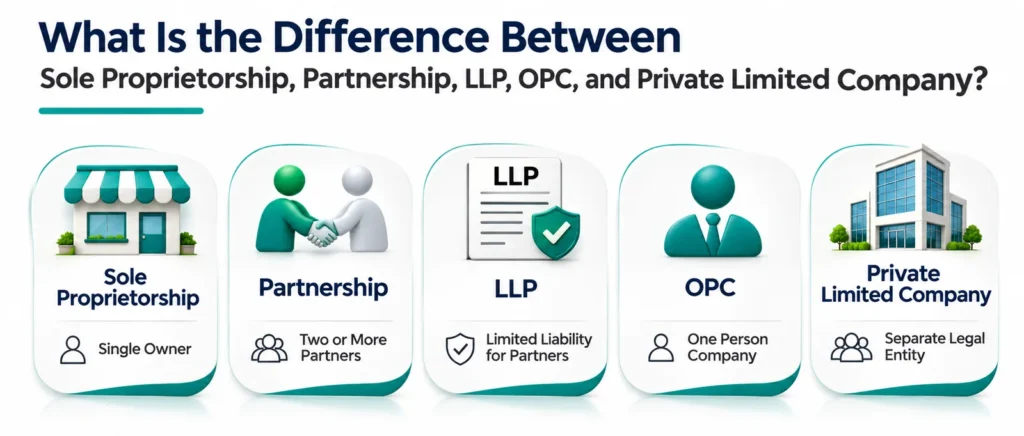
What Is the Difference Between Sole Proprietorship, Partnership, LLP, OPC, and Private Limited Company?
These five business structures differ in ownership, legal identity, personal liability, taxation, registration costs and annual compliance requirements. Understanding these differences helps you choose the right structure before starting a business in India.
1. Sole Proprietorship: A Simple Option for One Owner
A Sole Proprietorship is owned and managed by one individual. It has no separate legal identity, and business income is generally taxed as the owner’s personal income.
Advantages of Sole Proprietorship
- Complete ownership and control.
- No MCA incorporation required.
- Relatively low setup costs.
- Fewer corporate compliance requirements.
- Simple decision-making.
Disadvantages of Sole Proprietorship
- Unlimited personal liability.
- Cannot issue equity shares.
- Restructuring is required to introduce co-owners.
- Business continuity depends on the owner.
Who Should Choose It?
Suitable for freelancers, independent consultants, small traders, home-based entrepreneurs and beginners testing low-risk business ideas with limited investment.
2. Partnership Firm: Two or More People Running a Business Together
A Partnership Firm allows two or more individuals to operate a business and share profits according to a partnership deed, which defines their responsibilities, ownership arrangements and profit-sharing terms.
Advantages of a Partnership Firm
- Relatively simple setup.
- Shared investment, skills and responsibilities.
- Flexible profit-sharing arrangements.
- No MCA company incorporation required.
- Generally lower maintenance costs than a company.
Disadvantages of a Partnership Firm
- Generally unlimited personal liability.
- Partners may be liable for other partners’ business actions.
- Partnership disputes can affect operations.
- Cannot issue equity shares.
Who Should Choose It?
Suitable for small businesses with two or more trusted partners who understand their financial responsibilities. A properly drafted partnership deed is important to prevent ownership and management disputes.
3. Limited Liability Partnership (LLP): A Separate Legal Entity for Partners
An LLP is a separate legal entity registered under the Limited Liability Partnership Act, 2008. It requires at least two partners and two designated partners, with at least one designated partner meeting the Indian residency requirement.
Advantages of an LLP
- Separate legal identity.
- Limited liability under normal circumstances.
- Flexible profit-sharing arrangements.
- No general minimum capital contribution requirement.
- Fewer company-style governance formalities.
Disadvantages of an LLP
- Requires at least two partners.
- Mandatory annual MCA filings.
- Cannot issue equity shares.
- Less suitable for venture capital funding.
Who Should Choose It?
Suitable for consulting agencies, professional firms, technology service providers and partner-led businesses seeking operational flexibility and limited liability.
Our CA and CS team can assist with LLP Registration in India and ongoing compliance.
4. One Person Company (OPC): A Company for a Single Founder
An OPC allows an eligible individual to own 100% of a company while benefiting from a separate legal identity and limited liability. Appointing an eligible nominee is mandatory.
Advantages of an OPC
- Complete ownership for one eligible founder.
- Separate legal identity.
- Limited liability protection under normal circumstances.
- No second shareholder required.
- Formal corporate structure.
Disadvantages of an OPC
- Mandatory annual company filings and statutory audit.
- Appointment of a nominee is required.
- Cannot accommodate multiple shareholders while remaining an OPC.
- Restrictions on certain business activities.
- Conversion is generally required to introduce equity investors.
Who Should Choose It?
Suitable for eligible solo entrepreneurs who want complete ownership, limited liability and a separate corporate identity.
Probay’s CA and CS professionals can assist with One Person Company Registration, documentation and compliance.
5. Private Limited Company: A Common Choice for Growth-Oriented Startups
A regular Private Limited Company is a separate legal entity registered under the Companies Act, 2013. It requires at least two shareholders and two directors, including one director who meets the Indian residency requirement.
Advantages of a Private Limited Company
- Separate legal identity.
- Limited liability under normal circumstances.
- Ability to issue shares and attract investors.
- Structured ownership and management.
- Suitable for business expansion and equity funding.
Disadvantages of a Private Limited Company
- Requires at least two shareholders.
- More incorporation documentation.
- Mandatory statutory audit and annual filings.
- Additional legal responsibilities for directors.
- Generally higher ongoing compliance costs.
Who Should Choose It?
Suitable for technology startups, product-based businesses, growth-focused service providers and entrepreneurs planning to attract investors or expand operations.
Our CA and CS team assists with Private Limited Company Registration, ownership planning and statutory compliance.
Complete Comparison of the Five Business Structures
| Feature | Sole Proprietorship | Partnership | LLP | OPC | Private Limited |
|---|---|---|---|---|---|
| Minimum owners | 1 | 2 | 2 | 1 | 2 |
| Separate legal entity | No | Generally no | Yes | Yes | Yes |
| Personal liability | Unlimited | Generally unlimited | Generally limited | Generally limited | Generally limited |
| MCA incorporation | No | No | Yes | Yes | Yes |
| Registration costs | Generally low | Generally low | Moderate | Moderate | Generally higher |
| Equity shares | No | No | No | Single shareholder | Multiple shareholders |
| External equity funding | Not directly | Not through shares | Not through shares | Requires conversion for multiple shareholders | Suitable |
| Annual MCA filings | No | No | Mandatory | Mandatory | Mandatory |
| Statutory audit | As applicable | As applicable | Subject to applicable thresholds | Required | Required |
| Compliance burden | Generally low | Generally low | Moderate | Moderate | Generally higher |
| Suitable for | Small solo businesses | Small co-owned businesses | Partner-led businesses | Solo company founders | Growth-focused startups |
The best business structure depends on your ownership preferences, investment capacity, financial risks, compliance budget and future expansion plans. Probay’s CA and CS team can help you evaluate these factors before registration.
Want the Easiest Setup With Minimal Annual Compliance? Here Is Which Structure to Pick
Beginners should consider annual compliance costs, legal responsibilities and filing requirements before choosing a business structure. Fewer compliance obligations allow more time and resources for business growth.
Sole Proprietorship: Usually the Simplest for a Solo Beginner
A Sole Proprietorship generally has the fewest corporate compliance requirements and does not require annual MCA filings. However, applicable income tax, GST, TDS, accounting, business licences and tax audit requirements must still be followed.
Partnership Firm: Simple Corporate Compliance but Greater Personal Risk
A Partnership Firm does not require annual MCA filings but must comply with applicable accounting and tax requirements. Partners generally have unlimited personal liability, making it less suitable for businesses involving significant financial risks.
LLP: A Balance Between Protection and Compliance
An LLP offers limited liability and flexible management with mandatory annual MCA filings.
Form 11: Annual Return
Contains LLP and partner details. The usual filing deadline is 30 May.
Form 8: Statement of Account and Solvency
Contains financial information and solvency details. The usual filing deadline is 30 October.
Both deadlines are subject to applicable extensions. Income tax, GST and audit requirements may also apply.
OPC: One Owner, but Company Compliance Still Applies
An OPC offers complete ownership with simplified governance requirements. However, maintaining financial records, statutory audits and annual MCA filings remains mandatory.
Private Limited Company: More Formal Responsibilities
A Private Limited Company generally requires more extensive compliance, including:
- Financial statements and statutory audits.
- Board and shareholder meetings, as applicable.
- Annual MCA filings and statutory records.
- Director-related compliance.
- Applicable income tax and GST filings.
Annual Compliance Comparison for Beginners
| Structure | MCA Annual Filings | Compliance Burden |
|---|---|---|
| Sole Proprietorship | No | Low |
| Partnership Firm | No | Low to moderate |
| LLP | Mandatory | Moderate |
| OPC | Mandatory | Moderate to high |
| Private Limited Company | Mandatory | Generally higher |
Choose a structure that balances compliance costs with financial risk, liability protection and future business requirements.
How Probay’s CA and CS Team Helps You Manage Annual Compliance
Probay’s Chartered Accountants assist with accounting, taxation, financial statements and audit requirements, while our Company Secretaries manage applicable statutory records, MCA filings and corporate compliance.
Our Company Annual Filing Services help business owners manage statutory responsibilities while focusing on business growth.
Want to Raise Funding or Win Big B2B Clients From Day One? Pick This Company Structure
If you plan to attract investors, work with large corporate clients or expand across India, choose a business structure that supports fundraising, ownership changes and long-term growth.
Why a Private Limited Company Is Often Preferred for Equity Funding
A Private Limited Company is generally the most suitable structure for startups seeking equity investment. It allows founders to issue shares, introduce investors, offer employee stock options where eligible and manage ownership changes.
An LLP can receive investment through permitted arrangements but cannot issue equity shares like a company.
Does a Private Limited Company Automatically Attract Investors?
No. Investors evaluate your business model, market potential, financial performance, ownership arrangements, legal compliance and growth opportunities. Company registration provides a suitable legal framework but does not guarantee funding.
Which Structure Is Better for Large B2B Clients?
A Private Limited Company may meet the procurement requirements of many corporate clients. However, LLPs and Sole Proprietorships can also secure B2B contracts depending on vendor eligibility, industry requirements and service quality.
What Corporate Clients May Check Before Giving You Work
| Requirement | Why It Matters |
|---|---|
| Business registration | Verifies legal structure |
| PAN and GST registration, where applicable | Supports tax verification |
| Business bank account | Ensures organised payments |
| Financial statements | Demonstrates financial position |
| Contracts and agreements | Defines business responsibilities |
| Relevant licences | Confirms regulatory compliance |
| Ownership information | Supports due diligence |
| Past projects and references | Demonstrates experience |
Which Structure Should Different B2B Founders Consider?
Technology Startup Seeking Angel Investment
A Private Limited Company is generally suitable for startups planning to raise equity funding.
Two-Person Digital Marketing Agency
An LLP or Private Limited Company may be suitable, depending on ownership, liability and expansion plans.
Independent Business Consultant
A Sole Proprietorship or OPC may be suitable depending on financial risks and client requirements.
Manufacturing Business With Multiple Founders
An LLP or Private Limited Company may offer better liability protection when dealing with significant investments, equipment and contracts.
Product-Based Startup Planning National Expansion
A Private Limited Company supports equity fundraising, structured ownership and business expansion.
How Probay’s CA and CS Team Helps With Growth Planning
Our Chartered Accountants assist with financial planning, capital requirements, taxation and accounting. Our Company Secretaries help with shareholding arrangements, incorporation documents, corporate approvals and statutory compliance.
If you are planning to attract investors or expand your business, Probay’s CA and CS team can assist with Private Limited Company Registration and future corporate requirements.
Starting Small Today: How Easy Is It to Upgrade Your Business Structure Later in India?
You can start with a simple business structure and upgrade as your business grows. However, changing structures may involve new incorporation, asset transfers, contract updates, tax registrations and statutory approvals.
Can a Sole Proprietorship Become a Private Limited Company?
Yes. A proprietor can incorporate a Private Limited Company and transfer existing business operations to it.
The process generally involves:
- Incorporating the new company.
- Deciding shareholders and directors.
- Transferring business assets, liabilities and contracts.
- Reviewing applicable tax and stamp duty implications.
- Updating bank accounts, licences and registrations.
Tax relief may be available subject to applicable conditions.
Can a Partnership Firm Become an LLP?
Yes. An eligible Partnership Firm can convert into an LLP by completing the prescribed documentation, statutory filings and conversion requirements. Existing assets, liabilities and contractual obligations must also be considered.
Can an LLP Become a Private Limited Company?
Yes, subject to applicable legal eligibility and registration requirements. Founders must review ownership arrangements, creditor obligations, documentation, tax implications and existing business contracts.
Can an OPC Become a Private Limited Company?
Yes. An OPC can convert into a Private Limited Company by meeting the minimum shareholder and director requirements and completing the prescribed conversion filings.
The earlier compulsory conversion thresholds of ₹50 lakh paid-up capital and ₹2 crore turnover were removed in 2021.
Business Structure Upgrade Comparison
| Current Structure | Future Structure | Key Requirements |
|---|---|---|
| Sole Proprietorship | Private Limited | Incorporation and business transfer |
| Sole Proprietorship | LLP | LLP formation and business transfer |
| Partnership Firm | LLP | Statutory conversion and partner details |
| Partnership Firm | Private Limited | Applicable registration procedure |
| LLP | Private Limited | Eligibility, ownership, filings and taxation |
| OPC | Private Limited | Additional member, director and conversion filings |
| Private Limited | OPC | Eligibility, ownership consolidation and approvals |
When Should You Consider Changing Your Structure?
Consider upgrading your business structure when:
- Bringing in co-founders or shareholders.
- Raising equity investment.
- Managing increasing financial risks.
- Expanding business operations.
- Meeting corporate client requirements.
- Seeking limited liability protection.
How Probay Helps With Business Structure Changes
Probay’s Chartered Accountants help evaluate financial implications, taxation and asset transfers, while our Company Secretaries assist with ownership restructuring, legal documentation, statutory approvals and conversion filings.
Our CA and CS team helps you determine whether upgrading your business structure is beneficial and manage the transition while meeting applicable legal and financial requirements.
Which Business Structure Is Best for Your Specific Business Idea?
The right business structure depends on your business activities, number of founders, financial risks, investment requirements and future growth plans.
If You Want to Start Freelancing
A Sole Proprietorship is suitable for independent freelancers with limited expenses and financial risks. An OPC may be preferable if you want a separate legal identity and limited liability.
If You Want to Start an Online Store
A Sole Proprietorship may suit small online sellers. An LLP or Private Limited Company may be more appropriate as inventory, financial risks and investment requirements increase. Applicable GST and e-commerce regulations must also be considered.
If You Want to Start a Digital Marketing Agency
Solo founders can consider a Sole Proprietorship or OPC, while multiple founders may choose an LLP or Private Limited Company. A Private Limited Company is generally more suitable for equity funding and expansion.
If You Want to Start a Consulting Firm
An LLP offers operational flexibility and limited liability for two or more consultants. Independent consultants may consider a Sole Proprietorship or OPC.
If You Want to Start a Manufacturing Business
An LLP or Private Limited Company may be suitable for managing machinery investments, supplier contracts and financial risks. However, limited liability does not eliminate personal guarantees or statutory responsibilities.
If You Want to Build a Technology Startup
A Private Limited Company is generally suitable for technology startups seeking investors, employee stock options and future funding rounds. An OPC may suit eligible solo founders who do not initially need additional shareholders.
Business Idea and Structure Matching Table
| Business Idea | Structure to Consider | Main Benefit |
|---|---|---|
| Freelance writing | Sole Proprietorship | Simple ownership |
| Home-based tutoring | Sole Proprietorship | Lower compliance burden |
| Solo software consulting | Sole Proprietorship or OPC | Ownership flexibility |
| Two-person consulting agency | LLP | Limited liability |
| Technology startup | Private Limited Company | Equity funding |
| Small retail shop | Sole Proprietorship or Partnership | Simple operations |
| Growing online product brand | LLP or Private Limited Company | Business expansion |
| Manufacturing startup | LLP or Private Limited Company | Liability protection |
| Single-founder corporate business | OPC | Complete share ownership |
| Multi-founder scalable startup | Private Limited Company | Structured ownership and funding |
These are general recommendations. Probay’s CA and CS team can help you choose a suitable business structure based on your specific requirements, financial capacity and applicable industry regulations.
What Are the Real Costs of Registering and Maintaining Each Business Structure?
The total cost of starting a business includes both initial registration expenses and recurring compliance costs. Beginners should consider both before choosing a business structure.
Initial Registration Expenses
Depending on your business structure, initial expenses may include:
- Digital Signature Certificates (DSCs).
- Name reservation and government filing fees.
- State-specific stamp duty.
- Incorporation documents and professional fees.
- Applicable business licences and registrations.
A Sole Proprietorship does not require MCA incorporation, while LLPs, OPCs and Private Limited Companies require formal incorporation.
Recurring Compliance Expenses
Ongoing business expenses may include:
- Accounting and bookkeeping.
- Income tax and applicable GST filings.
- Statutory audits, where required.
- Annual MCA filings.
- Event-based compliance and statutory records.
- Professional CA and CS assistance.
Why the Cheapest Registration Package May Not Be the Cheapest Choice
An affordable company registration package may come with significant annual compliance expenses. Similarly, choosing a Sole Proprietorship solely to save money may expose your personal assets to business debts.
Compare the total registration and maintenance costs alongside financial risks and legal protection.
How a CA Helps You Estimate the Total Cost
Probay’s Chartered Accountants help estimate taxation, accounting and recurring compliance expenses, while our Company Secretaries explain incorporation costs, statutory filings and governance requirements.
Our CA and CS team helps you choose a financially suitable business structure without unnecessary registration expenses or unexpected compliance costs.
What Documents Do Beginners Need to Register a Business in India?
Business registration documents depend on your chosen legal structure, ownership and business activities.
Common Documents for Company or LLP Incorporation
- PAN, identity and address proofs of applicants.
- Recent photographs, where required.
- Registered office address proof and utility bill.
- Property owner’s consent or NOC, where applicable.
- Digital Signature Certificates (DSCs).
- Proposed business name and activity details.
- Share capital or capital contribution details.
- Applicable declarations and incorporation documents.
Additional documentation may be required for foreign participants and specific business activities.
Do You Need to Own an Office?
No. You can use a residential address as your registered office, subject to applicable documentation, property permissions and local regulations. However, registered office approval does not automatically permit all commercial activities at that location.
How Probay’s CA and CS Team Assists With Documentation
Probay’s CA and CS team helps review documents, plan ownership, prepare incorporation paperwork and complete applicable MCA filings, reducing avoidable registration delays.
Beginners can also learn How to Start a Company in India Without Getting Trapped in Legal Paperwork before beginning the registration process.
Can You Register a Company in India Without a Business Partner?
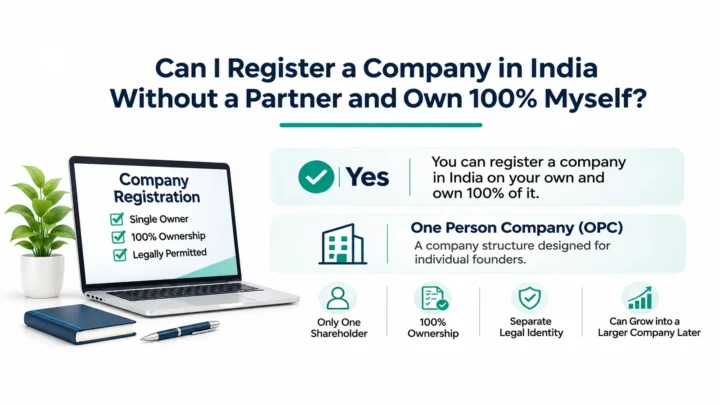
Yes. A Sole Proprietorship allows independent business ownership, while an eligible individual can register a One Person Company (OPC) as a separate legal entity. A regular Private Limited Company requires at least two shareholders.
What if You Want to Own 100% of Your Company?
An OPC allows an eligible founder to retain 100% share ownership without a business partner. However, appointing an eligible nominee and meeting annual compliance requirements remain mandatory. Introducing additional shareholders requires conversion into a suitable company structure.
Can You Own 99% of a Private Limited Company?
Yes. One shareholder can own 99% of the shares while another holds 1%, subject to applicable legal requirements. However, the second shareholder retains legal rights associated with their shares.
Probay’s CA and CS team helps you understand shareholding, voting rights, ownership arrangements and compliance requirements before incorporation.
Learn more about single-founder ownership in Can I Register a Company in India Without a Partner?.
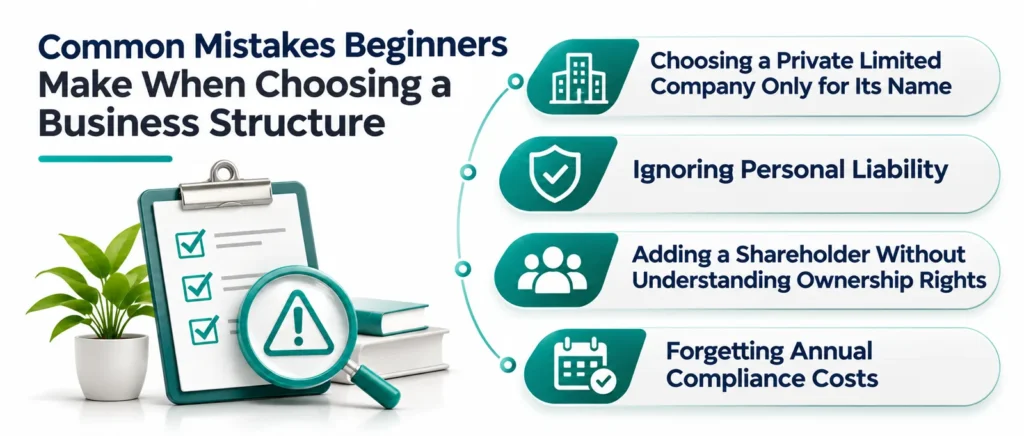
Common Mistakes Beginners Make When Choosing a Business Structure
Choosing a business structure based solely on recommendations, competitor choices or low registration fees can lead to unnecessary financial and legal complications.
Choosing a Private Limited Company Only for Its Name
A Private Limited Company is not necessary for every business. Beginners testing low-risk business ideas may benefit from a simpler structure with lower compliance costs.
Ignoring Personal Liability
Sole Proprietorships and traditional Partnership Firms generally have unlimited personal liability, which can expose personal assets to business debts and contractual obligations.
Adding a Shareholder Without Understanding Ownership Rights
Shareholders have legal, financial and voting rights. Understand the implications of share allocation before introducing another shareholder.
Forgetting Annual Compliance Costs
Companies and LLPs have mandatory recurring filing requirements. Failing to budget for annual compliance can result in unexpected expenses, additional fees and legal complications.
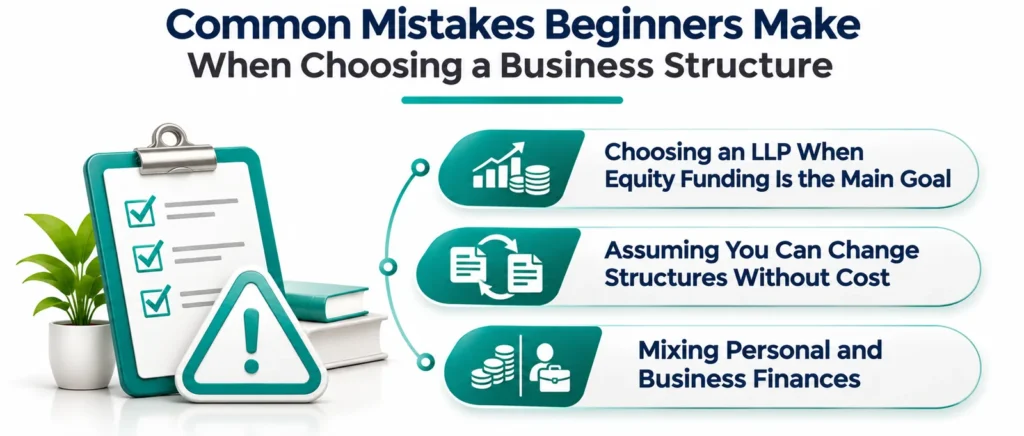
Choosing an LLP When Equity Funding Is the Main Goal
An LLP is suitable for many partner-led businesses, but a Private Limited Company is generally more appropriate for startups planning to raise equity funding and attract shareholders.
Assuming You Can Change Structures Without Cost
Changing your business structure may involve legal filings, tax implications, contract updates and asset transfer expenses. Consider your future business requirements before registration.
Mixing Personal and Business Finances
Maintain separate business and personal financial records for accurate accounting, tax reporting and financial planning. This separation is especially important for LLPs and incorporated companies.
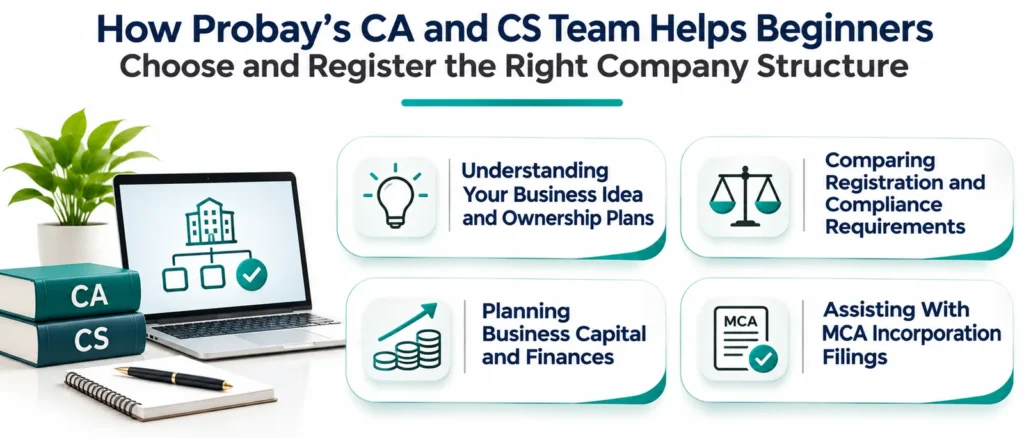
How Probay’s CA and CS Team Helps Beginners Choose and Register the Right Company Structure
Probay’s Chartered Accountants and Company Secretaries help first-time entrepreneurs choose a suitable business structure, plan finances, prepare registration documents and understand ongoing legal responsibilities.
1. Understanding Your Business Idea and Ownership Plans
Our team evaluates your business activities, number of founders, investment requirements, ownership preferences and future expansion plans to identify a suitable business structure.
2. Comparing Registration and Compliance Requirements
We help you compare Sole Proprietorship, Partnership, LLP, OPC and Private Limited Company based on ownership, legal identity, liability protection, registration costs and annual compliance requirements.
3. Planning Business Capital and Finances
Our Chartered Accountants help estimate startup expenses, working capital requirements, tax obligations and accounting costs, helping you avoid unnecessary registration expenses.
4. Assisting With MCA Incorporation Filings
Our CA and CS team assists with company name selection, ownership details, capital structure, registered office documentation, incorporation forms and applicable MCA filings.
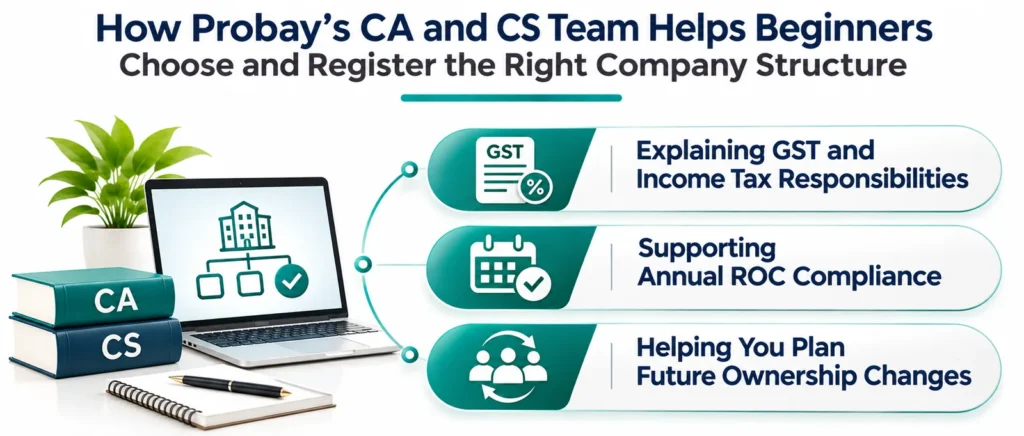
5. Explaining GST and Income Tax Responsibilities
Our Chartered Accountants help you understand income tax treatment, applicable GST registration, tax filing requirements and financial responsibilities based on your chosen business structure.
6. Supporting Annual ROC Compliance
Our CA and CS team assists with statutory records, annual MCA filings and compliance planning for companies and LLPs through our Company Annual Filing Services and applicable LLP compliance services.
7. Helping You Plan Future Ownership Changes
Our Company Secretaries assist with director appointments, partner changes, share issuance and business restructuring, while our Chartered Accountants help evaluate the associated financial and tax implications.
Company Registration Support in Delhi NCR
If you are planning to start a business in Delhi NCR, Probay also provides location-focused company registration information.
Entrepreneurs in the capital can explore Company Registration in Delhi, while founders in nearby business centres can learn about Company Registration in Noida and Company Registration in Ghaziabad.
The central incorporation laws are broadly the same across India, but state-specific stamp duty, local licences, and certain registration requirements may differ.
A Simple Checklist Before You Choose Your Business Structure
Before spending money on registration, answer these questions.
- Will I start the business alone or with someone else?
- How much money can I invest without affecting essential personal expenses?
- What financial risks will my business face?
- Do I need a separate legal entity?
- Do I plan to raise equity funding?
- Will my customers require a particular business structure?
- Can I afford annual accounting and compliance costs?
- Do I understand how business profits will be taxed?
- Will I need to add partners or shareholders later?
- Have I checked which licences and registrations my activities require?
- Have I discussed my plans with a qualified CA or CS?
If you cannot answer several of these questions, you may not yet have enough information to select a structure confidently.
That does not mean you should delay your business indefinitely. It means you should understand the main financial and legal consequences before making a commitment.
Frequently Asked Questions About the Best Company Structure for Beginners in India
1. Which is the best company structure for beginners in India?
A Sole Proprietorship suits small solo businesses, an LLP suits partner-led businesses, an OPC suits eligible single founders seeking limited liability, and a Private Limited Company suits growth-oriented startups seeking equity investment.
2. Which business structure is the cheapest to start in India?
A Sole Proprietorship is generally the least expensive because it does not require MCA incorporation. However, applicable licences and registrations may involve costs.
3. Can I start a business in India with ₹50,000?
Yes. Many small service businesses can start with ₹50,000 or less. Choose a suitable structure and preserve sufficient working capital for operations.
4. Is an LLP better than a Private Limited Company for beginners?
An LLP offers flexible management and generally fewer governance requirements, while a Private Limited Company is more suitable for equity funding and shareholder-based expansion.
5. Is a Sole Proprietorship legally valid in India?
Yes. It is a recognised business structure, although it does not have a separate legal identity. Applicable tax, registration and licensing requirements must still be followed.
6. Can one person register a Private Limited Company in India?
A regular Private Limited Company requires at least two shareholders. However, an eligible individual can register a One Person Company (OPC).
7. Does an OPC need a second shareholder?
No. An OPC requires only one shareholder and an eligible nominee. The nominee does not automatically receive shares or ownership rights.
8. Is there a minimum capital requirement to register a Private Limited Company?
There is no general statutory minimum paid-up capital requirement. However, registration expenses, stamp duty and sector-specific capital requirements may apply.
9. Which structure has the lowest annual compliance?
A Sole Proprietorship generally has the lowest corporate compliance burden, although applicable income tax, GST and accounting obligations remain.
10. Can an LLP raise funds from investors?
Yes, through legally permitted funding arrangements. However, an LLP cannot issue equity shares like a Private Limited Company.
11. Is GST registration compulsory for every new business?
No. GST registration depends on turnover, business activities, location and applicable compulsory-registration provisions.
12. Can I use my home address to register a company?
Yes, subject to applicable address documentation, property permissions and local regulations.
13. Can I change my Sole Proprietorship into a Private Limited Company later?
Yes. You can incorporate a Private Limited Company and transfer existing business operations, subject to applicable legal, tax and regulatory requirements.
14. Does a Private Limited Company have to pay tax if it makes no profit?
A company with no taxable income may have no income tax liability, subject to applicable tax provisions. However, accounting, audit and statutory filing obligations remain.
15. Can I register a company without hiring a CA or CS?
You can complete certain registration steps independently, but some incorporation forms require professional certification. A qualified CA or CS can help manage documentation and reduce avoidable errors.
16. Which business structure is best for a digital marketing agency?
Solo founders may consider a Sole Proprietorship or OPC, while agencies with multiple founders may choose an LLP or Private Limited Company.
17. Which structure is best for an online selling business?
A Sole Proprietorship may suit small online sellers, while an LLP or Private Limited Company may support larger operations, multiple founders and investment plans.
18. Can an OPC be converted into a Private Limited Company?
Yes. An OPC can convert by meeting applicable shareholder, director and statutory filing requirements. The former compulsory conversion thresholds were removed in 2021.
19. Do LLPs and Private Limited Companies need annual filings even without business activity?
Yes. LLPs and companies generally have mandatory annual statutory filing obligations, even without active business operations.
20. How can Probay’s CA and CS team help me choose the right structure?
Probay’s Chartered Accountants and Company Secretaries help you compare business structures, estimate registration costs, understand taxation, plan ownership and manage ongoing compliance based on your business goals.
Choose a Business Structure That Supports Your Business, Not Just Its Registration
The best company structure for beginners in India is one that matches your budget, ownership preferences, financial risks, compliance capacity and future growth plans.
A Sole Proprietorship may suit small businesses, an LLP may suit partner-led firms, an OPC may suit eligible solo founders, and a Private Limited Company may suit startups seeking equity investment.
Choose a structure that supports long-term business growth rather than focusing solely on registration costs or popularity.
Start Your Business With the Right Legal Structure and Professional Guidance
Still unsure whether a Sole Proprietorship, LLP, OPC or Private Limited Company is right for you? Share your business idea, budget and future plans with Probay’s CA and CS team. We’ll help you choose a suitable structure before you spend money on registration.