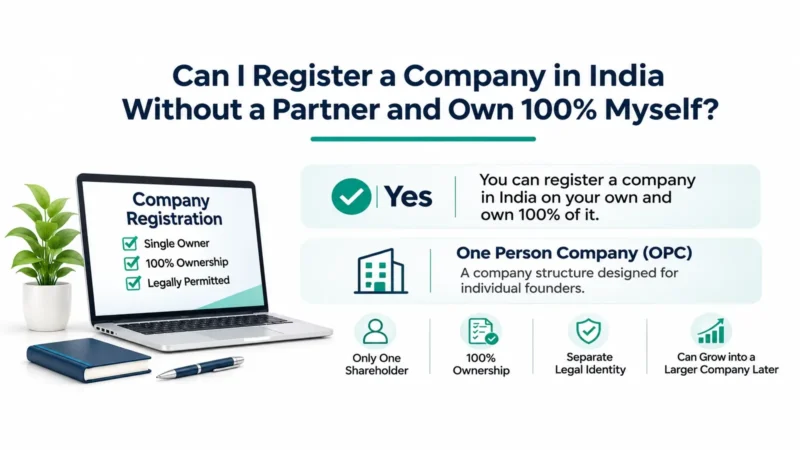
Yes, you can register a company in India without a partner and retain 100% ownership by establishing a One Person Company (OPC) under the Companies Act, 2013, provided you meet the eligibility requirements.
Unlike a regular Private Limited Company, which requires at least two shareholders and two directors, an OPC allows you to become the sole shareholder without sharing ownership with friends or family members. A Sole Proprietorship also offers complete ownership but does not provide a separate legal identity.
At Probay, our team of Chartered Accountants (CAs) and Company Secretaries (CSs) helps you choose the right business structure, complete company registration and manage ongoing legal, tax and ROC compliance while retaining full ownership of your business.
Can I Legally Register a Company in India Without a Partner?
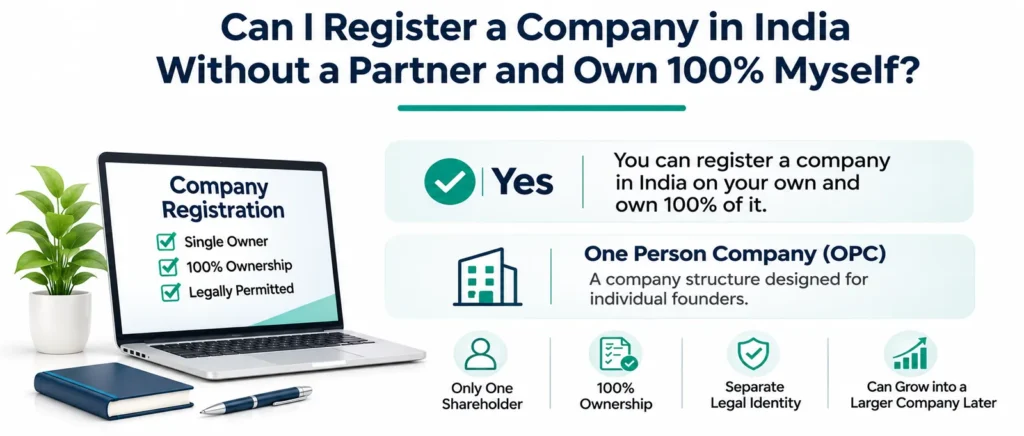
Yes. Under the Companies Act, 2013, an eligible individual can register a One Person Company (OPC), own 100% of its shares and act as its director without bringing in a business partner.
For example, if you have ₹3 lakh in savings and want to start a digital marketing agency independently, an OPC allows you to operate through a separate legal entity while retaining complete ownership.
Although appointing an eligible nominee is mandatory, the nominee does not automatically receive shares or ownership rights. They become the company’s member only if you die or become incapable of entering into a contract, as provided under applicable law.
Therefore, you can legally register a company in India without a partner and retain full ownership through an OPC.
What Does Owning 100% of a Company Actually Mean?
Owning 100% of a company means holding all its issued shares. For example, if your OPC has 10,000 equity shares, you can own every share without sharing ownership.
| Particulars | Details |
|---|---|
| Total issued shares | 10,000 |
| Shares owned by you | 10,000 |
| Shares owned by another person | 0 |
| Your ownership percentage | 100% |
| Number of shareholders | 1 |
| Minimum directors required | 1 |
| OPC nominee required | Yes |
As the sole shareholder, you retain all shareholder rights. However, an OPC is a separate legal entity, so its finances, assets, liabilities and statutory obligations must remain separate from your personal affairs.
Can I Make All Business Decisions Myself?
Yes. As the sole shareholder and director of an OPC, you can independently make business, investment and management decisions, subject to applicable laws and company documents.
However, certain decisions still require formal resolutions, accounting records or statutory filings. Probay’s CA and CS team can help you manage these requirements while retaining complete ownership and control of your company.
Which Business Structures Allow 100% Ownership in India?
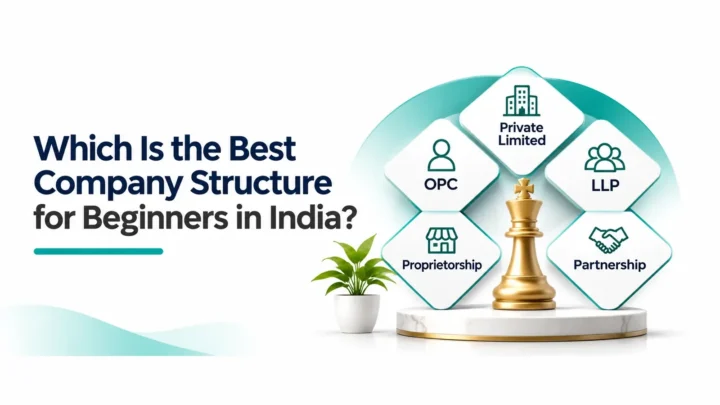
A Sole Proprietorship and a One Person Company (OPC) allow an individual to retain 100% business ownership. However, only an OPC provides a separate incorporated legal entity. A regular Private Limited Company or LLP requires at least two members or partners.
Comparison of Business Structures for Solo Entrepreneurs
| Feature | Sole Proprietorship | One Person Company | Private Limited Company | LLP |
|---|---|---|---|---|
| Minimum owners or members | 1 | 1 | 2 | 2 |
| 100% individual ownership | Yes | Yes | Not ordinarily | No |
| Separate legal entity | No | Yes | Yes | Yes |
| Limited liability | No | Generally yes | Generally yes | Generally yes |
| Minimum directors | Not applicable | 1 | 2 | Not applicable |
| Minimum designated partners | Not applicable | Not applicable | Not applicable | 2 |
| MCA incorporation | No | Yes | Yes | Yes |
| Annual ROC filings | No | Yes | Yes | LLP filings apply |
| Suitable for | Individual businesses | Solo founders | Growth-oriented businesses | Businesses with partners |
A Sole Proprietorship may suit freelancers and small individual businesses, while an OPC offers separate legal identity and complete ownership. A Private Limited Company may be more practical for founders planning to raise equity investment.
Probay’s CA and CS team can help you choose a suitable business structure based on ownership, taxation, legal responsibilities, compliance costs and future growth plans.
What Is a One Person Company and How Does It Work?
A One Person Company (OPC) is a business structure introduced under the Companies Act, 2013, that allows an eligible individual to register a company without a second shareholder and retain 100% ownership.
As an OPC owner, you can hold all the shares and act as the company’s director. However, the company has a separate legal identity, meaning its contracts, assets, revenue and liabilities belong to the company rather than you personally.
This structure allows solo entrepreneurs to maintain complete ownership while enjoying the benefits of an incorporated company.
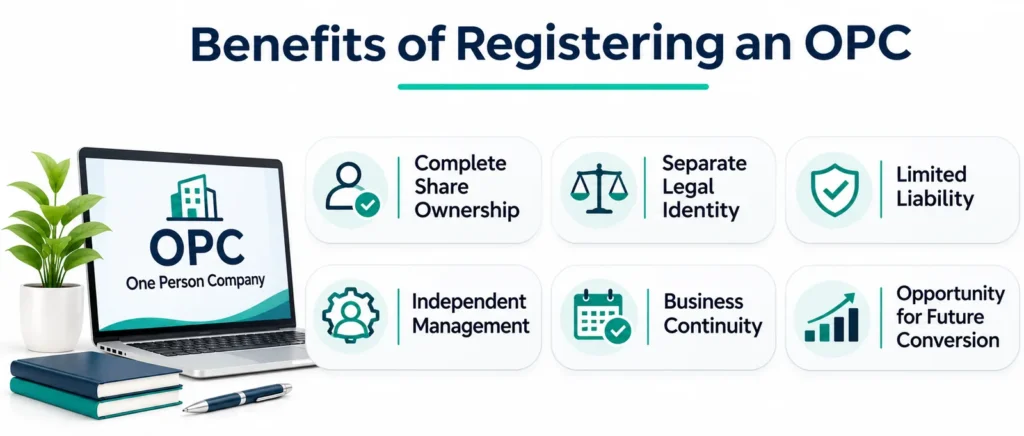
Benefits of Registering an OPC
1. Complete Share Ownership
You can own 100% of the company’s issued shares without involving another shareholder, allowing you to retain complete business ownership.
2. Separate Legal Identity
An OPC can own assets, enter into contracts, open a bank account and conduct business in its own name, independently of its shareholder.
3. Limited Liability
Your liability is generally limited to the unpaid amount on your shares, if any. However, personal guarantees, fraud and certain statutory obligations may create personal liability.
4. Independent Management
You can act as the sole shareholder and director, managing your company independently without appointing a second director, subject to applicable legal and residency requirements.
5. Business Continuity
The mandatory nominee arrangement ensures a mechanism for ownership succession under specified circumstances without giving the nominee immediate ownership rights.
6. Opportunity for Future Conversion
You can convert an OPC into a regular Private Limited Company by following the applicable legal procedure when you want to introduce additional shareholders or investors.
Disadvantages of Registering an OPC
An OPC requires proper accounting records, financial statements, statutory audits, tax compliance and annual ROC filings. You cannot add another shareholder without converting the company, and certain activities, including specified non-banking financial investment activities, are restricted.
If you plan to bring in investors, conversion may involve additional costs and paperwork. Probay’s CA and CS team can help you evaluate these limitations and compliance responsibilities before registration.
Who Is Eligible to Register a One Person Company in India?
An OPC can be registered by an eligible Indian citizen, whether residing in India or abroad. Only a natural person can become an OPC member, not another company, LLP or organisation.
OPC Eligibility Requirements
| Requirement | Applicable Rule |
|---|---|
| Citizenship | Indian citizen |
| Residential status | Resident or non-resident Indian citizen |
| Age | Must be an adult |
| Type of member | Natural person |
| Maximum OPC memberships | One at a time |
| Nominee | Eligible nominee required |
| Business activity | Must be legally permitted |
| Legal capacity | Must satisfy applicable legal requirements |
Can an NRI Register an OPC in India?
Yes. A non-resident Indian citizen can register an OPC and retain 100% ownership. However, director residency, banking, taxation and foreign exchange requirements must be considered.
Every company generally requires at least one director who has stayed in India for 182 days during the financial year, with proportional requirements for newly incorporated companies. An NRI may need to appoint another eligible director without giving them shares.
Probay’s CA and CS team can help you manage these requirements.
Can a Woman Register a Company Without Her Husband?
Yes. An eligible woman entrepreneur can register an OPC, own 100% of its shares and act as its director without involving her husband, family members or a male business partner.
Can a Salaried Employee Register an OPC?
Yes, subject to applicable employment conditions. Check your employment agreement for restrictions on outside businesses, competing activities and additional directorships. Government employees and individuals in regulated professions may face further restrictions.
Do I Need a Partner, Nominee, or Second Director for an OPC?
An OPC requires an eligible nominee but does not require a business partner, second shareholder or ordinarily a second director. Appointing additional directors or hiring professionals does not mean sharing company ownership.
Difference Between a Shareholder, Director, Partner, and Nominee
| Role | Main Responsibility | Automatically Owns Company Shares? |
|---|---|---|
| Shareholder | Holds company shares | Yes |
| Director | Manages company affairs | No |
| OPC nominee | Becomes a member in specified circumstances | No |
| LLP partner | Participates under the LLP agreement | Not applicable |
| Chartered Accountant | Accounting, taxation, audit and advisory | No |
| Company Secretary | Company law and corporate compliance | No |
You can retain 100% ownership while appointing additional directors or engaging CA and CS professionals.
Can My Brother, Sister, or Spouse Be My OPC Nominee?
Yes, provided they meet the eligibility requirements and give the prescribed consent. A nominee does not automatically receive shares, voting rights or company profits during your membership.
Can I Change My OPC Nominee Later?
Yes. You can change your nominee by obtaining the necessary consent and completing applicable statutory filings within the prescribed timelines. Probay’s Company Secretaries can assist with the entire process.
Can I Register a Private Limited Company and Own 100% of It?
A regular Private Limited Company requires at least two members at incorporation. Therefore, you cannot ordinarily become its sole shareholder, but you can retain majority ownership by holding 99% or even 99.99% of its shares.
Example of 99% Ownership in a Private Limited Company
Suppose your company issues 10,000 equity shares.
| Shareholder | Number of Shares | Ownership Percentage |
|---|---|---|
| You (Founder) | 9,900 | 99% |
| Second Shareholder | 100 | 1% |
| Total | 10,000 | 100% |
You retain significant voting control, but the second shareholder has legal rights. Company decisions must comply with the Companies Act, Articles of Association and applicable shareholder agreements.
Can I Give Someone Only One Share?
Yes. Subject to applicable law, you can hold 9,999 out of 10,000 shares, giving you 99.99% ownership. However, even a single share carries legal rights, which you should understand before finalising ownership.
Can My Wife or Father Become the Second Shareholder?
Yes. An eligible family member can become a genuine shareholder. However, you must consider their shareholder rights, potential disagreements, share transfers and ownership succession.
Probay’s Private Limited Company Registration Services can help you understand shareholding arrangements, ownership rights and incorporation requirements before registering your company.
Is an OPC Better Than a Private Limited Company for a Solo Founder?
An OPC is suitable for solo founders who want 100% ownership without introducing additional shareholders. A regular Private Limited Company may be more practical if you plan to raise equity investment or bring in co-founders. Both structures offer separate legal identities and require ongoing statutory compliance.
OPC vs Private Limited Company
| Factor | One Person Company | Regular Private Limited Company |
|---|---|---|
| Minimum shareholders | 1 | 2 |
| Minimum directors | 1 | 2 |
| 100% individual share ownership | Yes | Not ordinarily |
| Nominee required | Yes | No OPC-style nominee |
| Separate legal entity | Yes | Yes |
| Statutory audit | Generally required | Generally required |
| Annual ROC compliance | Required | Required |
| Additional shareholders | Requires conversion | Permitted, subject to law |
| Outside equity investment | Requires conversion | Generally more suitable |
Example: Starting a Digital Marketing Agency Alone
If you have ₹2 lakh to start an SEO, website development or digital marketing agency without outside investors, an OPC may be suitable for retaining complete ownership. However, a Sole Proprietorship may be more economical if you are still testing your business idea.
Example: Starting a Technology Startup
If you plan to raise investment or issue shares to employees and future co-founders, a Private Limited Company may be more practical, provided you have at least two genuine shareholders.
Probay’s CA and CS team can help you compare registration costs, annual compliance expenses, ownership requirements and future investment opportunities before choosing a business structure.
Is a Sole Proprietorship Better If I Want to Own My Business Alone?
A Sole Proprietorship is one of the simplest business structures in India, allowing you to retain 100% ownership without another shareholder, partner or director. However, it does not provide a separate legal identity, meaning you and your business are legally the same person.
Advantages of a Sole Proprietorship
A Sole Proprietorship involves fewer registration and compliance formalities, no annual ROC filings, and no nominee or corporate board requirements. It is suitable for freelancers, small service providers, shop owners and entrepreneurs testing new business ideas.
Disadvantages of a Sole Proprietorship
The main disadvantage is unlimited personal liability, meaning your personal assets may be at risk if the business cannot meet its financial obligations. The absence of a separate corporate identity can also make equity investment, ownership transfers and business expansion more complicated.
OPC vs Sole Proprietorship: Which Costs Less?
A Sole Proprietorship generally has lower compliance costs because it does not require company incorporation or annual ROC filings. An OPC involves formal accounting, statutory audits and corporate compliance expenses.
Probay’s CA and CS team can help you compare registration costs, annual expenses, liability risks and compliance requirements before choosing the right structure.
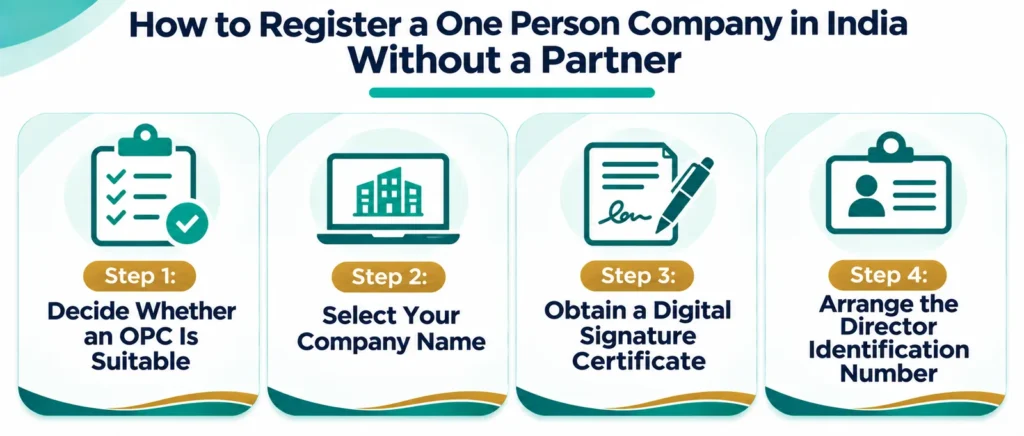
How to Register a One Person Company in India Without a Partner
OPC registration is completed online through the Ministry of Corporate Affairs (MCA) using SPICe+ and applicable linked forms. Accurate documentation and professional assistance can help simplify the process.
Step 1: Decide Whether an OPC Is Suitable
Consider your business activities, expected revenue, liability risks and future investment plans. An OPC is suitable for retaining 100% ownership, while a Private Limited Company may be preferable if you expect outside investors. Probay’s CA and CS team can help you choose the right structure.
Step 2: Select Your Company Name
Choose a unique company name that complies with MCA naming rules and does not conflict with existing company names or protected trademarks. Our CS team can assist with name verification, the required OPC designation and name reservation.
Step 3: Obtain a Digital Signature Certificate
A Digital Signature Certificate (DSC) is required to electronically sign applicable incorporation documents. The required signatories must obtain valid DSCs through identity verification and supporting documentation.
Step 4: Arrange the Director Identification Number
A Director Identification Number (DIN) identifies an individual serving as a company director. You can apply for a DIN through the incorporation process where permitted or provide your existing valid DIN.
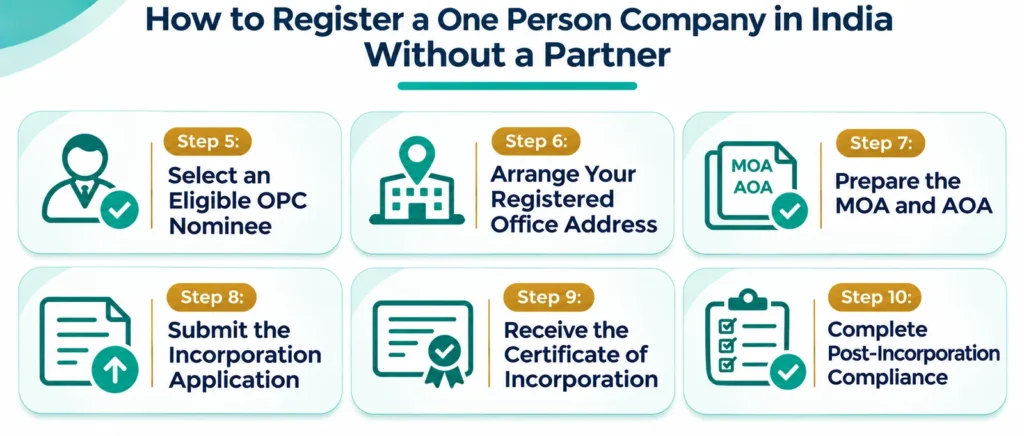
Step 5: Select an Eligible OPC Nominee
Choose an eligible nominee who provides the prescribed consent and supporting documents. The nominee does not automatically become a shareholder or business partner. Our CS team can assist with nomination formalities.
Step 6: Arrange Your Registered Office Address
You can use a residential or commercial address that meets statutory requirements. Required documents may include address proof, a utility bill, rental documents and the property owner’s no-objection certificate (NOC).
Step 7: Prepare the MOA and AOA
The Memorandum of Association (MOA) defines the company’s objectives, while the Articles of Association (AOA) govern its internal management. Probay’s CS team can prepare and review these documents according to your business activities and legal requirements.
Step 8: Submit the Incorporation Application
Submit SPICe+ and applicable linked forms covering company name, director details, nominee particulars, PAN, TAN and other integrated registrations. Our CA and CS team assists with documentation, application filing and professional certification where applicable.
Step 9: Receive the Certificate of Incorporation
Once approved, the ROC issues the Certificate of Incorporation and Corporate Identity Number (CIN). PAN and TAN are generally allotted through the integrated process, confirming the company’s legal incorporation.
Step 10: Complete Post-Incorporation Compliance
Open a company bank account, deposit subscribed share capital, appoint the first auditor, issue share certificates and maintain statutory records. File INC-20A within 180 days of incorporation where applicable.
Probay’s CA and CS team can help you complete these formalities and manage statutory deadlines.
What Documents Are Required to Register an OPC?
The exact document requirements depend on the applicant, nominee, registered office, and proposed company activities.
The following table covers commonly required information.
| Document or Information | Purpose |
|---|---|
| PAN of proposed member | Identity and tax verification |
| Aadhaar or other accepted identification | Identity verification |
| Residential address proof | Personal address verification |
| Photograph | Applicant identification, where required |
| Email address and mobile number | Registration communication |
| Digital Signature Certificate | Electronic signing |
| Existing DIN, if applicable | Director identification |
| Nominee identity proof | Nominee verification |
| Nominee address proof | Nominee verification |
| Nominee consent | Required OPC nomination |
| Registered office address proof | Company address verification |
| Property owner’s NOC | Permission to use the address, where applicable |
| Proposed company name | Name reservation |
| Business activity details | Preparation of company objects |
| Capital details | Proposed share capital structure |
| MOA and AOA | Constitutional documents |
Incorrect names, inconsistent addresses, incomplete declarations, and unsuitable documents can cause filing delays.
Our CA and CS team can help review the information before submission.
How Much Does It Cost to Register an OPC in India?
OPC registration costs depend on the registered-office state, share capital, MCA charges, stamp duty, DSC charges and professional fees. The total cost varies according to your business requirements.
OPC Registration Cost Components
| Expense | What It Covers |
|---|---|
| Digital Signature Certificate | Electronic document signing |
| Name reservation | Company name approval |
| MCA filing charges | Applicable government fees |
| Stamp duty | State-specific charges |
| Professional fees | CA and CS registration assistance |
| Registered office documentation | Address-related documents |
| Additional licences | Applicable business permissions |
| Post-incorporation services | Initial accounting and statutory compliance |
Always check which services are included in your registration package and which require additional payment.
Is ₹1 Lakh Minimum Capital Required for OPC Registration?
No. An ordinary OPC limited by shares has no statutory minimum paid-up capital requirement of ₹1 lakh. However, you must determine its authorised and subscribed capital while keeping sufficient funds for business operations.
Our Chartered Accountants can help you understand share capital, business expenses, company loans and personal investments.
Are Registration Costs and Annual Compliance Costs Different?
Yes. Registration costs are generally one-time incorporation expenses, while annual compliance costs include accounting, statutory audits, income-tax returns, ROC filings and other applicable services.
Probay’s CA and CS team can help you estimate both expenses before registration, allowing you to plan your business budget effectively.
What Taxes Will I Pay If I Own 100% of an OPC?
An OPC is taxed as a domestic company, while Sole Proprietorship income is generally taxed as the proprietor’s personal business income. Even with 100% ownership, your OPC’s income remains separate from your personal income.
Tax Differences Between an OPC and a Sole Proprietorship
| Tax Matter | OPC | Sole Proprietorship |
|---|---|---|
| Income tax | Domestic company taxation | Individual income taxation |
| PAN | Separate company PAN | Proprietor’s PAN |
| GST registration | As per applicable GST rules | As per applicable GST rules |
| Accounting records | Company accounting requirements | Applicable business and tax records |
| Statutory company audit | Required | Not applicable |
| Tax audit | Subject to tax provisions | Subject to tax provisions |
| Owner’s withdrawals | Lawful company payments | Proprietor’s drawings |
Can I Transfer All My OPC Profits to My Personal Bank Account?
No. Company funds and personal finances must remain separate. Payments to yourself must be properly recorded as director remuneration, dividends, genuine expense reimbursements or other lawful transactions.
For example, if your OPC earns ₹10 lakh and incurs ₹6 lakh in expenses, the remaining ₹4 lakh is not automatically your personal income. Our Chartered Accountants can help calculate taxable profits and manage lawful withdrawals.
Is GST Registration Mandatory for an OPC?
No. GST registration depends on turnover, business activities, location and applicable compulsory-registration provisions. Certain businesses may require registration even below the standard turnover threshold.
Probay’s CA team can help determine your GST obligations and manage applicable tax compliance requirements.
What Annual Compliance Is Required for an OPC?
An OPC must maintain accounting records, prepare financial statements, complete statutory audits and meet applicable tax and ROC filing requirements. Although an OPC enjoys certain compliance relaxations, it is not exempt from annual compliance.
Important Annual Compliance Requirements
| Compliance | What It Means | When Required |
|---|---|---|
| Bookkeeping | Recording income and expenses | Throughout the year |
| Financial statements | Preparing financial reports | Annually |
| Statutory audit | Audit by an eligible auditor | Annually |
| AOC-4 | Filing financial statements with ROC | Within applicable deadline |
| MGT-7A | Filing annual returns | Annually |
| Income tax return | Filing company tax returns | Annually |
| TDS compliance | Tax deduction, payment and reporting | When applicable |
| GST returns | Filing GST returns | When applicable |
| Statutory records | Maintaining company records | Ongoing |
| Event-based filings | Reporting company changes | When applicable |
Does an OPC Need Annual Filing Even Without Income?
Yes. An OPC must complete applicable annual ROC filings and statutory compliance even if it has no customers, revenue or business activity.
Does an OPC Need a Chartered Accountant?
An OPC requires a statutory audit by an eligible and independent auditor. A Chartered Accountant can also assist with bookkeeping, financial statements, tax calculations and income-tax returns, subject to applicable professional restrictions.
Does an OPC Need a Company Secretary?
An OPC is generally not required to appoint a full-time Company Secretary merely because it is incorporated. However, professional CS assistance helps manage ROC filings, statutory registers, director-related documentation and corporate compliance.
Probay’s Company Annual Filing Services help OPC owners manage ongoing statutory obligations and compliance deadlines.
Can I Convert My OPC Into a Private Limited Company Later?
Yes. You can convert an OPC into a regular Private Limited Company by following the applicable legal procedure. This allows you to introduce additional shareholders, co-founders or equity investors without closing your existing company.
When Should I Consider OPC Conversion?
Consider conversion when you want to raise equity investment, introduce co-founders, issue shares to additional owners or restructure ownership for business expansion.
Conversion is not mandatory simply because your business becomes profitable. The earlier compulsory conversion thresholds based on capital and turnover were removed through the 2021 amendments.
What Happens to My Ownership After Conversion?
Your ownership depends on the new shareholding arrangement.
| Shareholder | Ownership After Conversion |
|---|---|
| You (Founder) | 90% |
| New Shareholder | 10% |
| Total | 100% |
You can retain majority ownership but will no longer own 100% of the company once another shareholder acquires shares.
Probay’s CA and CS team can assist with OPC conversion, shareholding arrangements, statutory filings and applicable accounting and tax requirements.
Can I Register an LLP Without a Partner?
No. Under the Limited Liability Partnership Act, 2008, an LLP requires at least two partners. Although it offers a separate legal identity and generally provides limited liability protection, it cannot be registered by a single individual.
Can I Control Most of an LLP?
Yes. An LLP agreement can establish unequal capital contributions, profit-sharing ratios and management responsibilities. However, the second partner must be genuine, and a 99% profit-sharing arrangement is not equivalent to owning 99% of a company’s equity.
Probay’s LLP Registration Services can help you understand partnership arrangements, ownership rights and applicable legal requirements.
Can I Register an OPC Using My Home Address?
Yes. You can use your residential address as an OPC registered office without renting commercial space, provided you have the required documents and permissions. However, certain commercial activities at residential properties may require separate local approvals.
Can I Register an OPC in Delhi?
Yes. Eligible founders can register an OPC in Delhi by providing the required address documents and completing MCA incorporation formalities. Applicable stamp duty and local requirements may affect registration costs.
Probay’s Company Registration Services in Delhi can help simplify the process.
Can I Register an OPC in Noida?
Yes. You can register an OPC in Noida under central company law, subject to applicable Uttar Pradesh stamp duty and local requirements. Our Company Registration Services in Noida assist with documentation and incorporation.
Can I Register an OPC in Ghaziabad?
Yes. Eligible individuals can register an OPC in Ghaziabad by providing valid registered-office documents and completing MCA formalities. Probay’s Company Registration Services in Ghaziabad can help you manage these requirements.
Can My Company Serve Customers Outside Its Registered City?
Yes. An OPC registered in Delhi, Noida or Ghaziabad can serve customers across India. However, additional registrations, licences or approvals may apply depending on your business activities and operational locations.
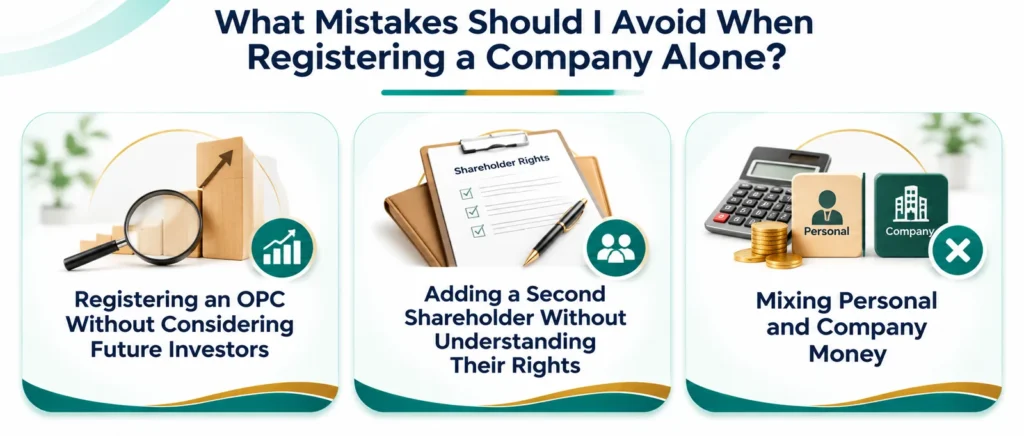
What Mistakes Should I Avoid When Registering a Company Alone?
Starting a company independently gives you greater ownership control, but avoiding common legal and financial mistakes can prevent unnecessary expenses and compliance complications.
Registering an OPC Without Considering Future Investors
If you plan to raise equity investment soon, consider whether an OPC is the right structure. Converting an OPC later involves additional legal procedures, costs and documentation.
Adding a Second Shareholder Without Understanding Their Rights
Adding a family member or friend as a second shareholder gives them legal shareholder rights, even if they hold only one share. Our CS team can help you understand these implications before finalising ownership.
Mixing Personal and Company Money
Keep personal and company finances separate and maintain accurate transaction records. Improper use of company funds can create tax, accounting and compliance problems. Consult our CA team before making unusual financial transactions.
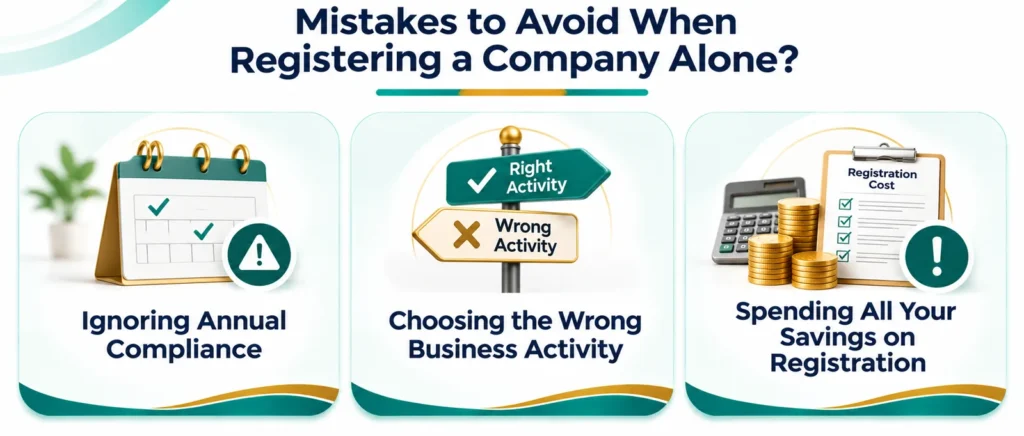
Ignoring Annual Compliance
OPC registration comes with ongoing accounting, statutory audit, tax and ROC filing obligations. Missing compliance deadlines can result in additional fees, penalties and legal complications.
Choosing the Wrong Business Activity
Your incorporation documents must accurately reflect your proposed business activities. Certain activities require additional licences, while specified non-banking financial investment activities are restricted for OPCs. Our CS team can help review these requirements before incorporation.
Spending All Your Savings on Registration
Keep sufficient funds for marketing, equipment, software, employees and daily operations instead of spending all your savings on registration. Our CA team can help you estimate expenses and plan your working capital requirements.
How Probay’s CA and CS Team Helps You Register a Company With 100% Ownership
You can retain complete company ownership without managing complicated legal and financial formalities yourself. Probay’s team of Chartered Accountants and Company Secretaries assists with company registration, taxation, accounting and ongoing compliance.
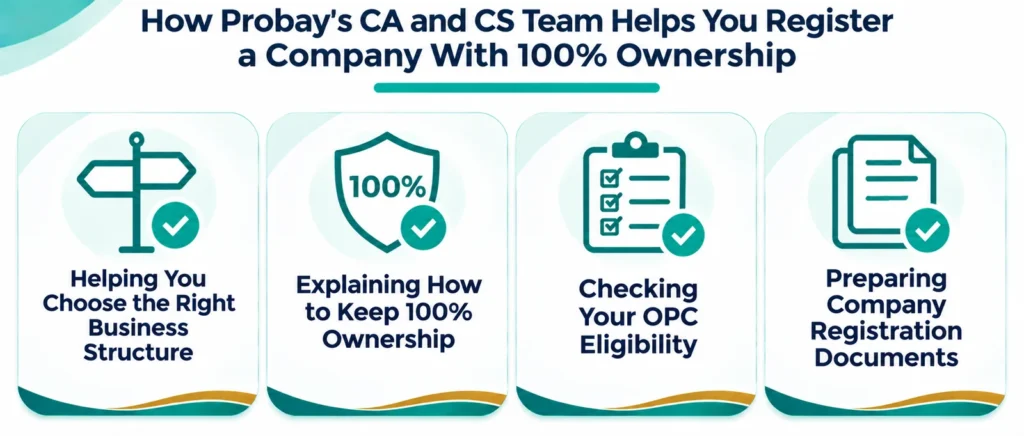
Helping You Choose the Right Business Structure
Our CA and CS team helps you compare OPC, Sole Proprietorship, Private Limited Company and LLP based on your investment, business activities, ownership preferences, compliance costs and future growth plans.
Explaining How to Keep 100% Ownership
Our CS professionals explain the differences between shareholders, directors and OPC nominees, helping you retain complete ownership without unnecessarily giving away shares or compromising your ownership rights.
Checking Your OPC Eligibility
We review your citizenship, nominee requirements, director eligibility and proposed business activities before incorporation to identify potential legal issues and reduce avoidable registration delays.
Preparing Company Registration Documents
Our team assists with identity documents, address proof, registered-office details and nominee documentation. Our CS professionals also help prepare the MOA, AOA and applicable incorporation documents.
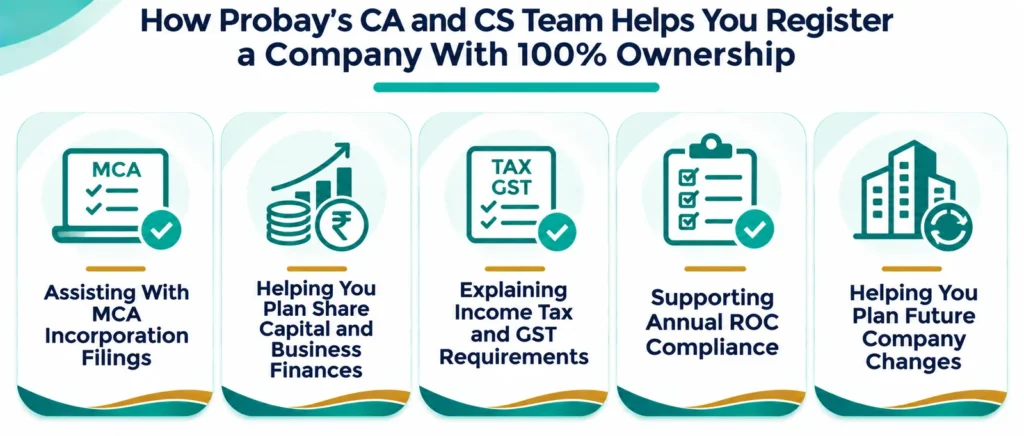
Assisting With MCA Incorporation Filings
Our CA and CS team assists with SPICe+, linked forms, supporting documents, declarations, digital signatures and professional certification where required.
Helping You Plan Share Capital and Business Finances
Our Chartered Accountants help you understand authorised, subscribed and paid-up capital, assess business funding requirements and make informed financial decisions before incorporation.
Explaining Income Tax and GST Requirements
Our CA team helps you understand company taxation, GST registration requirements, accounting obligations and the tax treatment of payments made to company owners.
Supporting Annual ROC Compliance
Our CA and CS team assists with financial statements, statutory audit coordination, annual returns, ROC filings and event-based compliance, helping you manage ongoing statutory responsibilities.
Helping You Plan Future Company Changes
Whether you want to appoint additional directors, convert your OPC into a Private Limited Company or introduce new shareholders, our CA and CS professionals help you manage the applicable legal, financial and compliance requirements.
Which Business Structure Should I Choose Based on My Situation?
There is no single structure that is best for every entrepreneur.
Your decision should reflect your business needs, available investment, legal risks, and future plans.
| Your Situation | Structure to Consider | Main Reason |
|---|---|---|
| I want to start freelancing alone | Sole Proprietorship | Fewer company-related formalities |
| I want a company and complete share ownership | OPC | Allows one eligible member |
| I want a separate legal entity | OPC | Incorporated company structure |
| I plan to bring in investors soon | Regular Private Limited Company | Supports multiple shareholders |
| I want to start a business with another professional | LLP | Partnership-based structure |
| I am testing an idea with limited savings | Sole Proprietorship | May reduce initial formalities |
| I want a formal company without a co-founder | OPC | Single-member structure |
| I already own an OPC and want additional shareholders | OPC conversion | Allows transition to a multi-member company |
If you are still learning the basics, our article on How to Start a Company in India Without Getting Trapped in Legal Paperwork explains the early decisions first-time entrepreneurs should understand.
What Should I Check Before Registering a Company Without a Partner?
Use this checklist to plan your business, ownership, registration and compliance requirements before incorporation.
Business Planning
- Identify your products, services and target customers.
- Estimate your investment, expected income and monthly expenses.
- Consider future investors and incorporation requirements.
Ownership Planning
- Compare OPC and Sole Proprietorship.
- Confirm your OPC eligibility and understand nominee responsibilities.
- Decide whether to retain 100% ownership or introduce shareholders later.
Registration Preparation
- Shortlist suitable company names.
- Prepare identity, address and registered-office documents.
- Select an eligible nominee and obtain consent.
- Determine share capital and applicable business licences.
Financial and Compliance Planning
- Estimate registration and annual compliance costs.
- Understand income-tax, GST and ROC filing requirements.
- Plan accounting records and maintain sufficient working capital.
- Arrange professional CA and CS assistance.
Proper planning helps you retain ownership, manage expenses and avoid unnecessary legal and compliance complications.
Frequently Asked Questions About Registering a Company Without a Partner
Can one person register a company in India?
Yes. An eligible individual can register a One Person Company (OPC) under the Companies Act, 2013, and become its sole shareholder.
Can I own 100% of a company in India?
Yes. An OPC allows 100% share ownership. A Sole Proprietorship also allows complete business ownership but does not provide a separate legal identity.
Can I register a Private Limited Company without a partner?
Yes, through an OPC. However, a regular Private Limited Company requires at least two members at incorporation.
Is a nominee the same as a business partner?
No. An OPC nominee does not automatically receive shares or management rights. The nominee becomes a member upon the original member’s death or incapacity to contract.
Can my wife or husband become my OPC nominee?
Yes, provided your spouse meets the eligibility requirements and gives the prescribed consent. Nomination does not grant immediate ownership rights.
Can I register an OPC without a nominee?
No. Appointing an eligible nominee is mandatory for OPC registration.
Can I be the only director of my OPC?
Yes. You can be the sole shareholder and director, subject to applicable director eligibility and residency requirements.
Can I register an OPC while working in a private company?
Yes, subject to your employment agreement, outside business restrictions and conflict-of-interest conditions.
Can I register an OPC using my residential address?
Yes, provided you have the required address documents, property permissions and applicable local approvals.
Is GST registration compulsory for every OPC?
No. GST registration depends on turnover, business activities and applicable compulsory-registration provisions.
Does an OPC require an annual audit?
Yes. An OPC generally requires a statutory audit by an eligible auditor, separate from applicable income-tax audit requirements.
Is ₹1 lakh minimum capital required for OPC registration?
No. There is no general statutory minimum paid-up capital requirement of ₹1 lakh for an ordinary OPC limited by shares.
Can an OPC hire employees?
Yes. An OPC can hire employees according to its business requirements and applicable employment laws.
Can an OPC apply for a business loan?
Yes. Loan approval depends on lender requirements, creditworthiness and repayment capacity. Security or personal guarantees may be required.
Can I convert my OPC into a Private Limited Company?
Yes. You can convert an OPC into a regular Private Limited Company by completing the prescribed legal procedure and meeting shareholder and director requirements.
Is there a maximum turnover limit for an OPC?
The earlier compulsory conversion thresholds based on turnover and capital were removed in 2021. Crossing those thresholds no longer requires mandatory conversion.
Can I register two OPCs in my own name?
No. An individual cannot be a member of more than one OPC simultaneously.
Can a foreign citizen register an OPC in India?
No. Only eligible Indian citizens, including those residing abroad, can register an OPC.
What happens to my OPC if I die?
The designated nominee becomes the company’s member, subject to applicable legal procedures and statutory formalities.
Can I withdraw money from my OPC whenever I want?
No. Company payments must follow applicable legal, accounting and tax requirements and be properly classified and recorded.
Is an OPC better than a sole proprietorship?
An OPC offers a separate legal identity and limited liability, while a Sole Proprietorship generally involves fewer compliance requirements. The right choice depends on your business risks, finances and growth plans.
Can Probay help me register an OPC without giving away ownership?
Yes. Probay’s CA and CS team assists with OPC eligibility, registration documents, MCA filings, taxation and ongoing compliance without requiring you to share company ownership.
Register Your Company Without Giving Away Ownership – Get Help From Probay’s CA and CS Team
Start your company independently and retain 100% ownership through an OPC. Probay’s expert Chartered Accountants and Company Secretaries help you choose the right business structure, complete registration and manage ongoing compliance.