Starting a business in India does not mean you have to become an expert in company law, taxation or government paperwork. A company registration consultant in India can help you choose the right business structure, prepare legal documents, complete government filings and manage ongoing compliance.
Imagine you have ₹10 lakh in personal savings and want to start selling products across India. You have a business plan and suppliers, but dealing with MCA registration, DIN, DSC, GST returns and ROC filings feels overwhelming.
At Probay, our team of Chartered Accountants (CA) and Company Secretaries (CS) helps manage these technical responsibilities. While you remain responsible for providing accurate information, approving important decisions and fulfilling your legal duties, our professionals help you handle the paperwork so you can focus on customers, sales and business growth.
Can a Company Registration Consultant in India Handle the Entire Company Registration Process?
Yes, a company registration consultant can manage most of the technical work involved in establishing a business entity in India. From understanding your business idea to preparing incorporation documents and coordinating government applications, professional assistance can make the process much easier.
A first-time business owner may not understand the difference between authorised capital and paid-up capital. You may also be unfamiliar with company objectives, shareholder rights, director responsibilities and government filing procedures. These are areas where an experienced CA and CS team can provide practical assistance.
What Work Can a Company Registration Consultant Handle for You?
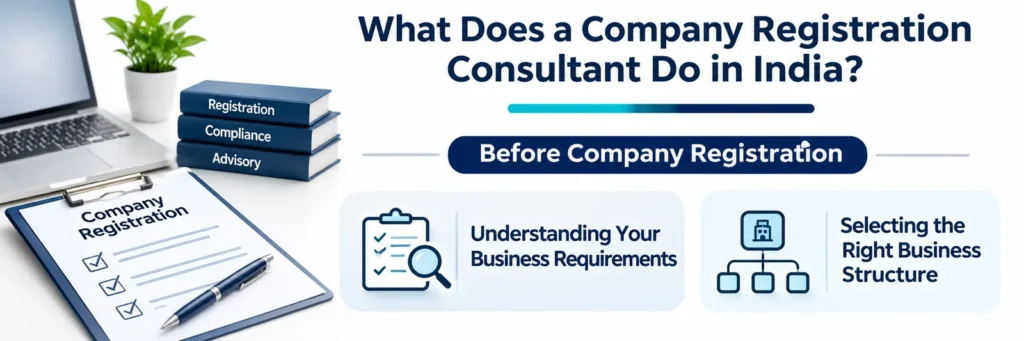
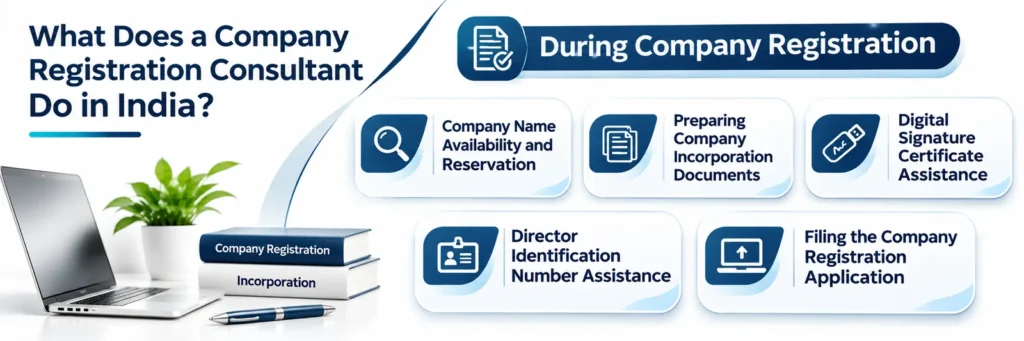
Company registration services in India generally involve several stages. Depending on your business requirements and the professional services you select, your consultant can assist with the following activities:
- Business structure selection: Understanding your investment, ownership preferences, business activities and future plans to identify a suitable legal structure.
- Company name selection: Checking proposed company names and preparing the relevant name reservation application.
- Digital Signature Certificate (DSC): Assisting proposed directors and subscribers with obtaining digital signatures and completing required verification.
- Director Identification Number (DIN): Helping eligible individuals apply for their director identification numbers through the appropriate process.
- Incorporation documents: Preparing the Memorandum of Association (MOA), Articles of Association (AOA) and other applicable documents.
- MCA registration: Preparing incorporation applications and coordinating their submission through the Ministry of Corporate Affairs.
- Government resubmission requests: Helping correct documentation errors or provide additional information requested by the authorities.
- Post-registration assistance: Explaining initial company compliance, bank account requirements, capital contributions and annual filing responsibilities.
You do not need to prepare every document yourself. Your primary responsibility is to provide accurate information about yourself and your proposed business and complete the approvals, signatures and verification required from you.
What Can You Outsource and What Must You Handle Personally?
A company registration consultant can manage technical paperwork and statutory filings, but you remain responsible for providing accurate information, approving documents and making business decisions.
| Activity | Consultant’s Role | Your Responsibility |
|---|---|---|
| Business structure | Compare suitable options | Approve the structure |
| Company name | Check availability and prepare applications | Select the preferred name |
| Legal documentation | Prepare and review documents | Provide accurate information |
| DSC application | Coordinate the application | Complete personal verification |
| Incorporation forms | Prepare applicable forms | Review and sign |
| ROC filings | Prepare and coordinate filings | Provide records and approvals |
| Bank account | Coordinate documentation | Complete bank formalities |
| Accounting | Maintain financial records | Share transaction details |
| Tax compliance | Calculate taxes and prepare returns | Approve and arrange payments |
| Ownership decisions | Provide professional advice | Make final decisions |
Probay’s CA and CS team helps manage these technical responsibilities. If you are a first-time founder, understanding how to start a company in India without getting trapped in legal paperwork can help you prepare for your first consultation.
How Our CA and CS Team Helps You Manage the Legal and Financial Side of Your Company
Company registration involves more than submitting government forms and receiving a Certificate of Incorporation. Choosing the wrong ownership structure, incorrectly introducing personal funds or misunderstanding director responsibilities can create legal and financial complications later.
Probay’s team of Chartered Accountants (CA) and Company Secretaries (CS) helps you establish the right legal and financial foundation, manage incorporation paperwork and fulfil ongoing compliance requirements as your business grows.

Role of a Chartered Accountant in Company Registration and Business Compliance
A Chartered Accountant (CA) helps you manage accounting, taxation, financial planning and reporting, allowing you to establish a proper financial foundation for your business.
Financial Planning Before Starting Your Company
Suppose you have ₹15 lakh in personal savings to start a manufacturing or trading business. Apart from budgeting for inventory, marketing and equipment, you must decide how to introduce these funds into your company.
Our CA team helps you understand the financial and tax implications of share capital, permitted director loans and other suitable funding arrangements.
Accounting and Bookkeeping
Every business transaction, including office rent, software subscriptions and product purchases, must be recorded appropriately.
Our Chartered Accountants help establish an accounting system, maintain financial records and track income, expenses, assets and liabilities so you can understand your company’s financial performance.
GST and Income Tax Compliance
Tax obligations depend on your business activities, turnover and applicable legal requirements. Our CA team assists with:
- GST registration and applicable return filing.
- Annual income tax return preparation.
- Advance tax calculations.
- TDS deduction and payment requirements.
- Financial reporting and tax planning.
- Responding to applicable tax notices.
Identifying these responsibilities early helps prevent unnecessary expenses and taxation mistakes.
Annual Financial Statements and Statutory Audit
Registered companies generally require annual financial statements and statutory audits, even with zero turnover.
Probay’s CA team assists with financial statement preparation, supporting documentation and audit coordination while ensuring applicable statutory auditor independence requirements are maintained.
Role of a Company Secretary in Company Registration and Compliance
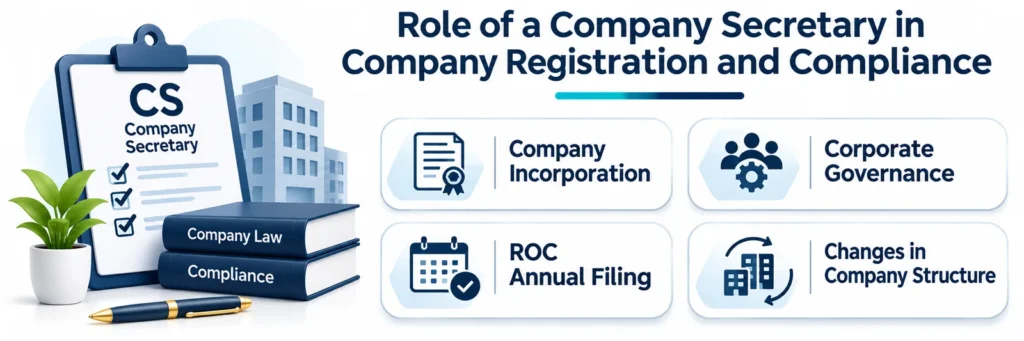
A Company Secretary (CS) specialises in corporate law, statutory documentation, corporate governance and company compliance. While a CA manages financial and taxation matters, a CS helps your company operate within its legal framework.
Company Incorporation
Our CS team assists with incorporation documents, ownership arrangements, director and shareholder responsibilities, and applicable government filings.
Corporate Governance
Our Company Secretaries help you understand director responsibilities, shareholder approvals and documentation requirements for important business decisions.
ROC Annual Filing
Our CS team prepares annual returns, reviews statutory records, monitors filing deadlines and assists with applicable company annual filings.
Changes in Company Structure
Introducing investors, appointing directors, increasing share capital or changing your registered office may require additional statutory filings.
Our CS team assists with corporate approvals, resolutions, statutory documentation and event-based compliances, helping you manage business changes without unnecessary paperwork.
Difference Between CA and CS Services for Company Registration
| Professional service | Chartered Accountant (CA) | Company Secretary (CS) |
|---|---|---|
| Business structure advice | Financial and tax implications | Corporate and ownership implications |
| Company incorporation | Assistance and certification where permitted | Assistance and certification where permitted |
| Accounting and bookkeeping | Primary responsibility | Supporting coordination |
| GST and income tax | Primary area of expertise | Supporting coordination |
| Share capital planning | Financial implications | Corporate procedures |
| Board resolutions | Financial input where required | Documentation and procedures |
| Statutory registers | Supporting coordination | Primary area of expertise |
| ROC annual filing | Financial records and permitted certification | Corporate records and permitted certification |
| Director appointments | Financial implications where relevant | Appointment procedures and filings |
| Statutory financial audit | Eligible independent CA | Not a statutory financial auditor |
Access to both CA and CS services for company registration allows you to manage financial requirements and corporate compliance through a coordinated professional approach.
Owner vs. Director in India: Can You Own 100% of a Company While Someone Else Runs Daily Operations?
Indian company law allows ownership and management to be separated. You can own 100% of a One Person Company (OPC) and appoint another eligible person as its director. In a Private Limited Company, you can retain majority ownership while appointing directors who do not hold shares.
This arrangement may suit founders who have sufficient investment but lack the time or experience to manage daily business operations.
What Is the Difference Between Owner and Director of a Company?
A shareholder owns shares, a director supervises company affairs, and a manager handles assigned business operations. The same person can perform all three roles, but it is not compulsory.
| Responsibility | Shareholder | Director | Manager |
|---|---|---|---|
| Owns company shares | Yes | Not compulsory | Not compulsory |
| Receives dividends | According to share rights | If also a shareholder | If also a shareholder |
| Shareholder voting | According to voting rights | If also a shareholder | If also a shareholder |
| Board decisions | If also a director | Yes | If also a director |
| Daily operations | Optional | Depends on appointment | Generally |
| Signs company documents | If authorised | Within applicable authority | If authorised |
| Statutory director duties | If also a director | Yes | If also a director |
Shareholders own shares in the company, not its assets or bank balance directly.
Can I Own 100% of a Company in India Without Being Its Director?
Yes. An eligible individual can own 100% of an OPC while appointing another eligible person as its director. An OPC also requires a nominee who does not automatically receive ownership or management rights.
| Position | Person | Share Ownership |
|---|---|---|
| Sole shareholder | Founder | 100% |
| Director | Appointed professional | 0% |
| Business manager | Appointed employee | 0% |
| OPC nominee | Eligible nominated individual | 0% while remaining a nominee |
Probay’s CA and CS team can help you establish a suitable ownership and management arrangement, complete director appointment formalities and manage ongoing compliance through our One Person Company registration services.
Can I Own a Private Limited Company While Someone Else Manages It?
A standard Private Limited Company requires at least two shareholders and two directors. You cannot ordinarily register it with yourself as its only member, but you may hold a significant majority of the shares.
For example, you could hold 99% of the shares while another genuine shareholder holds 1%. The company could also appoint eligible directors who do not own any shares.

This structure may be useful when you want to:
- Maintain majority ownership of your business.
- Appoint an experienced management team.
- Expand your business across India.
- Bring in additional investors in the future.
- Separate business management from personal ownership.
- Establish a formal corporate governance system.
Majority shareholding can provide significant voting control, but it does not mean you can ignore the legal powers of the board, shareholder rights or other applicable company requirements.
Our CA and CS team can help you plan your ownership arrangement before completing Private Limited Company registration.
Can a Director Be Appointed Without Shares?
Yes. An eligible individual can become a company director without owning shares, subject to applicable legal requirements and company rules.
You can appoint an experienced professional to supervise business operations and pay them an approved salary or remuneration without giving them equity. However, establish clear responsibilities, approval limits and reporting requirements before appointment.
Should You Appoint a Director or Hire a Manager Instead?
If you only need someone to supervise employees, manage inventory or coordinate with suppliers, hiring a manager may be sufficient.
A director holds a formal legal position with statutory responsibilities, while a manager generally handles daily operations within their assigned authority.
Probay’s CS team helps you choose a suitable management arrangement, define responsibilities and complete applicable appointment formalities without unnecessarily sharing business ownership.
What Is a Power of Attorney (POA) or Authorized Signatory, and How Does It Work?
A Power of Attorney (POA) or authorised signatory arrangement allows you to delegate specific business and legal responsibilities without transferring company ownership. However, the authority must be properly documented and comply with applicable laws.
What Is a Power of Attorney?
A Power of Attorney is a legal document that authorises another person to perform specified activities on your behalf.
For example, if you live in Mumbai but want to establish a company in Delhi NCR, a POA may allow someone to handle certain local business activities and execute permitted documents.
However, a POA does not automatically allow someone to:
- Complete your personal identity verification.
- Use your personal Digital Signature Certificate (DSC).
- Sign every statutory declaration on your behalf.
- Exercise authority beyond the permitted scope.
Probay’s CA and CS team can help you understand which responsibilities can legally be delegated and which require your personal involvement.
What Is an Authorized Signatory in Company Registration and Compliance?
An authorised signatory is a person permitted to sign documents or perform specific activities on behalf of a company. This authority may be granted through a board resolution, authority letter or valid Power of Attorney (POA).
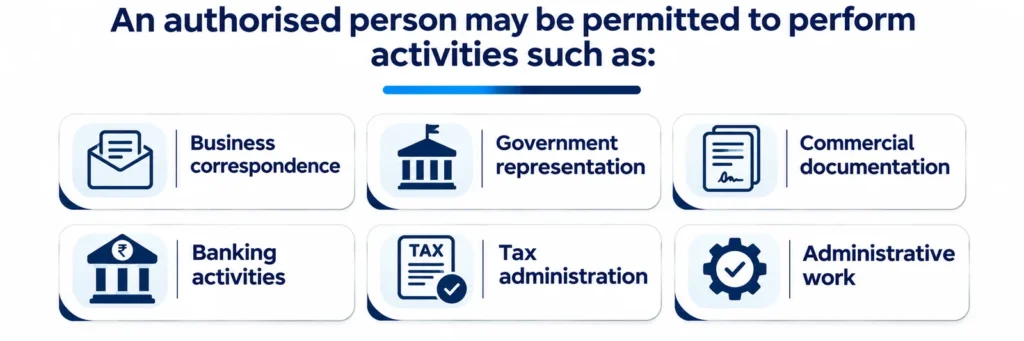
An authorised signatory may handle:
- Business correspondence: Signing approved letters and applications.
- Government representation: Representing the company before permitted authorities.
- Commercial documentation: Signing approved business agreements.
- Banking activities: Performing transactions within the approved bank mandate.
- Tax compliance: Handling permitted tax-related activities.
- Administrative work: Submitting documents and coordinating applications.
However, a general authorisation does not cover every statutory filing or banking transaction. Probay’s CS team can help you establish appropriate authorisations and define their legal limits.
Difference Between Power of Attorney and Authorized Signatory
| Particular | Power of Attorney | Authorised signatory |
|---|---|---|
| Purpose | Delegates defined legal authority | Authorises specified signing or related activities |
| Method of appointment | Properly executed POA | Resolution, authority letter or other valid authorisation |
| Transfers ownership | No | No |
| Automatically makes someone a director | No | No |
| Allows banking access | Only with appropriate authority and bank acceptance | Subject to approved banking arrangements |
| Can sign every ROC form | No | No |
| Can have limited authority | Yes | Yes |
| Can be withdrawn | Subject to applicable terms and law | Through applicable revocation procedures |
Should You Give Your Consultant a General or Limited Power of Attorney?
A limited Power of Attorney is often more suitable when you only want someone to perform specific administrative activities. Giving unrestricted authority without understanding its consequences can expose your company to unnecessary risks.
For example, if you only need someone to coordinate a property document, you should not automatically give that person authority to borrow money, transfer company shares or enter into major commercial agreements.
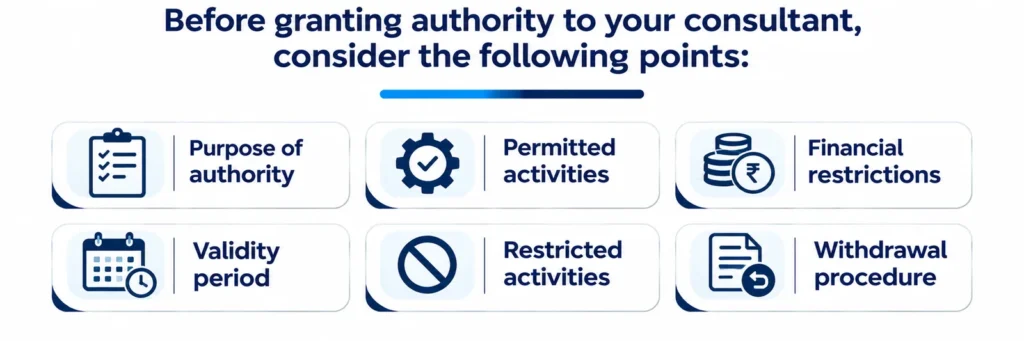
Before granting authority, consider the following points:
- Purpose of authority: Clearly mention why the person is being authorised.
- Permitted activities: Specify exactly what the individual can do.
- Financial restrictions: Establish transaction limits and additional approval requirements.
- Validity period: Decide whether the authority is temporary or ongoing.
- Restricted activities: Identify actions that the individual cannot perform.
- Withdrawal procedure: Understand how authority can be revoked and communicated to relevant parties.
Our Company Secretaries can help identify appropriate corporate approvals and coordinate the necessary legal documentation when specialist assistance is required.
Can a Power of Attorney Transfer Your Responsibilities as a Director?
No. Delegating specific activities does not transfer your position as a director or remove your statutory responsibilities. Section 166 of the Companies Act, 2013, also prevents directors from assigning their office to another person.
You can appoint professionals to prepare company documents, but you cannot simply give someone authority to become responsible for everything while you ignore your director duties.
If you want to appoint someone to manage your business but are unsure how much authority they should receive, Talk to Our CA and CS Experts before finalising your company structure.
Adding a Family Member or Friend as Director Just for Paperwork: Is It Safe and Legal in India?
A Private Limited Company requires at least two directors. If you do not have a business partner, you can legally appoint an eligible family member or trusted friend as a director.
However, directorship is a formal legal position with statutory responsibilities, not simply a registration formality. Appointing someone without explaining their duties can create legal complications.
Can I Make My Wife, Husband, Brother or Friend a Director?
Yes. You can appoint an eligible family member or friend as a director, provided they:
- Give their consent to the appointment.
- Meet applicable legal eligibility requirements.
- Obtain a Director Identification Number (DIN), where required.
- Provide the necessary documents and declarations.
- Understand their statutory responsibilities.
Becoming a director does not automatically grant company ownership. However, if you also make them a shareholder, they receive the rights associated with their shares.
Probay’s CS team helps you understand these differences and establish a suitable ownership and director arrangement before company registration.

What Are the Legal Responsibilities of a Company Director?
Section 166 of the Companies Act, 2013, defines the legal duties of company directors, including family members and directors who are not involved in daily operations.
Key responsibilities include:
- Acting in the company’s interests: Making decisions in good faith for the company’s benefit.
- Exercising reasonable care: Understanding documents and decisions before approving them.
- Following company rules: Complying with applicable laws and governing documents.
- Avoiding conflicts of interest: Keeping personal interests separate from company decisions.
- Preventing improper financial benefits: Avoiding misuse of their position for unfair personal gain.
- Exercising independent judgement: Making responsible decisions rather than blindly following instructions.
Failure to fulfil applicable legal duties may result in penalties or legal proceedings against responsible directors or officers.
Risks of Adding Someone as Director Just for Paperwork
| Potential Risk | What Could Happen? | Recommended Precaution |
|---|---|---|
| Lack of legal knowledge | Approving documents without understanding them | Explain director duties |
| Unauthorised agreements | Making unapproved business commitments | Define signing authority |
| Financial misuse | Improper use of company funds | Establish banking controls |
| Personal disagreements | Family disputes affect business decisions | Document governance rules |
| Compliance failures | Missing statutory deadlines | Maintain a compliance calendar |
| Unexpected resignation | Falling below minimum director requirements | Plan management continuity |
| Conflicts of interest | Personal interests affect company decisions | Establish disclosure procedures |
| Legal liability | Penalties against responsible individuals | Maintain proper documentation |
Should You Give Shares to a Family Member Who Becomes a Director?
Not necessarily. Directorship and shareholding are separate roles. Giving a family member 50% ownership simply because they help with administration may create future disagreements over voting rights, profits and business control.
Depending on your company structure, you may appoint them only as a director or manager. Our CA and CS team can help you understand the financial and legal implications before issuing shares.
Is an OPC a Better Option If You Do Not Have a Business Partner?
A One Person Company (OPC) may be suitable if you want 100% individual ownership without a second shareholder.
However, if two people genuinely want to own and operate a business together, LLP registration may also be worth considering.
Probay’s CA and CS team can help you choose the right business structure based on ownership preferences, future funding requirements, growth plans and ongoing compliance costs.
What Documents Will I Need to Provide to My Company Registration Consultant?
Even when you hire professionals to handle the complete registration process, you must provide genuine information and supporting documents. Your consultant uses these records to prepare applications and establish the identity of the proposed directors, shareholders and business.

You do not need to understand every technical form before approaching a consultant. However, organising your documents early can reduce unnecessary delays.
Personal Documents
Depending on your citizenship, proposed role and applicable registration requirements, your consultant may ask for:
- PAN card.
- Aadhaar card or other applicable identity proof.
- Recent residential address proof.
- Photograph, where required.
- Active mobile number and email address.
- Existing Director Identification Number, if available.
- Applicable director consent and declarations.
Foreign individuals, non-resident shareholders and corporate shareholders may need additional documentation or authentication.
Registered Office Documents
A registered company needs an official address where government communications can be received. You may use an eligible commercial property, rented office or residential address, subject to applicable requirements.
Common supporting documents include property ownership records, a rent or lease agreement, a recent utility bill and a No Objection Certificate from the property owner, where required.
Business Information
Your consultant will also need to understand what your company plans to do. This information helps prepare incorporation documents and identify applicable registration requirements.
| Information required | Why it is needed |
|---|---|
| Preferred company names | Preparing name reservation applications |
| Proposed business activities | Preparing company objectives |
| Investment amount | Planning the company’s capital structure |
| Shareholders | Establishing company ownership |
| Directors | Establishing company management |
| Registered office address | Establishing the official business location |
| Expected sales and operations | Identifying applicable tax and compliance requirements |
| Future growth plans | Selecting a suitable business structure |
Our professionals can explain these requirements in simple language and help you prepare the necessary information.
Hiring a Legal or Tax Consultant? 5 Rules to Protect Your Company From Fraud in India
Hiring a qualified consultant can reduce paperwork and save time. However, you should maintain control over your company’s sensitive documents, digital signatures, financial records and official accounts.

Follow these five rules to protect your business while receiving professional assistance.
Rule 1: Verify the Professional Qualifications of Your CA and CS
Before hiring a company registration consultant, verify their professional qualifications and experience.
- Chartered Accountant (CA): Verify professional credentials with the Institute of Chartered Accountants of India (ICAI).
- Company Secretary (CS): Verify professional credentials with the Institute of Company Secretaries of India (ICSI).
- Certificate of Practice: Check whether the professional holds a valid certificate where required.
- Professional responsibilities: Confirm who will prepare, review and certify your documents.
Avoid choosing a consultant solely based on low prices or guaranteed government approval.
Rule 2: Never Share Your Digital Signature Password, Banking Passwords or OTPs
Your Digital Signature Certificate (DSC) is used to sign legally important documents. Your consultant can prepare these documents, but you should review them and retain control over your digital signature.
Never share unrestricted access to your:
- Digital Signature Certificate passwords.
- Internet banking credentials and OTPs.
- Personal and company email passwords.
- Income tax login credentials.
- Account recovery details.
Use legally permitted representative access or authorised user roles wherever available instead of sharing personal credentials.
Rule 3: Keep Your Company Email, Mobile Number and Bank Account Under Your Control
Maintain control over your company’s official email address, registered mobile number, government portal accounts and banking arrangements.
You can authorise consultants or employees to perform specific activities without granting unrestricted access. Establish banking approval limits and dual approval arrangements wherever available.
Routine compliance support should not automatically give someone authority to withdraw money, approve loans or change banking details.

Rule 4: Ask for a Written Agreement Before Paying Professional Fees
A low-cost company registration package may not include accounting, taxation, statutory audits or annual compliance. Always request a written quotation explaining the scope of services and applicable charges.
| Service or Expense | What You Should Confirm |
|---|---|
| Professional fees | Services included in the package |
| Government charges | Included or charged separately |
| Stamp duty | Applicable location-based charges |
| Digital signatures | Number and validity of DSCs |
| Incorporation documents | Documents provided after registration |
| Initial compliance | Post-registration activities covered |
| Accounting | Whether bookkeeping is included |
| GST and taxation | Registration and return filing services |
| Annual ROC compliance | Applicable forms and filings covered |
| Statutory audit | Separate engagement and audit fees |
| Additional charges | When extra fees may apply |
A written agreement helps prevent unexpected expenses and misunderstandings.
Rule 5: Collect and Maintain Copies of Every Company Document
Never depend entirely on your consultant to maintain company records. Keep secure copies of important documents, including:
- Certificate of Incorporation.
- Company PAN and TAN details.
- Memorandum of Association (MOA).
- Articles of Association (AOA).
- Incorporation applications and payment receipts.
- Director-related documents.
- Applicable tax registration certificates.
- Annual filings and financial statements.
- Company resolutions and filing acknowledgements.
Maintaining your own records makes it easier to change consultants, apply for funding, respond to government notices and manage future compliance requirements.
What Compliances Can a Company Registration Consultant Manage After Registration?
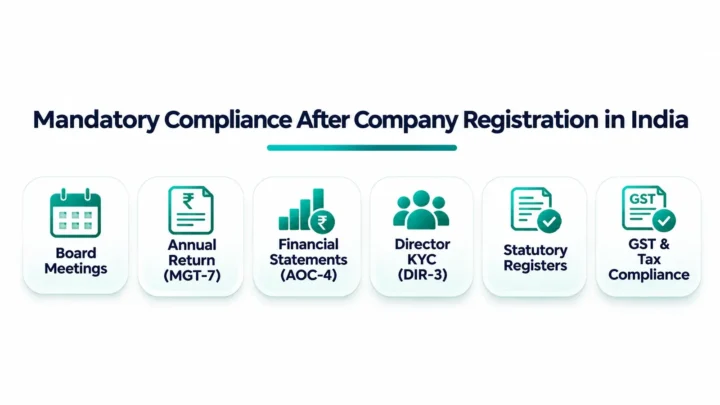
Company compliance begins after incorporation, even if your business has no sales or income. A company registration consultant can help manage statutory deadlines, accounting records, taxation and ongoing corporate filings.
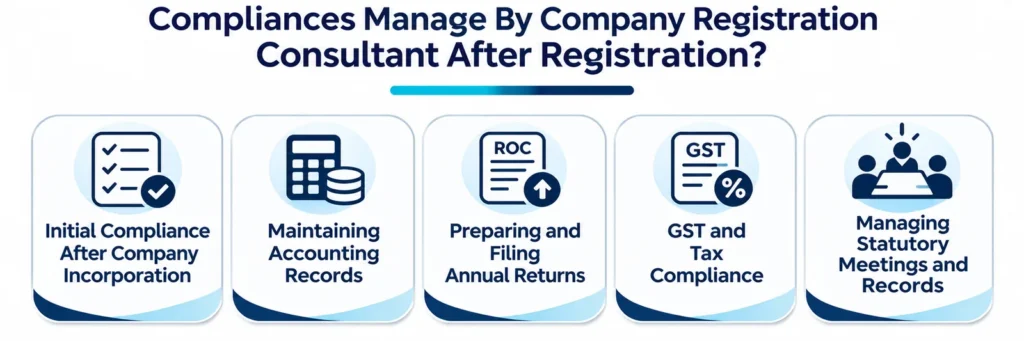
Initial Compliance After Company Incorporation
Probay’s CA and CS team helps you identify and complete applicable post-registration requirements.
| Initial Compliance Activity | General Statutory Timeline | Professional Assistance |
|---|---|---|
| Registered office verification | Within 30 days, where required | CS |
| First statutory auditor appointment | Board generally appoints within 30 days | CA and CS |
| First board meeting | Within 30 days, where applicable | CS |
| Issue of share certificates | Within two months of incorporation | CS |
| Commencement of business declaration | Within 180 days for applicable companies | CA and CS |
| Accounting records | From the first relevant transaction | CA |
| Statutory registers | Maintained and updated as required | CS |
Requirements may differ for OPCs, small companies and other eligible company categories. Learn more about compliance after company registration in India.
Maintaining Accounting Records
Our CA team assists with maintaining purchase invoices, sales records, business expenses, bank transactions and capital contributions. Regular bookkeeping helps prevent last-minute complications during tax filing and statutory audits.
Preparing and Filing Annual Returns
Our CA and CS team coordinates financial statement preparation, statutory documentation and applicable ROC filings through our Company Annual Filing services.
GST and Tax Compliance
Our Chartered Accountants help identify applicable tax obligations, calculate tax liabilities and manage GST returns, TDS compliance, advance tax and annual income tax returns.
Managing Statutory Meetings and Records
Our Company Secretaries assist with preparing meeting notices, resolutions, minutes and statutory registers, helping your company maintain proper corporate records and fulfil applicable legal requirements.
How Much Does It Cost to Hire a Company Registration Consultant in India?
The cost of hiring a company registration consultant in India depends on your business structure, registered office location, share capital, number of directors and scope of professional services.
Instead of comparing registration package prices alone, consider the total cost of establishing and maintaining your company.
| Cost Component | What It Generally Covers |
|---|---|
| Professional registration fees | Application preparation and professional assistance |
| Government charges | Applicable statutory fees |
| Stamp duty | State-specific charges |
| Digital Signature Certificates | Required digital signatures |
| Additional documentation | Declarations and supporting documents |
| Initial compliance | Post-registration requirements |
| Accounting services | Bookkeeping and financial records |
| Annual compliance | Corporate and tax filings |
| Statutory audit | Independent financial audit services |
If you are starting a business with personal savings, keep a separate budget for ongoing compliance alongside inventory, marketing and product development.
Probay’s CA and CS team can help you understand registration costs, identify applicable compliance expenses and choose professional services based on your business requirements and budget.
How Can You Manage Your Company With Minimum Personal Involvement in Legal Paperwork?
You can reduce your involvement in legal paperwork by delegating technical and administrative responsibilities to qualified professionals while retaining control over important business decisions.
Establish a Clear Division of Responsibilities
| Person or Team | Primary Responsibilities |
|---|---|
| Founder or shareholder | Ownership, investment and shareholder decisions |
| Directors | Corporate oversight and statutory duties |
| Business manager | Daily business operations |
| Chartered Accountant | Accounting, taxation and financial reporting |
| Company Secretary | Corporate documentation and ROC compliance |
| Independent statutory auditor | Statutory financial audit |
| Authorised employee | Approved administrative activities |
Probay’s CA and CS team can help you establish a structured compliance system, reducing your paperwork while ensuring you understand and fulfil your applicable legal responsibilities.

Create a Simple Monthly Compliance Routine
You do not need to spend every day reviewing government forms. Instead, establish a regular process for providing documents to your professionals and reviewing important company activities.
A practical monthly routine includes:
- Share your business invoices and bank statements with your accounting team.
- Review important expenses, outstanding payments and financial reports.
- Inform your CS about any changes in directors, shareholders or company activities.
- Review upcoming compliance deadlines.
- Approve necessary documents and arrange applicable statutory payments.
- Collect completed filing acknowledgements and store them securely.
This system allows you to maintain oversight without personally preparing every statutory document.
Frequently Asked Questions
Can a company registration consultant in India handle all my legal paperwork?
A consultant can manage most technical registration and compliance activities, including preparing documents and coordinating government filings. However, you must complete required personal verification, statutory signatures and important company approvals.
Can I own 100% of a company without becoming its director?
Yes. An eligible individual can own all the shares of a One Person Company while appointing another eligible individual as its director through the applicable appointment procedure.
Can a director be appointed without shares?
Yes. Indian company law generally permits directors to be appointed without holding shares, subject to the company’s governing documents and applicable requirements.
Can I appoint my wife or husband as a director just for paperwork?
You can appoint an eligible spouse as a director. However, they must understand and perform their statutory responsibilities. Directorship should not be treated as a meaningless formality.
Can a Power of Attorney transfer all my director responsibilities?
No. A Power of Attorney can authorise specified activities where legally permitted, but it cannot transfer your office as a director or eliminate your statutory duties.
Can my CA manage my company’s tax compliance?
Yes. A qualified Chartered Accountant can assist with accounting, financial reporting, applicable GST returns, income tax compliance and other financial requirements within the scope of their engagement.
Can a Company Secretary handle all ROC filings?
A qualified Company Secretary can assist with applicable ROC filings, statutory documentation and compliance procedures. Required signatures and approvals must still be obtained from the appropriate individuals.
Do I need to hire a full-time CA and CS for my new company?
Not necessarily. Many small businesses work with external CA and CS professionals. However, companies meeting certain legal conditions must make specified whole-time appointments.
Can someone else manage my company while I work a full-time job?
Yes, an appropriate ownership and management arrangement may allow this. However, you should review your employment contract, employer policies, conflict-of-interest restrictions and applicable service rules before establishing the business.
Can a company registration consultant operate my bank account?
Only where valid corporate authority and applicable bank mandates permit it. Hiring a consultant for registration or compliance does not automatically grant banking access.
Should I give my digital signature password to my company registration consultant?
No. You should maintain control of your digital signature credentials, review documents before signing them and personally authorise their use.
Can I change my company registration consultant after incorporation?
Yes. You can generally change professional service providers, subject to engagement terms and applicable legal procedures for formal statutory appointments.
Do I need to file company returns if I have not started earning money?
Generally, yes. Registered companies continue to have applicable statutory filing and financial reporting obligations even when they have no business income.
Is outsourcing company compliance in India legal?
Yes. Businesses can engage qualified external professionals for accounting, taxation and corporate compliance assistance. However, outsourcing does not remove the statutory responsibilities of the company or its directors.
Let Our CA and CS Team Handle Your Company Paperwork While You Focus on Business Growth
Starting a business with your personal savings is an important financial decision. You should not have to spend most of your time understanding complicated government forms when your main focus is developing products, finding customers and growing your company.
At Probay, our Chartered Accountants and Company Secretaries can help you establish a suitable business structure, understand ownership and director responsibilities, complete applicable registration procedures and manage ongoing corporate and financial compliance.
Whether you want to own a company independently, appoint someone else to manage daily operations or establish a business with family members, our team can help you understand the legal and financial arrangements before you proceed.
You remain in control of your business, investments and important decisions while receiving professional assistance with the technical paperwork and compliance requirements.
Get Professional Help With Company Registration and Compliance