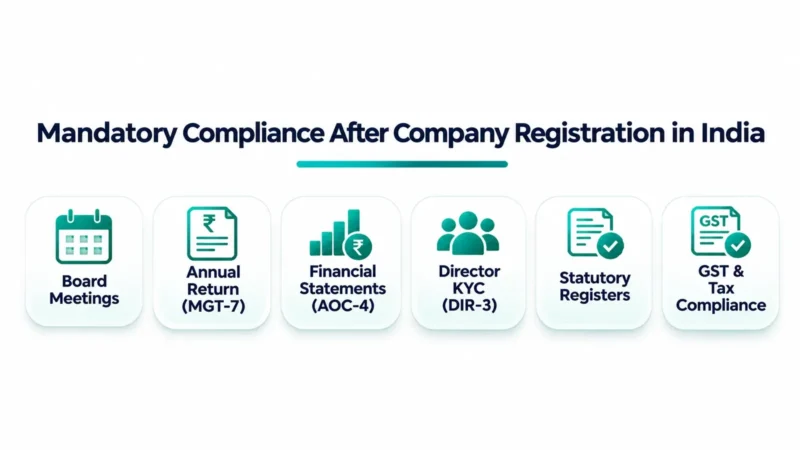
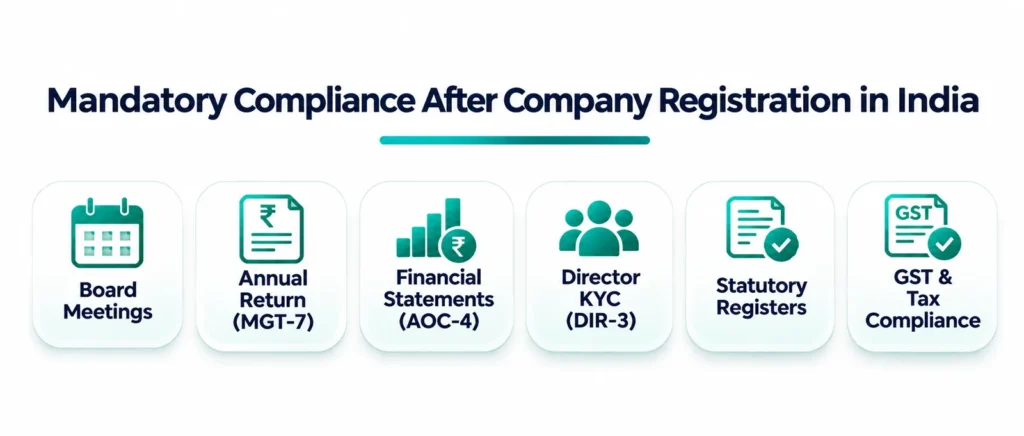
You want to start your first company, but what happens after registration? Will you have to file government forms every month, pay an accountant regularly or face penalties even when your business is not earning money?
Understanding Compliance After Company Registration in India can help you prepare for these responsibilities without feeling overwhelmed.
Most routine company law filings are annual. Your monthly responsibilities largely depend on your business activities, GST requirements, financial transactions and number of employees.
At Probay, our team of Chartered Accountants (CAs) and Company Secretaries (CSs) helps you understand what is mandatory, how much compliance may cost and which responsibilities we can handle for you, so you can focus on finding customers and growing your business.
Understanding Compliance After Company Registration in India
Compliance after company registration in India means fulfilling legal, financial and administrative responsibilities. It includes maintaining business records, filing statutory returns, paying applicable taxes and documenting important company decisions.
1. Maintaining a Separate Legal Identity
A registered company has its own legal identity, assets and liabilities. As a company owner, you must keep your personal and company finances separate.
2. Maintaining Proper Financial Records
Every company must record its income, expenses, assets and liabilities. For example, if you purchase a laptop using company funds, keep the invoice and record the expense in your company accounts.
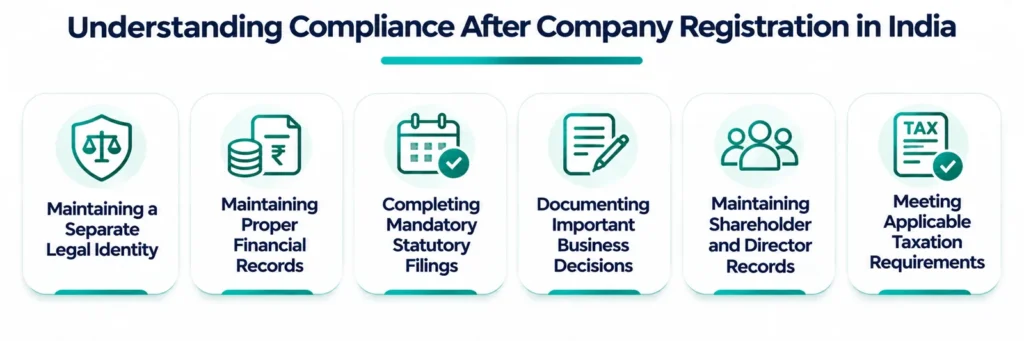
3. Completing Mandatory Statutory Filings
Companies must file applicable financial statements, annual returns and income tax returns within prescribed deadlines, even when they generate no revenue.
4. Documenting Important Business Decisions
Changes in directors, shareholders, share capital or registered office may require formal approvals, documentation and statutory filings.
5. Maintaining Shareholder and Director Records
Companies must maintain updated shareholder details, director information, ownership records and applicable statutory registers.
6. Meeting Applicable Taxation Requirements
GST, TDS, advance tax and other tax obligations depend on your business activities, turnover and financial transactions.
Probay’s CA and CS team helps you identify applicable compliance requirements, maintain statutory records and complete necessary filings, reducing your administrative workload.
Company Compliance Requirements in India: What Every New Founder Should Know
Company compliance requirements in India fall into four main categories:
| Compliance Category | When It Applies | Common Requirements |
|---|---|---|
| Post-incorporation compliance | After registration | Auditor appointment, share certificates and applicable commencement declaration |
| Regular compliance | Monthly or quarterly, as applicable | Bookkeeping, GST, TDS and payroll |
| Annual compliance | Every financial year | Statutory audit, financial statements, income tax and ROC filings |
| Event-based compliance | When business changes occur | Director changes, share allotment and registered office changes |
Your compliance workload depends on your business activities, financial transactions and number of employees.
| Business Situation | Compliance Workload | Main Responsibilities |
|---|---|---|
| Startup with no revenue | Relatively low | Initial formalities, accounting and annual filings |
| Small consulting company | Low to moderate | Accounting, taxation and annual filings |
| GST-registered online business | Moderate | GST returns, accounting and annual filings |
| Growing business with employees | Higher | Payroll, labour compliance, taxation and corporate filings |
Probay’s CA and CS team helps you identify applicable compliance requirements and plan recurring expenses based on your actual business needs.
If you are planning your first business, understanding how to start a company in India without getting trapped in legal paperwork can help you prepare for these responsibilities before registration.
Minimum Mandatory Compliance for a New Company: How to Avoid Heavy Penalties and Strike-Off
The first six months after company registration are particularly important.
Many entrepreneurs spend this period developing products, finding customers, creating websites, and arranging business funds. However, certain legal responsibilities cannot be postponed simply because the business has not started earning money.
Instead of trying to understand every company law provision immediately, divide your initial compliance requirements into three stages.
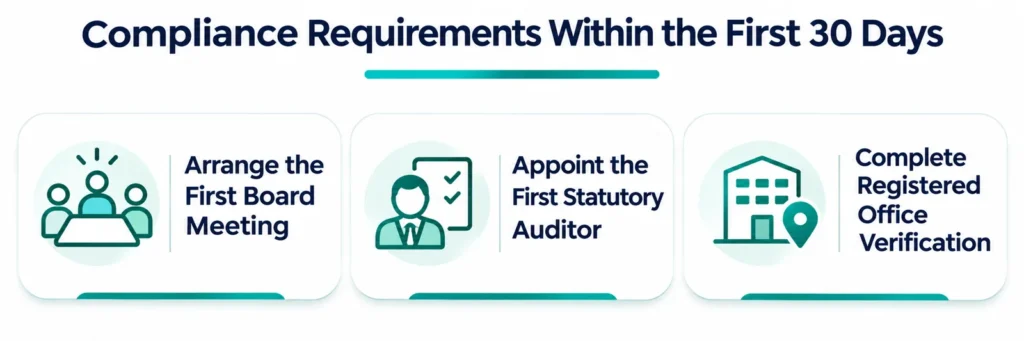
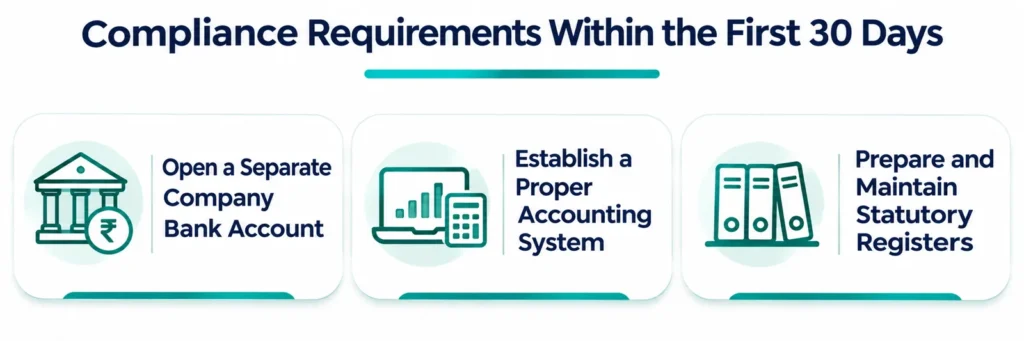
Compliance Requirements Within the First 30 Days
The first 30 days after company registration are important for establishing the financial, legal, and administrative foundation of your business. Completing these initial responsibilities on time helps prevent unnecessary penalties and future compliance complications.
| Responsibility | Normal timeline |
|---|---|
| Arrange the first board meeting | Within 30 days, subject to applicable exemptions |
| Appoint the first statutory auditor through the board | Within 30 days |
| Complete registered office verification, if pending | Within 30 days |
| Establish company banking arrangements | As early as possible |
| Begin maintaining financial records | From incorporation |
| Organise statutory registers | From incorporation |
- Arrange the First Board Meeting : Conduct the first board meeting within the prescribed period, where applicable, to discuss initial business decisions, banking arrangements, auditor appointments, and other administrative responsibilities.
- Appoint the First Statutory Auditor : The board of directors of a newly incorporated non-government company must generally appoint its first statutory auditor within 30 days. If the board fails to do so, the shareholders must complete the appointment through the prescribed process. This requirement applies even if the company has not started generating revenue.
- Complete Registered Office Verification : Ensure that your company’s registered office details are properly verified with the Registrar of Companies. Maintain the necessary address proof, ownership or rental documents, and applicable supporting records.
- Open a Separate Company Bank Account : Establish a dedicated company bank account to keep personal and business finances separate. For example, if you want to invest ₹1 lakh from your personal savings, ensure that it is correctly documented as share capital, a permitted loan, or another legally acceptable financial arrangement.
- Establish a Proper Accounting System : Start recording financial transactions from the date of incorporation. Maintain invoices, expense receipts, bank statements, capital contribution records, and other financial documents, even if your company has not started business operations.
- Prepare and Maintain Statutory Registers : Organise applicable statutory registers containing information about directors, shareholders, share capital, and other prescribed corporate details. Maintaining these records from the beginning simplifies future annual filings, audits, and ownership changes.
Probay’s team of Chartered Accountants (CA) and Company Secretaries (CS) can assist with these initial compliance requirements, including financial documentation, auditor appointment, corporate records, and statutory obligations, helping you establish a legally compliant business from the beginning.
Compliance Requirements Within the First 60 Days
During the first 60 days, focus on share ownership documentation, statutory records and financial management.
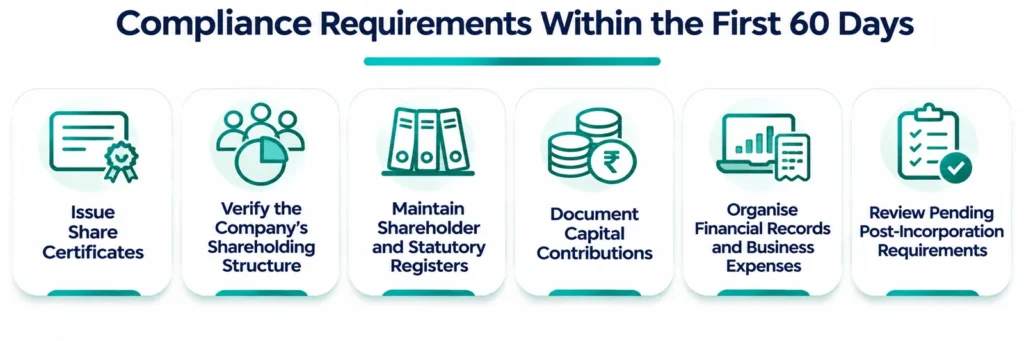
- Issue Share Certificates: Issue share certificates to subscribers within two months of incorporation, subject to applicable dematerialisation requirements.
- Verify the Company’s Shareholding Structure: Ensure company records accurately reflect each shareholder’s ownership percentage.
- Maintain Shareholder and Statutory Registers: Keep updated records of shareholders, directors, share capital and other prescribed corporate details.
- Document Capital Contributions: Maintain bank statements, payment confirmations and supporting records of shareholders’ capital contributions.
- Organise Financial Records and Business Expenses: Record all financial transactions and preserve invoices, receipts and bank statements, even if the company has no revenue.
- Review Pending Post-Incorporation Requirements: Check outstanding compliance obligations and prepare for upcoming deadlines, including Form INC-20A, where applicable.
Probay’s CA and CS team assists with share-related documentation, statutory registers, capital contribution records and accounting, helping you meet applicable compliance deadlines.
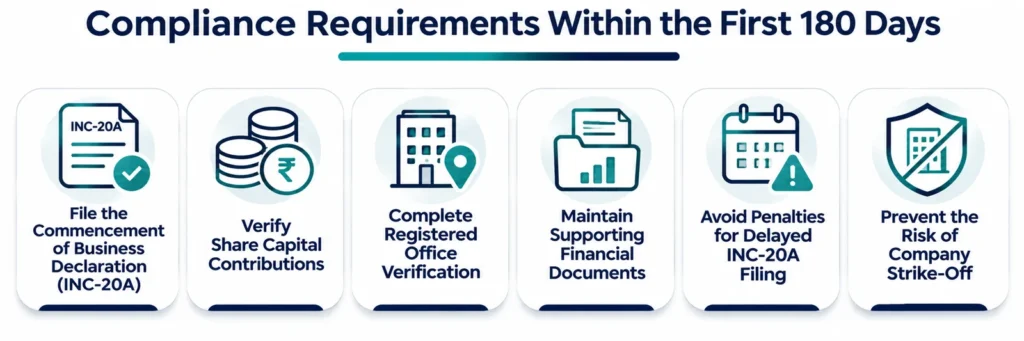
Compliance Requirements Within the First 180 Days
During the first 180 days, focus on completing the commencement of business declaration and verifying share capital contributions.
- File the Commencement of Business Declaration (INC-20A): Applicable companies with share capital must file Form INC-20A within 180 days of incorporation.
- Verify Share Capital Contributions: Ensure all subscribers have paid the agreed value of their shares before filing INC-20A.
- Complete Registered Office Verification: Applicable companies cannot commence business or exercise borrowing powers until the commencement declaration and registered office verification requirements are fulfilled.
- Maintain Supporting Financial Documents: Preserve bank statements, capital contribution records and payment confirmations.
- Avoid Penalties for Delayed INC-20A Filing: Missing the prescribed deadline can result in the following penalties:
| Person Responsible | Applicable Penalty |
|---|---|
| Company | ₹50,000 |
| Officer in default | ₹1,000 per day of continuing default |
| Maximum penalty per officer | ₹1,00,000 |
- Prevent the Risk of Company Strike-Off: Failure to complete commencement requirements may lead to ROC strike-off proceedings, subject to applicable legal conditions.
Probay’s CA and CS team assists with capital verification, supporting documentation, INC-20A filing and post-incorporation compliance. With our Private Limited Company registration services, you can also plan your ongoing compliance requirements and avoid unnecessary penalties.
Essential Documents You Should Maintain After Company Registration
Maintain a secure digital folder containing the following documents to simplify compliance after company registration in India:
- Certificate of Incorporation.
- Memorandum and Articles of Association (MOA and AOA).
- Company PAN, TAN and Director Identification Numbers (DINs).
- Registered office documents.
- Company bank account details.
- Shareholding and capital contribution records.
- Auditor appointment documents.
- Board resolutions and meeting minutes.
- Statutory filing acknowledgements.
- Applicable tax registration certificates.
Probay’s CA and CS team can assist with maintaining statutory records and financial documentation. However, always retain access to your important company documents.
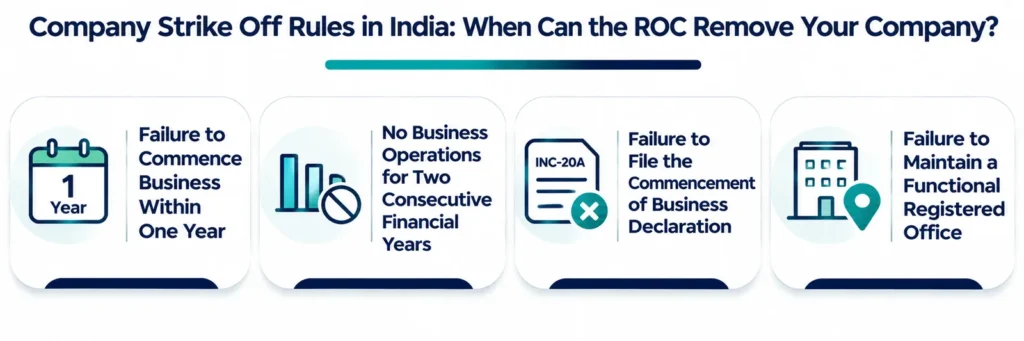
Company Strike Off Rules in India: When Can the ROC Remove Your Company?
Missing a single compliance deadline does not automatically result in company strike-off. However, under Section 248 of the Companies Act, 2013, the ROC may initiate strike-off proceedings in the following circumstances:
- Failure to Commence Business Within One Year: The company has not started business within one year of incorporation.
- No Business Operations for Two Consecutive Financial Years: The company remains inactive and has not applied for dormant company status.
- Failure to File the Commencement of Business Declaration: Subscribers have not paid the agreed share capital and the applicable Form INC-20A remains unfiled after 180 days.
- Failure to Maintain a Functional Registered Office: Physical verification reveals that the company is not carrying on business or operations.
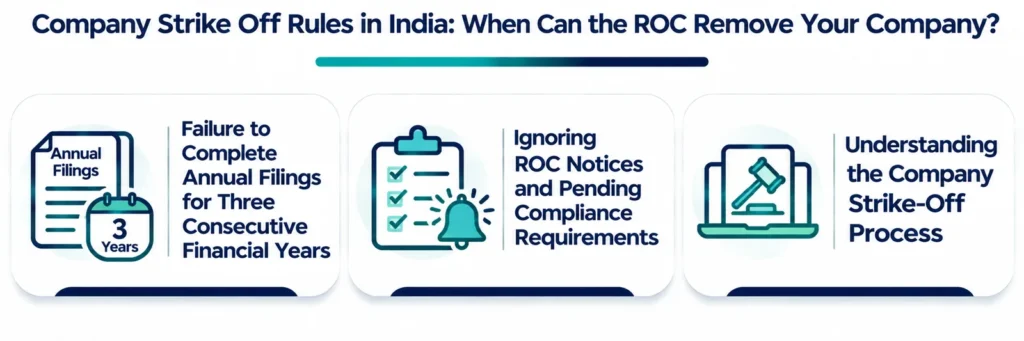
- Failure to Complete Annual Filings for Three Consecutive Financial Years: Failure to file financial statements or annual returns for three consecutive financial years may result in director disqualification for five years. However, this does not automatically result in company strike-off.
- Ignoring ROC Notices and Pending Compliance Requirements: Failure to respond to ROC notices or resolve statutory defaults may increase the risk of further legal action.
- Understanding the Company Strike-Off Process: The ROC must follow the prescribed legal procedure, issue notices and provide the company and its directors an opportunity to respond before removing the company’s name.
Understanding company strike off rules in India helps protect your company’s legal existence. Probay’s CA and CS team assists with pending annual filings, ROC notices, statutory defaults and lawful company closure through our Company Strike Off services.
How Expensive Can Delayed Compliance Become?
Delayed ROC annual filings can generally attract additional fees of ₹100 per day per applicable form. If you miss the deadlines for two annual filing forms, the additional fees can quickly increase.
| Delay in Each Form | Combined Additional Fees |
|---|---|
| 30 days | ₹6,000 |
| 60 days | ₹12,000 |
| 90 days | ₹18,000 |
| 180 days | ₹36,000 |
| 365 days | ₹73,000 |
These are illustrative additional filing fees. Separate statutory penalties and professional expenses may also apply.
Probay’s CA and CS team helps you complete your company annual filings within the prescribed deadlines, reducing the risk of unnecessary expenses and accumulated penalties.
Monthly vs. Annual Compliance Calendar: How Often Do You Actually File Reports in India?
Many new founders assume that compliance after company registration in India involves filing several government forms every month. However, your monthly responsibilities depend on your business activities, financial transactions, GST registration and number of employees.
For a small company with no employees and limited transactions, monthly compliance may mainly involve maintaining accounts and organising financial documents.
What Does a Normal Month Look Like for a Small Company Founder?
Suppose you run a small consulting company from home with five regular customers and no employees. Your monthly financial transactions may look like this:
| Transaction Type | Number of Transactions |
|---|---|
| Customer invoices | 5 |
| Software subscriptions | 3 |
| Internet and communication expenses | 2 |
| Marketing expenses | 2 |
| Professional service payments | 1 |
| Other expenses | 3 |
| Total transactions | 16 |
With only 16 transactions, your accounting requirements may be relatively straightforward. You can share invoices, expense receipts and bank statements with your CA, while your CS monitors statutory filing deadlines and corporate compliance requirements.
Mandatory Monthly Compliance Requirements
| Responsibility | Required for Every Company? |
|---|---|
| Maintaining books of accounts | Yes, on an ongoing basis |
| Recording income and expenses | Yes, where transactions occur |
| Bank reconciliation | Recommended |
| GST return filing | Where applicable |
| TDS deduction and payment | Depends on transactions |
| Employee payroll | If employees are hired |
| Provident fund (EPF) contributions | Where applicable |
| Employee State Insurance (ESI) contributions | Where applicable |
| Monthly ROC annual filing | No |
Maintaining financial records and filing government returns are different responsibilities. Every company must maintain accurate accounts, but not every company needs to submit government forms every month.
Monthly GST Compliance for Registered Companies
Private Limited Company registration does not automatically make GST registration compulsory. GST applicability depends on turnover, business activities, the nature of supplies and compulsory registration provisions.
Companies with active regular GST registration must follow applicable filing deadlines.
| GST Return or Payment | Standard Due Date |
|---|---|
| Monthly GSTR-1 | 11th of the following month |
| Monthly GSTR-3B | 20th of the following month |
| Quarterly GSTR-1 under QRMP | 13th of the month following the quarter |
| Quarterly GSTR-3B under QRMP | 22nd or 24th of the month following the quarter |
| Applicable monthly QRMP tax payment | 25th of the following month for the first two months of the quarter |
Eligible taxpayers with an aggregate turnover of up to ₹5 crore can opt for the Quarterly Return Monthly Payment (QRMP) scheme, subject to applicable conditions. This allows quarterly return filing while applicable monthly tax payments continue.
Probay’s CA and CS team helps you identify applicable monthly and annual compliance requirements, manage financial records, determine GST obligations and monitor statutory deadlines, allowing you to focus on growing your business.
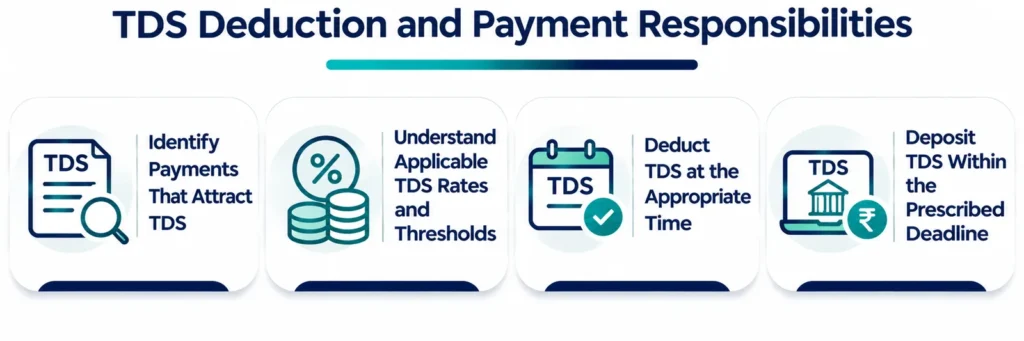
TDS Deduction and Payment Responsibilities
Tax Deducted at Source (TDS) is part of compliance after company registration in India. Companies must deduct tax from certain payments and deposit it with the government, where applicable.
- Identify Payments That Attract TDS: Common payments include salaries, office rent, professional fees, contractor payments, commission, brokerage and interest.
- Understand Applicable TDS Rates and Thresholds: TDS applicability depends on the payment type, monetary limits, recipient details and prescribed tax rates.
- Deduct TDS at the Appropriate Time: Generally, deduct TDS when the payment is made or credited, whichever is earlier. Certain payments, such as salaries, follow separate rules.
- Deposit TDS Within the Prescribed Deadline: Regular non-government deductors must generally deposit TDS by the 7th of the following month. For March deductions, the standard deadline is 30th April, subject to applicable exceptions.
Probay’s CA team helps identify applicable TDS requirements, calculate deductions and manage statutory payment deadlines.
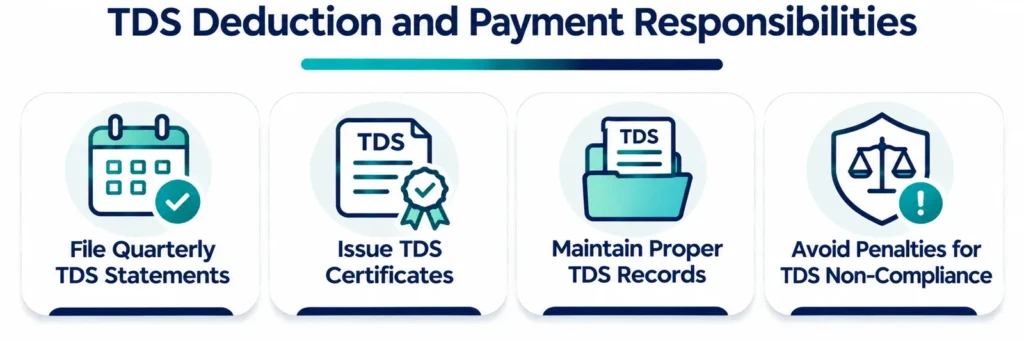
- File Quarterly TDS Statements: Submit applicable quarterly statements containing payment details, tax deductions, recipient information and tax deposits.
- Issue TDS Certificates: Provide applicable certificates, such as Form 16 for employees and Form 16A for other eligible recipients, within prescribed deadlines.
- Maintain Proper TDS Records: Preserve invoices, payment records, tax calculations, challans and filing acknowledgements for audits and tax assessments.
- Avoid Penalties for TDS Non-Compliance: Failure to deduct or deposit TDS and file applicable statements on time may attract interest, late fees, penalties and disallowance of certain business expenses.
Probay’s CA team assists with identifying applicable TDS obligations, calculating deductions, managing payment deadlines, filing quarterly statements and maintaining taxation records, reducing your compliance workload and the risk of unnecessary penalties.
Employee-Related Monthly Compliance
Companies without employees generally have fewer payroll responsibilities. As your business starts hiring, additional compliance requirements may include:
- Maintaining salary and attendance records.
- Calculating applicable salary TDS.
- Managing employee payroll.
- Depositing applicable provident fund (EPF) contributions.
- Managing applicable Employee State Insurance (ESI) contributions.
- Fulfilling other applicable labour law requirements.
A company with two employees may not have the same obligations as a company with 100 employees. Probay’s CA and CS team helps identify applicable requirements as your workforce grows.
Quarterly Compliance Responsibilities for Companies
Quarterly compliance generally includes applicable TDS statements, GST returns under QRMP and advance income tax payments.
| TDS Reporting Period | Standard Filing Deadline |
|---|---|
| April to June | 31st July |
| July to September | 31st October |
| October to December | 31st January |
| January to March | 31st May |
Advance tax generally becomes applicable when the estimated tax payable after relevant deductions is ₹10,000 or more.
| Standard Advance Tax Deadline | Cumulative Tax Payable |
|---|---|
| 15th June | 15% |
| 15th September | 45% |
| 15th December | 75% |
| 15th March | 100% |
Probay’s CA team reviews your financial performance, calculates applicable tax liabilities and helps you meet quarterly compliance deadlines.
How Often Do You Need to Conduct Board Meetings?
Board meetings are an important part of compliance after company registration in India. However, meeting requirements depend on your company’s legal structure and classification.
| Company Type | Minimum Board Meetings | Gap Between Meetings |
|---|---|---|
| Regular Private Limited Company | Four annually | Maximum 120 days |
| Eligible Small Company | One in each half of the calendar year | Minimum 90 days |
| Dormant Company | One in each half of the calendar year | Minimum 90 days |
| OPC with multiple directors | One in each half of the calendar year | Minimum 90 days |
| OPC with only one director | Exempt | Not applicable |
Companies must also maintain applicable board meeting documents, including:
- Meeting notices and agendas.
- Directors’ attendance records.
- Board resolutions.
- Minutes of meetings.
Probay’s Company Secretaries help determine applicable board meeting requirements, prepare statutory documents and maintain corporate records, reducing your administrative workload.
Annual Financial Statements and Statutory Audit
Preparing annual financial statements and completing a statutory audit are essential parts of compliance after company registration in India, even if your company has not generated revenue.
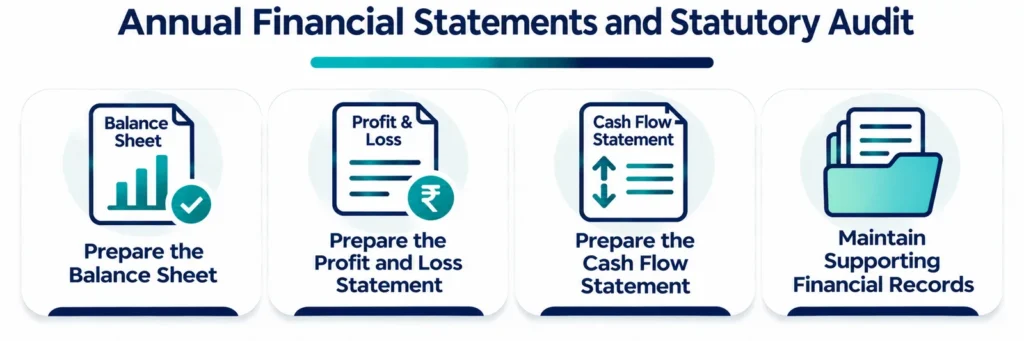
- Prepare the Balance Sheet: Record your company’s assets, liabilities and shareholders’ equity to understand its overall financial position.
- Prepare the Profit and Loss Statement: Record annual income and expenses to determine whether your company has earned a profit or incurred a loss.
- Prepare the Cash Flow Statement: Where applicable, document money entering and leaving your company through operating, investing and financing activities.
- Maintain Supporting Financial Records: Preserve invoices, bank statements, expense receipts, accounting records and explanatory notes to support financial reporting and statutory audits.
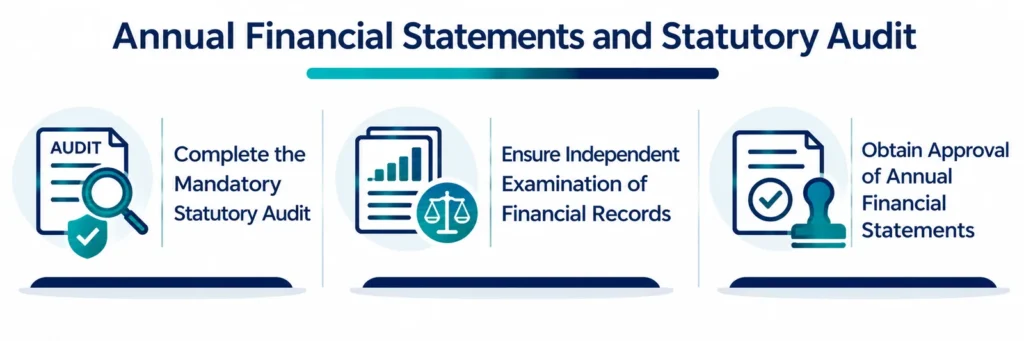
- Complete the Mandatory Statutory Audit: Companies registered under the Companies Act generally require an annual statutory audit, regardless of turnover, profitability or business activity.
- Ensure Independent Examination of Financial Records: An independent statutory auditor examines financial statements and supporting documents to assess whether they present a true and fair view of the company’s financial position.
- Obtain Approval of Annual Financial Statements: Obtain board approval, complete prescribed signatures and present audited financial statements to shareholders, where applicable, before completing annual ROC filings.
Probay’s CA and CS team assists with financial statement preparation, statutory audit coordination, corporate approvals and annual filings while maintaining applicable auditor independence requirements.
ROC Annual Filing Due Dates for Companies in India
Understanding ROC annual filing due dates helps you avoid unnecessary late fees and statutory penalties. Companies must submit prescribed financial statements, annual returns and other applicable information to the Registrar of Companies (ROC).
| ROC Form | Purpose | Standard Filing Deadline |
|---|---|---|
| AOC-4 | Annual financial statements | Within 30 days of AGM |
| MGT-7 | Annual return | Within 60 days of AGM |
| MGT-7A | Abridged annual return for OPCs and small companies | Applicable annual return deadline |
| DPT-3 | Reporting applicable deposits and outstanding receipts | 30th June |
| MSME-1 | Reporting qualifying overdue payments to micro and small enterprises | 30th April and 31st October, where applicable |
Companies must generally conduct their first Annual General Meeting (AGM) within nine months from the end of their first financial year. Subsequent AGMs must generally be conducted within six months from the end of the financial year.
For an existing Private Limited Company conducting its AGM on 30th September, the filing calendar would look like this:
| Activity | Illustrative Deadline |
|---|---|
| Financial year closing | 31st March |
| Annual General Meeting | 30th September |
| AOC-4 filing | 30th October |
| MGT-7 or MGT-7A filing | 29th November |
These deadlines assume no applicable extensions or special circumstances. One Person Companies are exempt from conducting an AGM and generally must file their financial statements within 180 days from the end of the financial year.
Probay’s CA and CS team prepares a company-specific compliance calendar, monitors ROC annual filing due dates and assists with applicable company annual filings to reduce the risk of missed deadlines and additional expenses.
Updated Director KYC Requirements
Director KYC is part of company compliance requirements in India and helps the Ministry of Corporate Affairs (MCA) maintain accurate records of individuals holding a Director Identification Number (DIN).
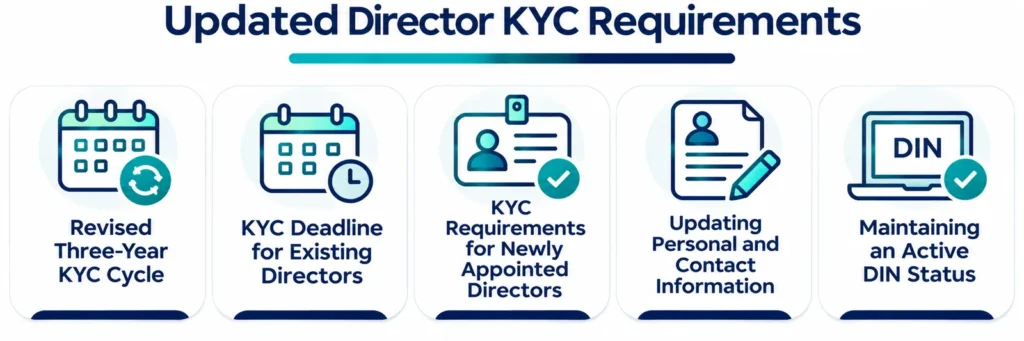
- Revised Three-Year KYC Cycle: Effective from 31st March 2026, the annual director KYC requirement has been replaced with a three-year compliance cycle.
- KYC Deadline for Existing Directors: Directors who completed KYC under the previous system generally need to complete their next filing by 30th June 2028, subject to applicable requirements.
- KYC Requirements for Newly Appointed Directors: New DIN holders must complete KYC within their applicable prescribed timelines.
- Updating Personal and Contact Information: Directors must maintain accurate personal and contact details and report applicable changes within prescribed timelines.
- Maintaining an Active DIN Status: Failure to complete applicable KYC requirements may result in DIN deactivation, additional fees and difficulties with corporate filings.
Probay’s CS team assists with DIN status verification, director KYC filings, personal information updates and compliance deadlines.
Annual Income Tax Return Filing
Annual income tax return filing is a mandatory part of compliance after company registration in India, regardless of your company’s turnover, profitability or business activity.
- Mandatory Filing Regardless of Revenue: Companies must file annual income tax returns even if they have no customers, revenue or taxable profits.
- Follow the Prescribed ITR Filing Deadline: The standard deadline for companies not subject to transfer pricing reporting requirements is generally 31st October, subject to applicable extensions.
- Report Income, Expenses and Financial Losses: Accurately report business income, operating expenses, deductions and financial losses.
- Calculate and Pay Applicable Income Tax: Calculate tax liability after considering applicable deductions, advance tax payments and TDS credits.
- Preserve Eligible Business Losses: Timely ITR filing helps preserve eligible business losses for adjustment against future taxable profits, subject to applicable conditions.
- Complete Income Tax and ROC Filings Separately: Income tax return filing and ROC annual filing are separate statutory responsibilities. Completing one does not fulfil the other.
Probay’s CA team assists with income tax calculations, financial documentation, eligible deductions, business loss reporting and timely ITR filing.
Complete Calendar for Compliance After Company Registration in India
| Month | Common Compliance Activities |
|---|---|
| April | Financial year-end accounting and applicable MSME-1 filing |
| May | Fourth-quarter TDS statements |
| June | Advance tax, applicable DPT-3 and director KYC when due |
| July | First-quarter TDS statements |
| August | Financial statement preparation and statutory audit work |
| September | AGM for most existing companies and advance tax |
| October | Applicable AOC-4, ITR, MSME-1 and TDS statements |
| November | Applicable ROC annual return filing |
| December | Advance tax and applicable GST annual return |
| January | Third-quarter TDS statements |
| February | Financial review and year-end planning |
| March | Final advance tax instalment and financial year closing |
Monthly GST returns, TDS payments, payroll and other applicable responsibilities may continue alongside this calendar. These are standard timelines, and actual deadlines depend on your company’s classification, business activities and applicable statutory requirements.
Event-Based Compliance: Filings That Are Not Part of Your Regular Calendar
Event-based compliance requirements arise when you make specific changes to your company’s management, ownership, capital or registered details.
| Business Change | Possible Compliance Requirement |
|---|---|
| Appointment of a director | Appointment documentation and statutory filing |
| Resignation of a director | Director resignation filing |
| Registered office change | Address modification filing |
| Introduction of new investors | Investment and share allotment documentation |
| Increase in authorised capital | Capital modification filing |
| Change of company name | Name approval and related filings |
| Transfer of shares | Ownership documentation and applicable formalities |
| Creation of certain charges | Charge registration |
These filings are not regular monthly or annual responsibilities. They become applicable when the corresponding corporate event occurs.
Probay’s CS team assists with event-based compliances, statutory documentation, corporate approvals and applicable ROC filings, helping you make important business changes while meeting legal requirements.
Zero Turnover in the First Year? Mandatory Nil Compliance Rules for New Companies in India
You may spend your first year developing a product or finding customers without generating any revenue. However, zero turnover does not mean zero compliance. Your registered company must continue fulfilling its applicable legal and financial obligations.
Which Compliance Requirements Continue When Turnover Is Zero?
| Compliance Requirement | Required With Zero Turnover? |
|---|---|
| Maintaining financial records | Yes |
| Annual financial statements | Yes |
| Statutory audit | Yes |
| ROC annual filings | Yes |
| Company income tax return | Yes |
| Corporate meetings | Subject to applicable exemptions |
| GST returns | If GST registration remains active |
| TDS reporting | Where applicable |
| Advance tax | If applicable tax liability arises |
| Employee compliance | Where applicable |
Zero Revenue Does Not Mean Zero Financial Transactions
Suppose you start a company with ₹3 lakh in share capital but generate no sales during your first year.
| Financial Activity | Amount |
|---|---|
| Initial share capital | ₹3,00,000 |
| Sales revenue | ₹0 |
| Website development | ₹60,000 |
| Marketing | ₹40,000 |
| Software subscriptions | ₹15,000 |
| Professional services | ₹20,000 |
| Other business payments | ₹15,000 |
| Total business payments | ₹1,50,000 |
| Remaining bank balance | ₹1,50,000 |
Despite having zero turnover, your company must record these transactions and prepare annual financial statements.
Probay’s CA and CS team helps maintain accurate accounts, classify startup expenditure, coordinate statutory audits and complete mandatory annual filings, even when your company generates no revenue.
Nil GST Return Filing Rules for Companies With Zero Turnover
Under the nil GST return filing rules, companies with active regular GST registration must continue filing applicable returns, even with zero sales.
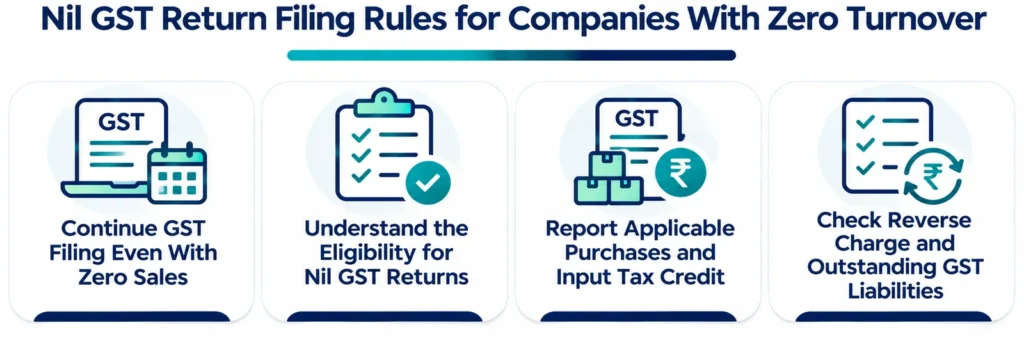
- Continue GST Filing Even With Zero Sales: File applicable GST returns within prescribed deadlines, regardless of revenue.
- Understand Eligibility for Nil GST Returns: Zero turnover does not automatically qualify a company for Nil GST filing. Other prescribed conditions must also be satisfied.
- Report Applicable Purchases and Input Tax Credit: Business purchases and input tax credit claims may require filing a non-Nil GSTR-3B.
- Check Reverse Charge and Outstanding GST Liabilities: Review applicable reverse charge liabilities, interest and late fees before filing a Nil GST return.
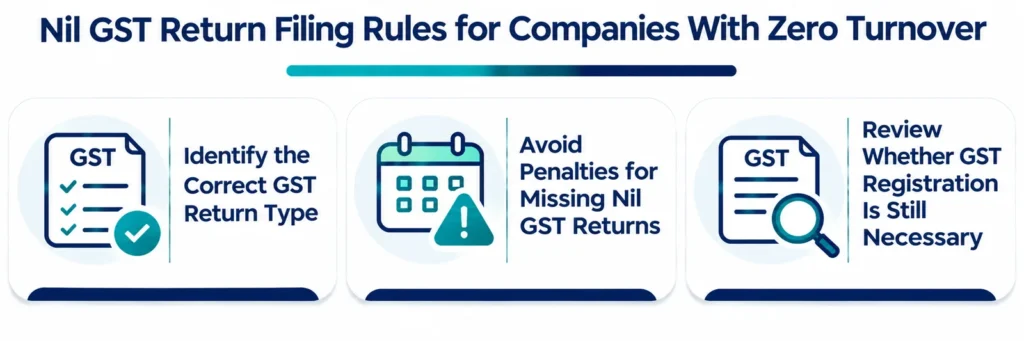
- Identify the Correct GST Return Type: Your GST return type depends on financial transactions, tax liabilities and applicable reporting requirements.
| Business Situation | Can You File a Nil GST Return? |
|---|---|
| No reportable transactions or tax liabilities | Yes, if all conditions are satisfied |
| No sales but reportable purchases | May require a non-Nil return |
| No sales but input tax credit claimed | Non-Nil GSTR-3B required |
| No sales but reverse charge liability | Non-Nil GSTR-3B required |
| Outstanding GST liabilities | Depends on reporting requirements |
| No GST registration | Generally not required |
- Avoid Penalties for Missing Nil GST Returns: Delayed GST return filing may attract applicable late fees, even when your company has zero sales or tax payable.
- Review Whether GST Registration Is Still Necessary: Inactive companies may apply for GST cancellation if eligible. Stopping business operations does not automatically cancel GST registration or remove filing obligations.
Probay’s CA team helps you understand nil GST return filing rules, determine the correct return type, complete applicable filings and assess whether your company still requires GST registration.
Do I Need to File ITR for a Company With No Business?
Yes. A registered company must file its Income Tax Return (ITR) even if it has no business operations, revenue or taxable profits.
- Mandatory ITR Filing With Zero Business Activity: Temporary business inactivity does not remove annual income tax filing obligations.
- Tax Payment and Return Filing Are Different: Your company may have zero tax payable but must still file its ITR.
- Report Business Expenses: Record applicable registration expenses, professional fees, software subscriptions and other business payments.
- Follow Applicable Income Tax Provisions: The Income-tax Act, 2025 applies from 1st April 2026. Follow the applicable provisions and deadlines for the relevant income period.
- Preserve Eligible Business Losses: Timely ITR filing may help carry forward eligible losses against future taxable profits.
- Avoid Penalties for Non-Filing: Missing filing deadlines may attract applicable late fees and restrict certain tax benefits.
Probay’s CA team assists with financial documentation, income tax calculations, business loss reporting and annual ITR filing, even when your company generates no revenue.
Can Filing Income Tax Returns Help a Loss-Making Company?
Yes. Suppose your company incurs an eligible business loss of ₹2 lakh during its first year and starts generating taxable profits the following year.
Subject to applicable tax provisions, you may carry forward eligible losses and adjust them against future taxable profits, potentially reducing your tax liability. Timely ITR filing is important for preserving these benefits.
What If You Want to Keep Your Company Inactive for Several Years?
If your business plans change, you should not simply stop completing statutory filings. Depending on your circumstances, consider the following options:
| Option | When It May Be Suitable |
|---|---|
| Continue maintaining the company | You intend to start operations soon |
| Apply for dormant company status | Your eligible company is intended for future use |
| Apply for lawful closure | You no longer intend to continue the business |
Dormant company status must be formally obtained and does not eliminate all compliance responsibilities. Similarly, company closure requires following the prescribed legal procedure.
Probay’s CA and CS team can review pending filings, outstanding liabilities and applicable company strike off rules in India to help you choose between maintaining your company, obtaining dormant status or applying for Company Strike Off.
5 Common Compliance Mistakes New Company Founders Make in India (And How to Avoid Them)
Many legal mistakes new business owners make occur because they focus on finding customers and growing their business without understanding their statutory responsibilities. Avoiding these five mistakes can save money, time and unnecessary paperwork.
Mistake 1: Assuming Registration Is the Final Step
Receiving a Certificate of Incorporation does not complete all legal formalities. Auditor appointments, share certificates, commencement declarations and statutory records have separate compliance requirements.
How to avoid it:
- Prepare a post-incorporation compliance checklist.
- Track applicable statutory deadlines.
- Maintain company registration documents.
- Ask your CS to monitor pending requirements.
Mistake 2: Mixing Personal and Company Money
Using company funds for personal expenses without proper accounting can create financial and legal complications. Your company is a separate legal entity, and its finances must reflect that separation.
How to avoid it:
- Maintain separate personal and company bank accounts.
- Preserve business invoices and expense receipts.
- Document director reimbursements and capital contributions.
- Discuss salaries, loans and withdrawals with your CA.
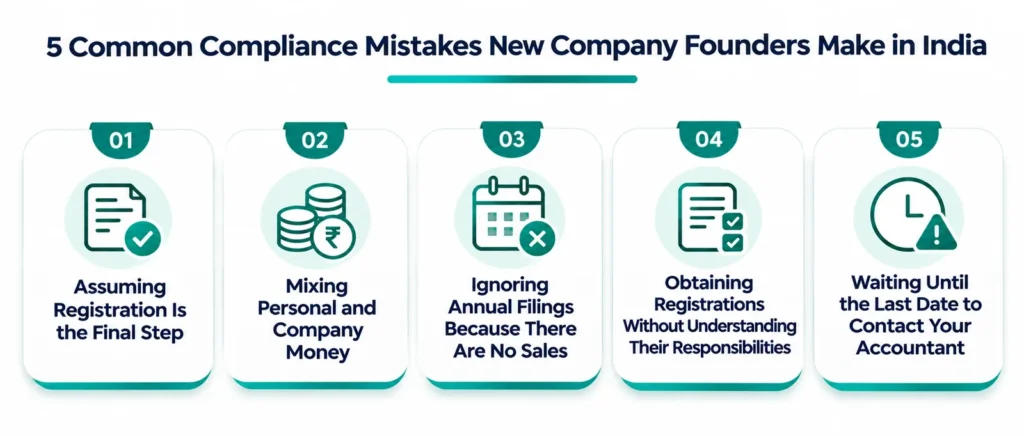
Mistake 3: Ignoring Annual Filings Because There Are No Sales
Zero turnover does not remove mandatory annual compliance responsibilities. Ignoring these obligations can result in additional fees and penalties before your business even starts earning.
How to avoid it:
- Maintain accounts from the incorporation date.
- Track ROC annual filing due dates.
- Complete statutory audits and income tax filings.
- Follow applicable nil GST return filing rules.
Mistake 4: Obtaining Registrations Without Understanding Their Responsibilities
Obtaining unnecessary GST registration or additional licences can increase recurring compliance costs. However, ignoring legally mandatory registrations can also create problems.
How to avoid it:
Ask your CA and CS to assess your business activities, expected turnover and applicable legal requirements before obtaining additional registrations.
Mistake 5: Waiting Until the Last Date to Contact Your Accountant
Last-minute compliance preparation increases the risk of errors, incomplete documentation and missed deadlines. Your CA and CS need sufficient time to prepare accounts, coordinate audits and complete statutory filings.
How to avoid it:
- Share financial documents regularly.
- Maintain an updated compliance calendar.
- Prepare annual accounts early.
- Keep digital signatures valid.
- Preserve statutory filing acknowledgements.
Probay’s CA and CS team helps you avoid these common legal mistakes new business owners make by organising financial records, monitoring statutory deadlines and managing applicable compliance requirements from the beginning.
How Much Does Compliance After Company Registration in India Cost?
Company compliance costs depend on your legal structure, financial transactions, GST registration, number of employees and statutory reporting requirements. A small company with ten monthly transactions generally requires less accounting work than a business processing hundreds of orders.
Factors That Determine Company Compliance Expenses
| Factor | Effect on Compliance Costs |
|---|---|
| Company structure | Determines statutory filing requirements |
| Transaction volume | Affects bookkeeping expenses |
| GST registration | Adds applicable GST filing responsibilities |
| Employees | Increases payroll and applicable labour compliance work |
| Statutory audit | Requires independent professional audit work |
| Foreign transactions | May require additional reporting |
| Corporate changes | May require event-based filings |
| Pending compliance | May attract additional fees and penalties |
How Much Money Should You Reserve Every Month?
Setting aside a monthly amount for annual compliance expenses can help you manage your working capital.
| Illustrative Annual Budget | Monthly Amount to Reserve |
|---|---|
| ₹12,000 | ₹1,000 |
| ₹18,000 | ₹1,500 |
| ₹24,000 | ₹2,000 |
| ₹36,000 | ₹3,000 |
| ₹48,000 | ₹4,000 |
| ₹60,000 | ₹5,000 |
These are illustrative budgeting examples, not fixed market prices or Probay service quotations.
Before choosing a compliance package, confirm whether it includes bookkeeping, statutory audit fees, ITR filing, ROC filings, GST returns, government charges and applicable taxes.
Probay’s CA and CS team can assess your business requirements and recommend a suitable compliance arrangement based on your actual workload and budget.
How Much Time Will You Personally Spend on Company Compliance Every Month?
With professional CA and CS support, you do not need to prepare every government form yourself. Your monthly involvement mainly includes sharing financial documents, reviewing records and approving business decisions.
| Business Situation | Estimated Monthly Founder Involvement |
|---|---|
| Pre-revenue company with limited transactions | 30–60 minutes |
| Small consulting company | 1–2 hours |
| GST-registered service business | 2–4 hours |
| Growing company with employees | 4–8 hours or more |
These are illustrative estimates. Actual time requirements depend on business complexity, financial records and professional arrangements. Your involvement may increase during annual audits, investment rounds or corporate changes.
Probay’s CA and CS team helps manage accounting, statutory filings and corporate documentation, making compliance after company registration in India more manageable while you focus on growing your business.
Which Business Structure Has the Lowest Compliance Burden?
Company compliance requirements in India vary according to your chosen business structure. A Sole Proprietorship generally has the lowest compliance burden, while a Private Limited Company has more corporate reporting responsibilities.
| Compliance Requirement | Sole Proprietorship | LLP | OPC | Private Limited Company |
|---|---|---|---|---|
| Separate legal identity | No | Yes | Yes | Yes |
| Minimum owners | One | Two | One | Two |
| ROC annual filings | No | Yes | Yes | Yes |
| Statutory audit | Not applicable under company law | Where applicable | Mandatory | Mandatory |
| Annual General Meeting | Not required | Not required | Exempt | Required |
| Board meetings | Not required | Not required | Relaxed or exempt | Applicable |
| GST compliance | Where applicable | Where applicable | Where applicable | Where applicable |
| Compliance workload | Low | Moderate | Moderate | Moderate to high |
Sole Proprietorship for Testing a Business Idea
A Sole Proprietorship generally has fewer compliance requirements and suits freelancers and individuals testing small business ideas. However, it does not provide separate legal identity or limited liability protection.
LLP for Professional and Service Businesses
An LLP offers limited liability protection with fewer corporate governance requirements. However, applicable annual filings remain mandatory.
| LLP Filing | Standard Deadline |
|---|---|
| Form 11 | 30th May |
| Form 8 | 30th October |
| Income tax return | Applicable ITR deadline |
| Designated partner KYC | Applicable KYC cycle |
Our LLP registration services can help you determine whether this structure suits your business.
One Person Company for Solo Founders
An OPC allows eligible individuals to own a company independently with certain compliance relaxations. However, statutory audits, annual ROC filings and income tax returns remain mandatory.
Consider One Person Company registration if you want to register a company in India without a partner.
Private Limited Company for Long-Term Business Growth
A Private Limited Company has additional compliance responsibilities but offers a structured framework for raising equity investment, introducing shareholders and expanding business ownership.
Probay’s CA and CS team helps you choose the best company structure for beginners in India based on your investment, compliance budget, business risks and future growth plans.
How Probay’s CA and CS Team Simplifies Compliance After Company Registration in India
You do not need to become an expert in accounting, taxation or corporate law to manage a registered company. Probay’s team of Chartered Accountants (CA) and Company Secretaries (CS) helps manage your financial and statutory responsibilities based on your actual business requirements.
How Our Chartered Accountants Help Your Business
- Maintaining books of accounts and financial records.
- Preparing annual financial statements.
- Managing GST returns and nil GST return filing rules.
- Calculating applicable TDS, advance tax and income tax.
- Preparing annual ITR and reporting eligible business losses.
- Coordinating statutory audits with independent auditors.
- Planning recurring compliance expenses.
Our CA team also helps you understand your company’s financial performance and make informed business decisions.
How Our Company Secretaries Help Your Business
- Managing post-incorporation compliance and INC-20A filing.
- Maintaining statutory registers and shareholding records.
- Preparing board meeting documents and resolutions.
- Monitoring ROC annual filing due dates.
- Completing applicable annual ROC filings.
- Managing director changes, share allotments and ownership changes.
- Reviewing pending compliance and company strike off rules in India.
Our CS team helps you fulfil applicable company law requirements without unnecessary administrative work.
How Our CA and CS Professionals Work Together
| Business Responsibility | CA Support | CS Support |
|---|---|---|
| Initial capital contribution | Accounting | Ownership documentation |
| Post-incorporation compliance | Financial records | Statutory requirements |
| Annual financial statements | Accounts preparation | Corporate approvals |
| Statutory audit | Audit coordination | Auditor appointment documentation |
| Income tax filing | Tax calculation and ITR | Corporate records |
| ROC annual filing | Financial information | Statutory filings |
| New investment | Financial and tax review | Share allotment documentation |
| Company closure | Financial and tax review | Statutory closure process |
With coordinated CA and CS support from Probay, you can manage your company’s compliance responsibilities more efficiently while concentrating on customers, revenue and business growth.
What Will You Still Need to Do as a Company Director?
Professional CA and CS support simplifies compliance after company registration in India, but your legal responsibilities as a director remain unchanged.
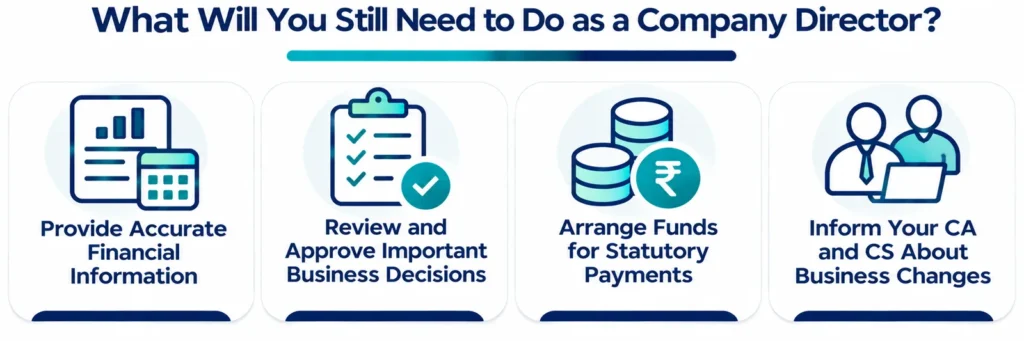
- Provide Accurate Financial Information: Regularly share invoices, bank statements, expense receipts and income records with your CA.
- Review and Approve Important Business Decisions: Review financial statements, board resolutions and investment proposals, and provide necessary approvals.
- Arrange Funds for Statutory Payments: Maintain sufficient funds for applicable taxes, government filing charges and professional fees.
- Inform Your CA and CS About Business Changes: Communicate director changes, new investments, share transfers, office relocation and employee appointments that may trigger additional compliance requirements.
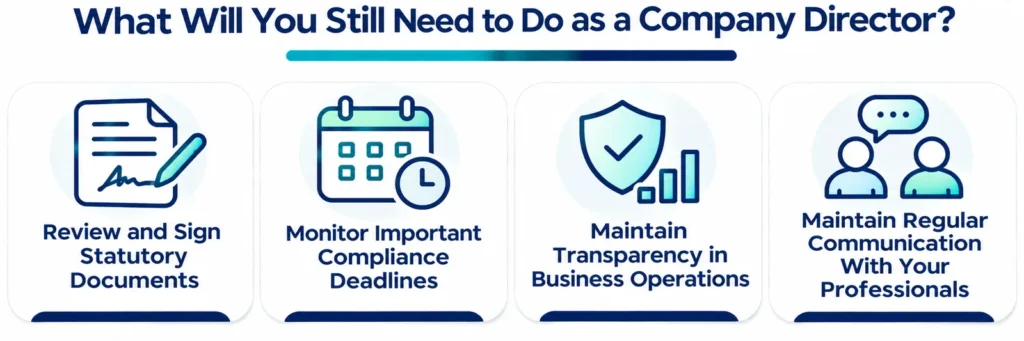
- Review and Sign Statutory Documents: Verify financial statements, declarations and statutory forms before signing. Maintain secure control over your Digital Signature Certificate (DSC).
- Monitor Important Compliance Deadlines: Stay aware of upcoming filing deadlines, pending approvals and statutory responsibilities.
- Maintain Transparency in Business Operations: Keep personal and company finances separate, document transactions and provide accurate financial information.
- Maintain Regular Communication With Your Professionals: Share documents monthly and discuss upcoming compliance requirements to avoid last-minute paperwork.
Probay’s CA and CS team assists with technical compliance, accounting and statutory filings, allowing you to focus on finding customers, developing products and growing your business.
Company Registration and Compliance Support in Delhi NCR and Across India
Businesses may have additional requirements depending on their registered office location, activities, employees, and applicable state laws.
Entrepreneurs planning company registration in Delhi can consult our CA and CS team to understand incorporation and ongoing compliance requirements.
Business owners considering company registration in Noida can obtain assistance with selecting a suitable company structure and planning recurring expenses.
First-time entrepreneurs exploring company registration in Ghaziabad can also receive professional guidance before making important registration decisions.
Our CA and CS professionals can assist businesses across India with applicable financial, taxation, and corporate compliance responsibilities.
Frequently Asked Questions
Is compliance after company registration in India mandatory even if I have no customers?
Yes. Financial statements, statutory audits, income tax returns and applicable ROC filings remain mandatory even with zero customers or revenue.
What are the minimum company compliance requirements in India?
These include maintaining accounts, appointing an auditor, completing applicable initial filings, maintaining statutory registers, conducting required meetings and completing annual filings.
Do I need to file ROC returns every month?
No. Most routine ROC filings are annual. Additional filings may arise when specific corporate changes occur.
What are the normal ROC annual filing due dates?
AOC-4 is generally due within 30 days of the AGM, while MGT-7 or MGT-7A is generally due within 60 days. Separate requirements apply to OPCs.
What are the nil GST return filing rules for an inactive company?
Companies with active regular GST registration must continue applicable filings. Nil returns are permitted only when all prescribed eligibility conditions are satisfied.
Do I need to file ITR for a company with no business?
Yes. Annual income tax return filing remains mandatory even when your company has no business activity, revenue or tax payable.
What are the company strike off rules in India for inactive companies?
The ROC may initiate strike-off proceedings if a company fails to commence business within one year or remains inactive for two consecutive financial years without applying for dormant status, subject to applicable legal conditions.
What are the common legal mistakes new business owners make?
Common mistakes include mixing personal and company finances, missing statutory deadlines, ignoring initial compliance and obtaining unnecessary registrations.
Do I need to hire a full-time CA after company registration?
No. Small companies can outsource accounting and taxation responsibilities to qualified Chartered Accountants.
Is appointing a full-time Company Secretary compulsory for every company?
No. Private Limited Companies with paid-up share capital of ₹10 crore or more generally require a whole-time CS. Smaller companies can obtain external CS assistance.
Can a small company maintain compliance with a monthly budget of ₹1,000?
It depends on the applicable requirements. An annual budget of ₹12,000 may not cover all accounting, audit, taxation and statutory filing expenses.
Is a statutory audit compulsory for a company with zero turnover?
Yes. Statutory audits are generally mandatory for companies regardless of turnover, profitability or business activity.
Can I stop GST return filing if my company is not operating?
No. Applicable GST filings must continue while registration remains active. Eligible companies may apply for GST cancellation.
Can directors be disqualified if annual filings are ignored?
Yes. Failure to file financial statements or annual returns for three consecutive financial years can result in director disqualification for five years under applicable provisions.
Can Probay help if my company already has pending compliance?
Yes. Probay’s CA and CS team can review pending filings, assess applicable penalties and assist with regularising company compliance.
When should I start planning compliance after company registration in India?
Ideally, before incorporation. Early planning helps you choose a suitable business structure, estimate recurring compliance costs and avoid unexpected expenses.
Grow Your Business Without the Stress of Company Compliance
Don’t let the fear of paperwork, statutory filings or annual maintenance costs stop you from starting your business. With proper planning and professional support, compliance after company registration in India can become much more manageable.
Whether you are starting your first company, operating with zero turnover or dealing with pending filings, Probay’s CA and CS team can help you understand your legal responsibilities, plan compliance expenses and avoid unnecessary penalties.
Worried about how much time and money company compliance will require? Let’s discuss your business and find a suitable compliance arrangement.